Get Full Government Meeting Transcripts, Videos, & Alerts Forever!
Get email alerts on the Capital Plan topic
No spam. Unsubscribe anytime.
Public Works and Resilience Office outline $52 billion, 10-year capital plan and funding limits
Summary
Office of Resilience and Capital Planning staff presented the city's updated 10-year capital plan, a $52 billion program that includes enterprise and external agency projects; only about $7 billion is for general-fund departments. Presenters warned deferred-maintenance backlog could grow unless pay-as-you-go and debt capacity improve.
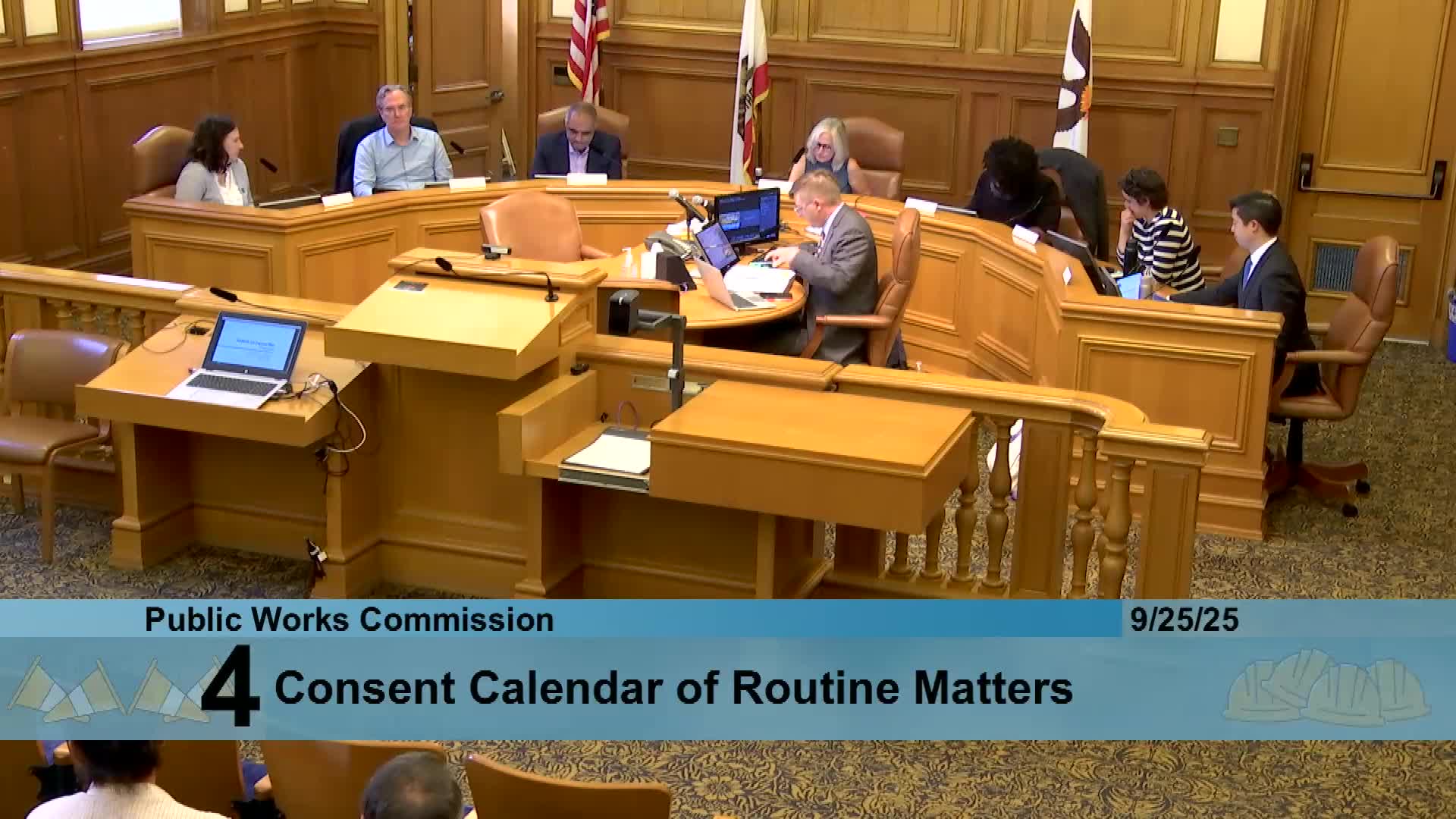
The San Francisco Office of Resilience and Capital Planning presented an updated 10-year capital plan on Sept. 25 that sizes the city's projected infrastructure needs at roughly $52,000,000,000 from fiscal 2026 through the plan horizon.
The plan covers enterprise agencies such as the airport and the Public Utilities Commission, external agencies including San Francisco Unified School District and City College, and general-fund departments. "Our capital plan spans the timeframe fiscal year 2026 through 02/1935. It's a $52,000,000,000 capital plan over those 10 years," said Nishad Joshi of the office. Joshi added that "only about 7,000,000,000, is dedicated to the general fund departments."
Why it matters: Commissioners were shown that most growth in the plan comes from enterprise and external agency projects, while the portion available to general-fund departments has remained relatively flat. Staff said that shortfalls in annual pay-as-you-go (PAYGO) funding and constrained certificate-of-participation (COP) capacity are the main drivers of the city's growing deferred-maintenance backlog.
Office staff described how the plan is constrained by funding sources and voter-authorized bonds. "We are required, per the code to, to list what we're able to fund over the next 10 years and what we cannot fund," said Brian Strong, chief resilience officer. Staff noted that general-obligation (GO) bonds remain a key tool but face voter thresholds and capacity limits; COPs are an alternative but draw on general-fund debt capacity.
Highlights and supporting details: - Funding mix: Staff said federal, state and other sources contribute heavily to the citywide total, but general-fund departments rely more on PAYGO, GO bonds and COPs. - Deferred maintenance: The presentation included a model of building renewal needs (vertical infrastructure) and a separate analysis for streets and pavement. Staff said the backlog has grown since COVID and that meeting the capital-plan recommendation would bend the backlog down while current funding levels would let it continue to grow. - Bond program: The office reviewed recent GO bond history and the city's self-imposed constraint on property-tax-supported debt service, noting the program has supported hospitals, housing and public health projects but is approaching capacity. - COPs and constraints: Staff said COPs have been used for critical repairs and for certain Treasure Island needs, but they count against a 3.25% discretionary-general-fund debt-service limit.
Commissioners asked for more detail on what the backlog categories include and how public-works priorities are evaluated for bond packages. Joshi said the facilities backlog in the slide refers to city-owned buildings (vertical work) and does not include horizontal infrastructure such as streets; he said street resurfacing modeling is available in the full plan posted on the city's website.
Next steps: Staff said the capital plan will remain a guiding document for the mayor's budget and future bond proposals and that the Office of Resilience and Capital Planning will continue to provide detail to the commission on specific funding choices.