Get Full Government Meeting Transcripts, Videos, & Alerts Forever!
Committee orders quick fix to Cambridge zoning after staff warns local Dover Amendment exemption no longer applies
Summary
Cambridge committee directed the city manager to bring local institutional-use zoning into conformity with state law after staff explained how multifamily zoning eliminated the local trigger for a previous Dover Amendment exemption; public commenters urged stronger neighborhood protections and universities offered to work with the city.
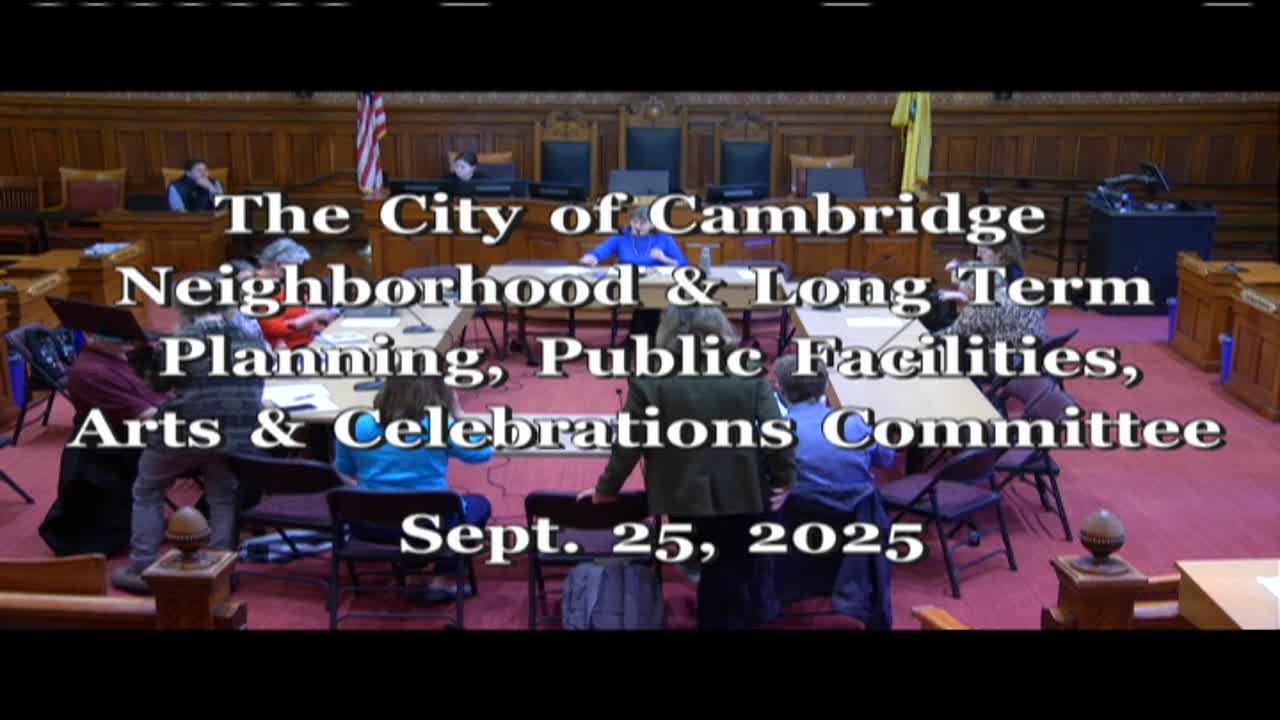
The Cambridge City Council’s Neighborhood and Long‑Term Planning Public Facilities, Arts and Celebrations Committee voted to direct the city manager to work with staff to ensure the city’s use-related zoning is consistent with state law, following a staff presentation about the loss of a local exemption tied to the Dover Amendment.
Jeff Roberts, the city’s director of zoning and development, told the committee that the discussion was prompted by the city’s recent multifamily zoning changes and by a re‑examination of a decades‑old local law. “Institutional uses are kind of a a way of describing uses that are generally, sort of non residential uses,” Roberts said, explaining that the city’s institutional category includes religious, educational, health‑care and local‑government uses, among others.
The committee’s action was the immediate outcome of a meeting convened to consider whether Cambridge should seek to reinstate — or otherwise replace — a local exemption that had previously allowed the city to restrict some institutional uses within certain residential districts. Roberts said a Cambridge home‑rule act from 1979–1980 had authorized the city to regulate religious and educational uses in limited residential districts defined by a minimum lot area per dwelling unit (1,200 square feet), but that the city’s multifamily zoning amendments eliminated that minimum lot‑area trigger and so changed the law’s practical effect.
Why this matters
Roberts and Assistant City Manager Melissa Peters framed the issue as a tension between state and federal law, local zoning practice and the city’s policy goals for housing and campus planning. Roberts noted that under state law commonly called the Dover Amendment (M.G.L. c. 40A, § 3), certain religious and educational uses cannot be banned outright by local zoning, though municipalities may…
Already have an account? Log in
Subscribe to keep reading
Unlock the rest of this article — and every article on Citizen Portal.
- Unlimited articles
- AI-powered breakdowns of topics, speakers, decisions, and budgets
- Instant alerts when your location has a new meeting
- Follow topics and more locations
- 1,000 AI Insights / month, plus AI Chat