Get Full Government Meeting Transcripts, Videos, & Alerts Forever!
Get email alerts on the Institutional Zoning topic
No spam. Unsubscribe anytime.
Committee orders quick fix to Cambridge zoning after staff warns local Dover Amendment exemption no longer applies
Summary
Cambridge committee directed the city manager to bring local institutional-use zoning into conformity with state law after staff explained how multifamily zoning eliminated the local trigger for a previous Dover Amendment exemption; public commenters urged stronger neighborhood protections and universities offered to work with the city.
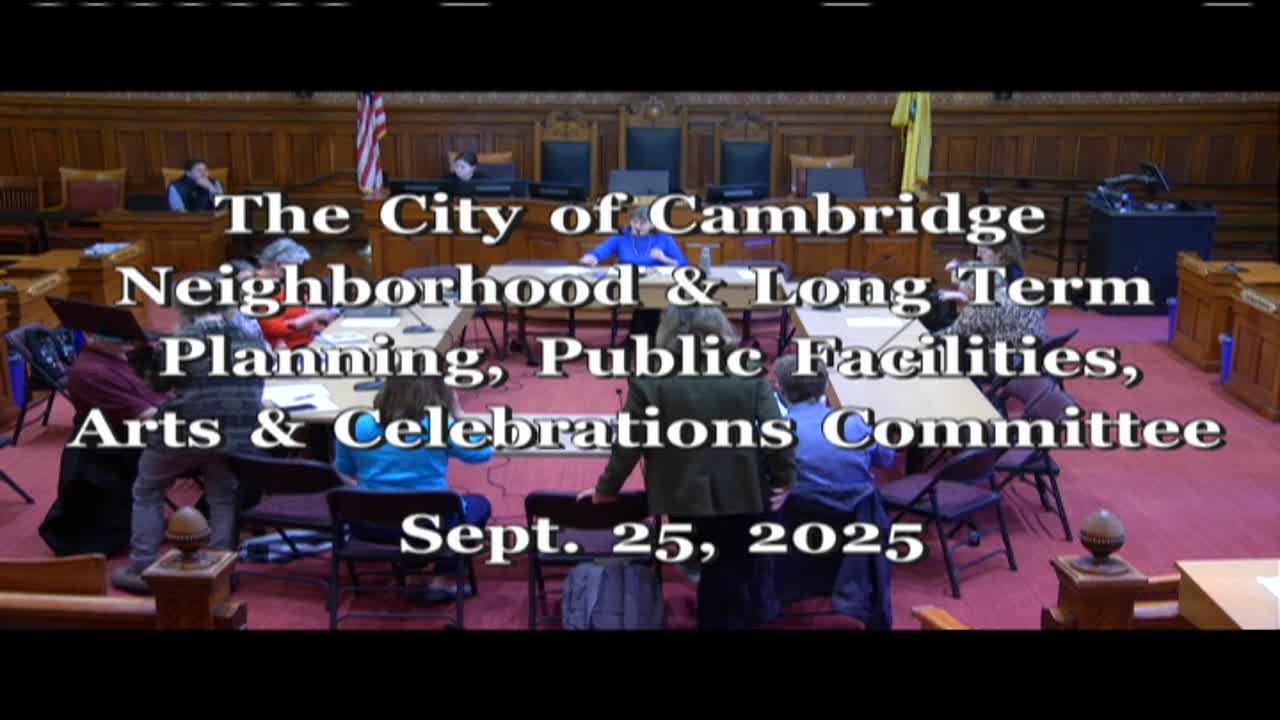
The Cambridge City Council’s Neighborhood and Long‑Term Planning Public Facilities, Arts and Celebrations Committee voted to direct the city manager to work with staff to ensure the city’s use-related zoning is consistent with state law, following a staff presentation about the loss of a local exemption tied to the Dover Amendment.
Jeff Roberts, the city’s director of zoning and development, told the committee that the discussion was prompted by the city’s recent multifamily zoning changes and by a re‑examination of a decades‑old local law. “Institutional uses are kind of a a way of describing uses that are generally, sort of non residential uses,” Roberts said, explaining that the city’s institutional category includes religious, educational, health‑care and local‑government uses, among others.
The committee’s action was the immediate outcome of a meeting convened to consider whether Cambridge should seek to reinstate — or otherwise replace — a local exemption that had previously allowed the city to restrict some institutional uses within certain residential districts. Roberts said a Cambridge home‑rule act from 1979–1980 had authorized the city to regulate religious and educational uses in limited residential districts defined by a minimum lot area per dwelling unit (1,200 square feet), but that the city’s multifamily zoning amendments eliminated that minimum lot‑area trigger and so changed the law’s practical effect.
Why this matters
Roberts and Assistant City Manager Melissa Peters framed the issue as a tension between state and federal law, local zoning practice and the city’s policy goals for housing and campus planning. Roberts noted that under state law commonly called the Dover Amendment (M.G.L. c. 40A, § 3), certain religious and educational uses cannot be banned outright by local zoning, though municipalities may impose reasonable dimensional regulations. Staff also discussed federal protections for religious land use, referred to in the meeting as RLUIPA (the Religious Land Use and Institutionalized Persons Act), which requires case‑by‑case analysis when local rules affect religious uses.
The staff presentation traced the local legal history: in 1979–1980 the city secured a special law to regulate educational and religious uses within residential zones meeting the 1,200‑square‑foot per‑unit threshold; the city then adopted detailed institutional‑use overlay rules in the early 1980s. Those rules relied on the older zoning structure, Roberts said, and the multifamily zoning amendments that eliminated minimum lot‑area measures removed the local trigger that gave the city effective authority to prohibit or condition certain institutional uses in those neighborhoods.
Public commenters: housing loss and neighborhood impacts
Six members of the public spoke during the allotted public‑comment period. Alan Jocelyn, an architect and leader of the Cary‑Corner Neighborhood Association, urged the committee to preserve the principles behind the former exemption to prevent loss of housing to institutional conversion. “Please prohibit loss of housing to institutional development,” Jocelyn said, and asked the council to require replacement housing if institutions displace residential units.
Other commenters echoed those concerns. Helen Walker described the historical context in which the local exemption was adopted and warned that institutional expansion had previously displaced residents and pushed up rents. Suzanne Blier, President of the Harvard Square Neighborhood Association and a Harvard faculty member, said she was “deeply conflicted” as both a neighbor and a university employee but urged protections because Cambridge is small and has limited space for growth.
Marilee Meyer and Heather Hoffman also testified that institutional conversions had carried housing and neighborhood impacts in prior decades and urged the council to proceed cautiously. Riverside resident Lawrence Atkins said neighborhood outreach had been insufficient and asked for more direct engagement with communities most affected by institutional growth.
Universities and the town–gown relationship
Representatives from MIT, Harvard and Lesley University described their approaches to campus planning and said the universities have generally worked with the city and neighbors rather than rely on statutory exemptions.
Sarah Gallup, director of the MIT Office of Government and Community Relations, said: “We’ve never exercised those rights,” referring to the option to assert the local exemption under the earlier law. She described MIT’s preference for collaborative town‑and‑gown planning and said development at MIT is driven by academic needs, funding and available land.
Tom Lucey, director of government and community relations at Harvard, said Harvard’s campus is “very mature” and that the university is focused on housing goals, including a target to house roughly half of graduate students. Joanne Kasuth, chief operations officer at Lesley University, said Lesley has been renovating and reinvesting in the Episcopal Divinity School campus purchased in 2018 and is currently focused on completing those projects.
Short‑term fix and longer discussion
Committee members and staff agreed there are two paths: a short, technical fix to remove conflicts between the city’s zoning code and state law, and a longer policy process about whether and how the city should use zoning to shape institutional growth. City Solicitor Megan Baer and staff said changing the use table so that it aligns with state law would be a relatively straightforward correction to avoid putting the city in the awkward position of having a local ordinance that conflicts with state statute.
Councilors said they also want a longer conversation that could include: whether to pursue a new home‑rule petition to recreate some form of local exemption; whether to revise dimensional rules (height, setbacks, FAR) to respond to neighborhood impacts; and how to incentivize universities to build more housing for students and employees.
Vote and next steps
Councilor Zuzi moved that “the city manager is hereby directed to work with relevant staff to ensure that the zoning code related to use is in compliance with state law.” The committee recorded three yes votes — Councilor Nolan, Councilor Sabrina Wheeler and Councilor Zuzi — and approved the direction. Councilors Zim and Siddiqui were recorded absent.
Staff told the committee they will prepare a policy order to place a short‑term conformity change on the council agenda and recommended a longer process that would include city staff, the institutions and neighborhood outreach to evaluate alternatives (such as a tailored home‑rule petition, dimensional adjustments, or other zoning and non‑zoning tools).
The committee said it will continue the conversation and asked staff to return with options and outreach plans; members emphasized that any long‑term action should balance neighborhood protections with the city’s housing goals and the town–gown partnership.
Ending
The committee’s action requires staff to begin a near‑term correction to reconcile Cambridge’s zoning with state law and initiates a longer review of institutional‑use policy. Committee members, staff and university representatives agreed to continue discussions and to involve neighborhood stakeholders as the city evaluates whether to seek legislative changes or to pursue other regulatory approaches.