Get Full Government Meeting Transcripts, Videos, & Alerts Forever!
Get email alerts on the Land Use And Planning topic
No spam. Unsubscribe anytime.
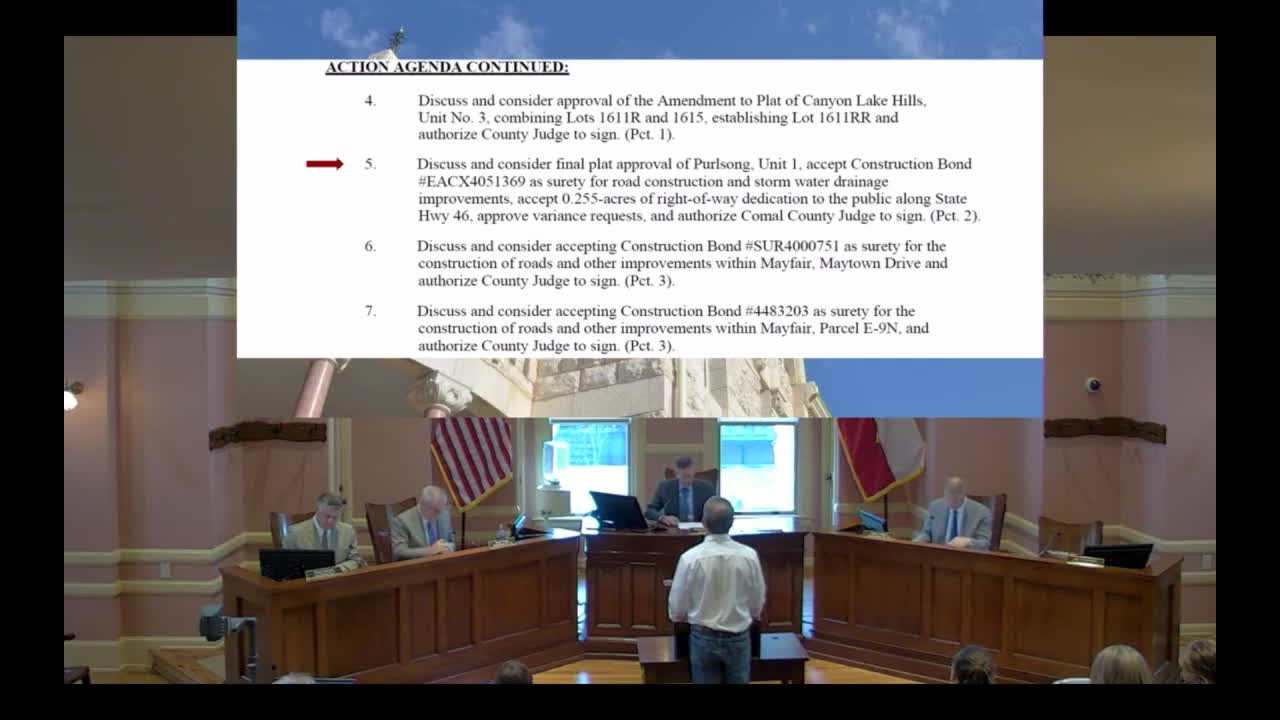
Comal County approves Pearl Song Unit 1 plat amid residents’ water and floodplain concerns
Summary
Commissioners approved the final plat for the Pearl Song (Pearlstone) Unit 1 subdivision after a lengthy public comment period raising water availability, wastewater permitting and floodplain concerns; county staff said review timelines and engineering approvals support the action.
Comal County Commissioners Court on Thursday approved the final plat for Pearl Song Unit 1, a large subdivision near State Highway 46, despite repeated public objections about groundwater, wastewater infrastructure and floodplain risk.
The approval, made by a motion from Commissioner Hogg and seconded by Commissioner Leacock, cleared the developer to record Unit 1 and proceed with the permitted road and drainage work. County staff said the application met the county’s administrative and technical review requirements and that statutory review timelines limited the court’s ability to delay final action.
Residents and neighborhood representatives urged the court to postpone or deny the plat. Dolores Patterson, who said she has lived in Comal County Estates for 31 years, told commissioners: “The density of this project is completely inconsistent with surrounding neighborhoods and far too high for an area that cannot sustain the growth at this level.” She and other speakers cited nearby wells going dry, two years of water restrictions affecting parts of Rockwell Ranch, and the absence of final permits for the proposed wastewater treatment plant.
Attorney Lauren Ice, representing neighbors adjacent to the proposed development, asked the court to deny or postpone the plat because the applicant requested variances from county code and did not submit documentation showing undue hardship required to justify those variances. “They have not provided the information to determine whether people’s groundwater wells are going to be impacted,” Ice told the court, adding the application lacked a required groundwater or water-availability report and a traffic analysis called for by county code.
County engineer David Vollbrecht reviewed the administrative timeline and engineering approvals for the plat and recommended approval. Vollbrecht said the county received the application and completed its administrative review and technical review within the statutory timeframes established by the 2023 state legislation. He noted that Texas Water Company had a water-availability report on file tied to a prior service agreement, that GBRA (Guadalupe-Blanco River Authority) signed off for public sewer service in portions of the development, and that the project includes road improvements and a planned signal and turn lanes on State Highway 46.
Vollbrecht explained the specific variances the developer requested: 30-foot streets in a 50‑foot right-of-way (the city of New Braunfels uses 50-foot rights-of-way for curb-and-gutter streets), a reduced building setback of 20 feet in some lots, and plans for some on-site sewage facilities (OSSF) on lots smaller than one acre. He said the county’s long-standing 60-foot right-of-way standard dates to a more rural design with roadside ditches, and that 50-foot rights-of-way are common for urban-style curb-and-gutter streets.
Opponents said the project’s high density — the master plan referenced up to 1,900 homes across phases — and the proposed wastewater treatment plant’s location in or near floodplain areas raise environmental and safety concerns. Angela Allen, representing Mission Hills Ranch neighborhood interests, said excavations already appear to have changed drainage patterns: “We have homes now that are being flooded and neighborhoods that are being — it takes a lot of hours and a lot of service, so I thank y’all for that. But I also ask you to use your discretion.”
Commissioners discussed the limited authority counties have to regulate density under state law and the statutory deadlines for plat approvals. The court was told that if a county fails to act within certain statutory periods, the plat may be approved administratively. Commissioners acknowledged constituents’ concerns and several said the county should update subdivision regulations to reflect more urban development patterns.
After discussion the court voted to approve the final plat. The motion carried by voice vote; the record does not list a roll-call tally for this item.
The county record shows remaining external approvals and conditions tied to the overall master plan. Neighbors raised outstanding items they said remained unresolved at the time of the vote: a certificate of convenience and necessity (CCN) from the Public Utility Commission for Texas Water Company, a TCEQ (Texas Commission on Environmental Quality) permit for the wastewater treatment plant, and a county-required water-availability/groundwater impact analysis. County staff said the developer provided required engineering approvals, service agreements and state-level water reports on file from prior submissions but that some state permits and local approvals were still pending or in process.