Get Full Government Meeting Transcripts, Videos, & Alerts Forever!
Get email alerts on the Public Works topic
No spam. Unsubscribe anytime.
Public Works outlines upkeep, tree plan and anti-dumping efforts
Summary
Department of Public Works leaders told the Governmental Operations Committee about staffing, programs and service volumes — including tree canopy planning, illegal-dumping prosecutions and streetlight and solid-waste operations.
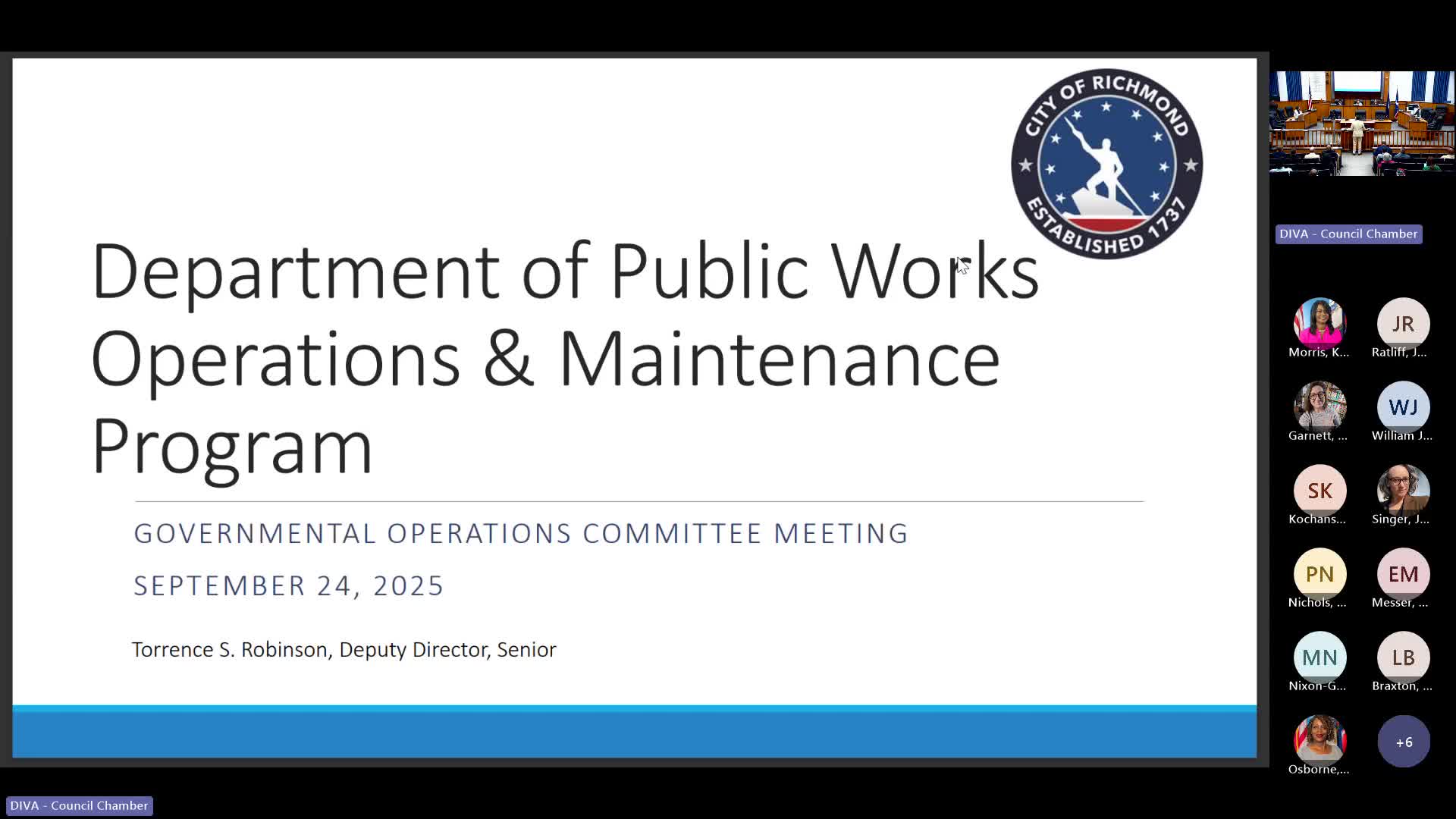
Terrence Robinson, deputy director of operations and maintenance for Richmond's Department of Public Works, gave the Governmental Operations Committee an overview of the department's operations and pending projects, saying the division’s mission is “to provide a clean, safe, and healthy environment.”
Robinson told the committee the operations and maintenance portfolio includes six major divisions and roughly 382 full-time equivalents with 30 funded vacancies. He summarized workload and program volumes: the Urban Forestry Division handles roughly 120,000 total tree sites (about 76,000 of them occupied), Street Cleaning sweeps about 5,000 lane miles a year, grounds maintenance covers about 3,000 acres across parks, medians and school sites, and roadway maintenance repairs roughly 6,000 square yards of sidewalks and more than 11,000 potholes annually. Solid waste services cover curbside trash for about 65,000 residents and curbside recycling for about 62,000 residents; Robinson said the system moves roughly 76,000 tons of trash per year.
Robinson said urban forestry uses a two-step service request process (assessment then response) and that the division reviews development permits. Michael Webb, the city’s urban forester, told the committee the city will begin a tree-canopy assessment in November and expects to complete it in 2026, with an initial round of community engagement during Tree Week. Webb said contractors plant most public-right-of-way trees from November through March and that in the past two calendar years the city planted more than 2,000 sites. Robinson and Webb said the tree plan will guide species selection and placement to avoid conflicts with power lines and other infrastructure.
Committee members pressed the department on illegal dumping and recent enforcement. Robinson said Public Works is coordinating with Richmond Police Department and code enforcement, and has launched an education campaign. He described plans “to place surveillance type cameras at some of the hot spots throughout the city” and reported the department is prosecuting an individual for illegal dumping, characterizing the prosecution as the first of its kind in five to ten years. John Walsh was named as the staff member leading the camera initiative.
Bobby Vincent, director of Public Works, said the department restructured graffiti removal into street cleaning and assigned a supervisor, increasing removal locations from roughly 500 per year to over 1,300. Vincent described efforts to recruit in-house power-line technicians for the streetlight division, raising salary ranges to compete with Dominion Energy and reducing reliance on contractors.
Robinson discussed audit follow-up work: the department has submitted standard operating procedures and other responses to open audit recommendations on graffiti removal and streetlight contract management; he said some cost-recovery work is under way in coordination with the city’s legal department. On streetlights, Robinson said the division manages approximately 45,000 fixtures (including about 12,000 ornamental lights) and has converted roughly 14,000 fixtures to LED. He said the division is developing a supervisory control and data acquisition system (SCADA) to better manage the network.
On leaves and the seasonal leaf-collection program, Robinson said vacuum service begins in November and unlimited bag collection occurs in November and December (with a preference for biodegradable bags), and that leaf pickup also depends on weather conditions.
Why it matters: the committee heard numerical service volumes and several near-term commitments — notably a tree-canopy assessment with community engagement, a targeted campaign against illegal dumping including surveillance and prosecutions, and an effort to bring more streetlight work in-house. Those activities affect neighborhood cleanliness, public safety and capital/operational budgets.
The committee had no formal action on the presentations; discussion transitioned to the city auditor's annual update at the end of the segment.
Ending: Committee members thanked department staff and scheduled follow-up questions and briefings on specific audit items and the tree-canopy timeline.