Get Full Government Meeting Transcripts, Videos, & Alerts Forever!
Get email alerts on the Parks Playground Accessibility topic
No spam. Unsubscribe anytime.
Cutler Bay seeks $200,000 FRDAP grant to build inclusive playground at Saga Bay Park
Summary
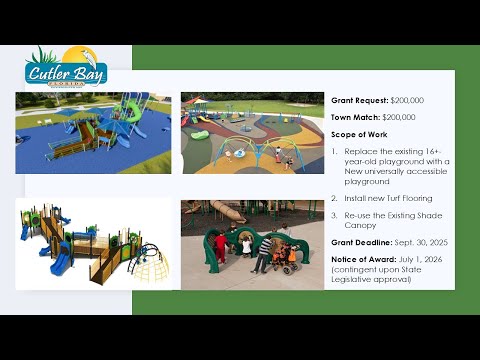
Town of Cutler Bay officials described plans and a public outreach process for a universally accessible playground at Saga Bay Park and said they will request $200,000 from the Florida Recreation Development Assistance Program, with a $200,000 town match.
Etienne Bejarano, park director for the Town of Cutler Bay, opened a public meeting to present plans for replacing the existing playground at Saga Bay Park and said the town is applying for a Florida Recreation Development Assistance Program grant.
"This is, for me specifically, a passion project. So getting this funding would be amazing for the town," Bejarano said, introducing the proposal and project team.
Alan Hughes, parks operations administrator, told attendees the town will request the maximum FRDAP award and described the program. "It's a competitive state funded program that grants up to $200,000 to local governments for the creation and improvements to outdoor parks. The program is administered by the Florida Department of Environmental Protection," Hughes said. He said the town will submit its application by Sept. 30, 2025, and that award notifications are expected in July 2026.
According to presenters, the project would replace a playground the town described as more than 16 years old with a universally accessible play area. The town plans to request $200,000 from FRDAP and commit a $200,000 local match. The proposed scope includes new turf surfacing, reuse of the existing shade canopy where feasible, and design features intended to support children with sensory and mobility needs.
Presenters and residents discussed several design elements that the town says it will consider as it moves into the design phase: a perimeter fence for safety, communication boards for nonverbal children, wheelchair-accessible ramps, sensory play elements and accessible swings. One resident described specific accessibility barriers at the current playground: "As a parent to a child with a disability that is wheelchair bound, it is difficult for us to go to the playground," the resident said, urging inclusion of accessible surfacing and equipment.
Staff described next steps and public involvement. Hughes said the town will continue outreach through its Parks and Recreation Advisory Committee, which meets the first Monday of the month in Room 220 at 6 p.m., and that the committee will help finalize design input if the grant is awarded. If funded, the town would have about three years to complete design and construction after receiving the award.
Attendees raised a handful of site questions: whether a nearby lake presented safety concerns (presenters said the lake is fenced and owned by an association), whether a splash pad could be included (staff said that feature was not in the current scope and would be located farther from restrooms), and whether sidewalk surfacing around the park could be improved to accommodate walkers or leg braces (staff noted the suggestion for consideration in design).
No formal vote was taken at the meeting. Presenters said the town already has allocated $200,000 in its current budget process as the local match and is seeking the FRDAP grant to expand the project budget and design possibilities.