Get Full Government Meeting Transcripts, Videos, & Alerts Forever!
Bureau of Planning and Sustainability releases Inner East infrastructure study; identifies areas for targeted land‑use work and infrastructure coordination
Summary
The Bureau of Planning and Sustainability presented a technical Inner East Side infrastructure study to the Climate Resilience and Land Use Committee, showing that some inner neighborhoods could accommodate increased housing with targeted investments while other subareas will require larger capital work, particularly for an aging trunk sewer and major corridors.
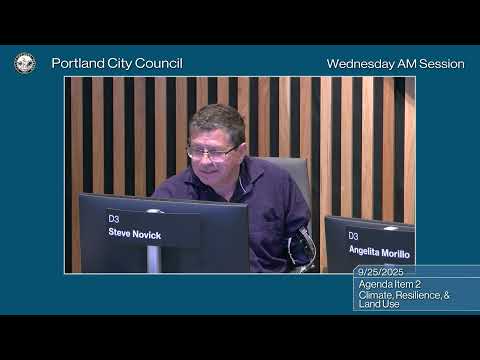
The Bureau of Planning and Sustainability (BPS) presented the Inner Southeast (Inner East Side) Infrastructure Study to the Climate Resilience and Land Use Committee on Thursday, describing a technical analysis intended to inform future land‑use planning and potential rezoning to support more housing.
BPS staff said the study tested two conceptual growth scenarios across four tiers of potential zoning changes, then asked bureaus including PBOT, the Bureau of Environmental Services (BES) and the Water Bureau to assess infrastructure capacity and risks under those scenarios. The analysis showed the study area is "generally well served by infrastructure," but that accommodating higher densities in some southern subareas would require more extensive capital planning and coordination, especially to address an aging trunk sewer (the Taggart D trunk line) and transportation congestion on major east‑west corridors such as Powell.
Ryan Singer, principal planner for long range planning and urban design at BPS, told the committee the higher‑growth conceptual scenario creates a theoretical capacity of roughly 144,000 units across the study area and a lower‑growth scenario about 90,000 units; BPS uses models to estimate a realistic utilization rate rather than assuming maximum build‑out. Using Metro's and state growth allocations, BPS estimated that expected growth would use a portion of that capacity — a utilization rate BPS tested at about 28% in some analyses — yielding an allocation in the tens of…
Already have an account? Log in
Subscribe to keep reading
Unlock the rest of this article — and every article on Citizen Portal.
- Unlimited articles
- AI-powered breakdowns of topics, speakers, decisions, and budgets
- Instant alerts when your location has a new meeting
- Follow topics and more locations
- 1,000 AI Insights / month, plus AI Chat