Get Full Government Meeting Transcripts, Videos, & Alerts Forever!
Get email alerts on the Urban Forest topic
No spam. Unsubscribe anytime.
Committee adopts amendments to Portland Urban Forest Plan, directs city to study assuming street‑tree responsibility
Summary
The Climate Resilience and Land Use Committee voted to adopt three amendments to the Portland Urban Forest Plan, directing staff to develop plans and financing strategies for citywide street tree maintenance and sidewalk repairs and narrowing financial assistance to qualifying low‑income property owners. Vote counts: Amendment 1 carried 4–1; Amend
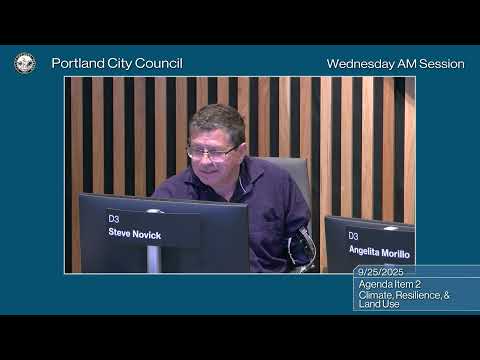
Councilor Novick's Climate Resilience and Land Use Committee adopted three amendments to the Portland Urban Forest Plan on Thursday, approving language that directs bureaus to develop plans and financing strategies for a comprehensive citywide street‑tree maintenance program and for how the city could assume legal and financial responsibility for street‑tree–related sidewalk repairs. The committee approved the package and voted to forward the amended resolution to full council, 4–1.
The amendments require that the city fund and implement a comprehensive citywide street‑tree maintenance program, direct staff to identify financing strategies (including new funding sources and cost‑saving measures) to reduce costs to property owners for sidewalks damaged by trees, and narrow a financial assistance provision to qualifying low‑income property owners. The motion to move the resolution (document number 20 25 3 51 as listed in committee) to full council passed with four ayes and one nay; Councilor Novick cast the only no vote.
The changes were proposed by Councilor Kanal and discussed by councilors and bureau staff as the committee considered tradeoffs between equity, long‑term costs, and the source of funds. Councilor Novick said he was concerned the amendment "commit[s] the city to assuming legal and financial responsibility for street trees" and that the Portland Clean Energy Community Benefits Fund might be asked to assume ongoing costs he thought could conflict with other priorities. He said he was "tentatively inclined to vote no" before the discussion concluded.
City Forester Jen Cairo told the committee the bureau's current estimate for a citywide maintenance program is about "$15 to $20,000,000 per year," based on an older estimate and ongoing pilot work. Cairo said the pilot is funded with Portland Clean Energy Community Benefits Fund dollars. Alex Farrokhana, chief engineer at PBOT, said PBOT has been part of the conversations and raised the need to clarify how sidewalk maintenance would be handled if the city assumes responsibility for tree‑related sidewalk repairs. He noted both funding for the planning work and future costs for construction and maintenance must be addressed.
Committee members pressed for clearer cost estimates and phasing. PBOT staff cited Denver’s prior estimate as an example of the scale of potential sidewalk repair costs—about $40,000,000 annually in that city—while cautioning that local analysis is needed to determine Portland’s actual costs. Councilor Kanal and other supporters described the amendments as establishing a planning and analysis timeline rather than an immediate fiscal commitment; Kanal said the intention is to "establish a plan for how the city could assume legal and financial responsibility," adding that the plan would include an estimate of potential costs and take into account projects already underway.
The committee also clarified the amendments’ deadlines: the street‑tree maintenance plan direction includes a target to establish a plan by November 2027; the sidewalk financing and planning direction calls for developing a plan by 2028 that "takes into account current projects underway for the city and includes an estimate of potential costs." Councilor Ryan and others asked that the planning work be coordinated with Parks, PBOT and Environmental Services so bureaus can estimate operational and capital impacts and identify funding options.
Roll calls recorded the committee votes. Amendment 1 passed with four ayes and one nay (Murillo — aye; Abalos — aye; Knoell — aye; Ryan — aye; Novick — nay). Amendment 2 and Amendment 3 each passed (amendment 2 recorded as a 5–0 vote in committee; amendment 3 adopted unanimously in the roll call presented). The committee then voted 4–1 to forward the amended resolution (document number as listed in committee) to full council with a recommendation to adopt.
The committee’s discussion emphasized that the amendments create a direction for planning and analysis rather than an immediate citywide takeover of costs. Staff said the current pilot and the PSF allocations (described in committee as three funding streams over five years totaling: $40,000,000 for equitable tree canopy plantings; $7,000,000 for a private property tree care program focused on low‑income property owners; and an additional $100,000,000 for street tree maintenance over five years) will provide near‑term funding and data to inform future decisions. Committee members asked staff to return to the council with clearer cost estimates, phasing options and identified funding sources before any commitment of long‑term operational funds.
The committee noted the amendments aim to reduce burdens on property owners, improve tree canopy health and support habitat connectivity citywide, while leaving open review of funding sources and the PSF advisory process. The amended resolution will be considered by full council at a later date.
The committee spent substantial time evaluating fiscal implications and inter‑bureau coordination; council members said they expect further briefings and cost estimates before final council action.
Votes at a glance: Amendment 1 (establish plan to assume responsibility for street trees) — passed 4–1. Amendment 2 (identify financing strategies; develop plan by 2028 including cost estimate) — passed (recorded 5–0 in committee). Amendment 3 (limit financial assistance to qualifying low‑income property owners) — passed (recorded as adopted). Final motion to forward amended resolution to full council — passed 4–1.
Next steps: The amended resolution will be transmitted to full council for consideration. Staff from Portland Parks & Recreation, PBOT and the Bureau of Environmental Services signaled they will continue planning and refine cost and funding estimates to inform council decisions.