Get Full Government Meeting Transcripts, Videos, & Alerts Forever!
Get email alerts on the Community Relations topic
No spam. Unsubscribe anytime.
Coral Gables commission agrees on banner, interfaith vigil and lighting instead of raising Israeli flag
Summary
After weeks of public comment and protest, the City Commission voted to display a remembrance banner, hold an interfaith vigil and light City Hall blue-and-white Oct. 7, rather than raise the Israeli national flag at City Hall.
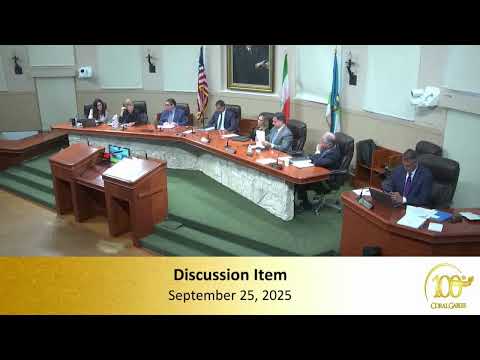
The Coral Gables City Commission voted Sept. 25 to mark Oct. 7 with a citywide remembrance package — a banner on City Hall, an interfaith gathering and blue-and-white lighting of City Hall — after weeks of heated public comment about a mayoral proposal to raise the flag of Israel on that date.
The commission’s compromise came after public testimony from residents on both sides of the issue, several of whom said a single national flag would divide the city. The commission’s action directs staff to place a remembrance banner (design selected as “option 3”), organize an interfaith event at City Hall, and light City Hall blue-and-white beginning the day before Oct. 7 and staying through the day after.
Why it matters: The question of raising the Israeli flag drew repeated public comment, with some residents saying raising that flag would appear to endorse one national perspective and others urging the city to recognize Israeli victims of the Oct. 7, 2023 attacks. The commission’s adopted approach aims to create a visible, inclusive memorial that is meant to acknowledge victims and promote a message of peace rather than select a single nation’s symbol.
What commissioners said: Mayor Vince Lago framed the vote as an attempt to “build community” while acknowledging that some residents would remain opposed to any visible city action. Vice Mayor Rhonda Anderson and other commissioners urged a neutral, inclusive memorial; Anderson proposed the banner-and-vigil option that the body adopted.
Public testimony: Residents from multiple backgrounds urged different approaches during public comment. Joel Shahada said he opposed singling out one national flag, saying, “A vote for this is an endorsement of genocide,” and other speakers, including Martha Schoolman and Edward Daboud, argued the city should find a less divisive way to remember victims. Several speakers urged an interfaith vigil and other neutral memorials instead of a national flag.
Next steps and logistics: Staff were directed to arrange the banner on the front of City Hall (selected design), schedule and coordinate the interfaith vigil (inviting faith leaders from the city’s Jewish, Christian and Muslim communities), and schedule the blue-and-white lighting for the day before through the day after Oct. 7. The commission asked staff to provide security and logistical details and to schedule the event and banner display so residents know where and when to attend.
Ending: The measure passed by unanimous recorded vote. Commissioners said they would monitor community reaction and consider additional public engagement if needed.