Get Full Government Meeting Transcripts, Videos, & Alerts Forever!
Get email alerts on the Nuisance Code Amendment topic
No spam. Unsubscribe anytime.
Shawnee County holds first reading of HR 2025-2 to revise nuisance code; no vote taken
Summary
County attorneys presented Home Rule Resolution HR 2025-2 on Sept. 25, a first reading to amend Shawnee County’s nuisance code, removing jail as a possible punishment, creating limited rebuttable presumptions for nuisances, and repealing administrative-hearing procedures while establishing a fine schedule and civil enforcement options.
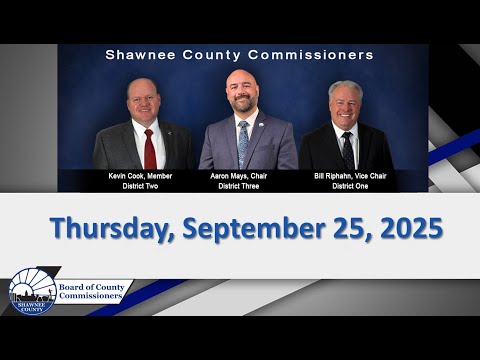
Shawnee County commissioners on Sept. 25 heard a first reading of Home Rule Resolution HR 2025-2, a proposed amendment to the Shawnee County Code that would revise nuisance enforcement across unincorporated parts of the county.
Kyle Edelman, assistant county counselor with the County Counselor’s Office, told commissioners, “This is our first reading of a home rule resolution which would amend certain portions of the Shawnee County code.” The presentation laid out several substantive changes including removal of imprisonment as an available penalty, a new rebuttable presumption that certain on-site conditions constitute a public nuisance, a new fine schedule, and repeal of the current administrative-hearing procedures.
The resolution would remove language that allows jail or imprisonment when a code section does not specify a penalty. It would keep three remaining penalty possibilities and would instead adopt a civil-enforcement framework: the County Counselor’s Office could seek injunctions or other civil relief, and the proposed language would establish fines for violations where previously none were codified. Edelman said the change is intended to align nuisance enforcement with the county’s policing of public nuisances rather than private property disputes.
Key provisions described in the presentation: - Presumption scope: The proposal would create a rebuttable presumption that a nuisance exists when enumerated conditions are found on parcels in platted subdivisions or on parcels of four acres or less that have a residence or are adjacent to a residence. The presumption also would apply to structures unfit for human occupancy or conditions posing an immediate threat to public health and safety. Edelman said those phrases are defined in the draft code changes. - Abandoned and improperly stored vehicles: The draft moves abandoned-vehicle language so that only specific sections would apply and adds a separate section addressing improperly stored vehicles. A vehicle would be considered improperly stored if it is rusted, wrecked, junked, partially dismantled, inoperative or abandoned and is parked, stored or left on a property for a period in excess of 30 days—unless it is enclosed in a building, screened from view from a public roadway, stored on racks or blocks at least 18 inches high, or is stored by a lawful business as part of its commercial activity (for example, towing or wrecking companies). - Notice and cure: The Health Department or other designated enforcement agency would have discretion to issue a notice and grant reasonable time to cure violations; an emergency exception would remain for immediate hazards. The draft would repeal current administrative-hearing procedures and replace them with the notice-based approach. - Enforcement pathway and penalties: The code would add a fine schedule and allow the County Counselor’s Office to pursue civil actions, such as injunctions or abatement by court order, rather than relying on administrative hearings.
Edelman told commissioners the county has not enforced the administrative-hearing procedures since a 2012 Kansas Court of Appeals decision found counties lack inherent authority to adopt self-help administrative remedies without enabling legislation. He said some counties (he identified Riley, Sedgwick and Reno counties) have enabling legislation that allows limited administrative procedures after a prior court conviction; those procedures typically contain sunset provisions of about three years.
Commissioners asked for clarifications. Commissioner Aaron Mays (District 3) asked whether the draft addressed animal-leash rules, noise regulation or firearm discharge; Edelman said the draft does not change those topics and that state law or sheriff enforcement typically governs firearms or other matters that do not rise to a public-nuisance standard. Commissioners also questioned visibility and public-health thresholds for abandoned vehicles and structures; Edelman said visible abandoned vehicles or conditions that create vermin harborage would be the sort of public hazards the code would cover.
No formal vote was taken on HR 2025-2; Edelman said this was the first reading and a second reading will be scheduled at a future meeting. A commissioner complimented Edelman on reorganizing the code language and said staff will continue discussions with the chief judge, Judge Edwards, about procedural implications.
The county’s presentation and discussion focused on distinctions between public nuisances—“unreasonable interferences with the right common to the general public” affecting health, safety or morals—and private nuisances, which affect only individual property use or enjoyment. Commissioners emphasized the proposed changes would apply to unincorporated portions of Shawnee County only.
A second reading and further editing of the resolution were expected to appear on an upcoming agenda; no ordinance adoption or penalties became effective at this meeting.