Get Full Government Meeting Transcripts, Videos, & Alerts Forever!
Get email alerts on the Public Health Finance topic
No spam. Unsubscribe anytime.
Lane County health centers warn of large shortfall amid state and federal funding uncertainty
Summary
Health and Human Services and the Community Health Centers of Lane County reported a mid‑year budget shortfall, staffing reductions and clinic consolidations as state and federal funding pressures mount; presenters warned potential changes in Medicaid managed‑care arrangements could worsen finances.
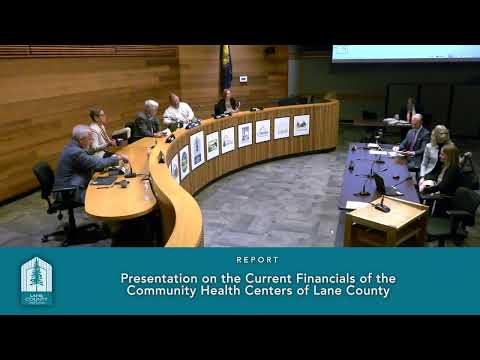
Lane County’s Health and Human Services director and the Community Health Centers of Lane County (CHC) told the Board of County Commissioners on Sept. 23 that the CHC faces a material operating shortfall and is pursuing a mixture of revenue actions and expenditure reductions to close the gap.
“ Our expenditures are growing faster than our revenues,” Health and Human Services Director Eve Gray said in the presentation describing the federally qualified health center’s funding model and recent financial performance.
Gray and Lisa Willis, CEO of the CHC, reviewed how CHC payment models work in Oregon: CHC revenue streams include per‑member per‑month capitation payments (a state capitation rate cited in the presentation was $50.46 per member per month), wrap prospective‑payment (PPS) adjustments for carved‑out services (the presentation showed a PPS wrap amount of $302.44 per eligible service), grant revenue, and fee‑for‑service billing. Willis explained capitation in plain terms: “capitation is a per member per month payment based on a population that is assigned to the health center.”
Financial picture and staff actions
CHC leaders said the organization began FY24 with an approximate fund balance carryover of $6,300,000, recorded roughly $40,000,000 in revenue and about $43,000,000 in expenses (excluding capital outlays), leaving a reduction in reserves. Revenues received in FY24 were cited at about 83% of budget; FY25 midyear collections had lagged earlier budget assumptions (one figure presented: 76% of budgeted revenues received in a later reporting period). Willis attributed part of the FY25 shortfall to an arduous go‑live on the new Epic electronic health record (revenue‑cycle disruption) and to temporary interruptions in receiving new Medicaid assigned lives from one coordinated care organization (CCO).
To reduce the projected FY25 deficit (staff described an estimate that at one point reached as high as $7,000,000 if no changes were made), CHC leadership said they identified approximately $4,500,000 in near‑term revenue opportunities this year (increasing to about $9,000,000 across three years) and planned roughly $3,000,000 in expenditure savings this fiscal year (about $4.5 million when annualized). Specific measures announced included eliminating roughly 30 vacant positions, reducing some management and support roles, consolidating care locations (moving providers from Brookside into other clinics such as Charnelton and Riverstone), ending the transition‑of‑care nursing program as a standalone team and absorbing that work into clinic teams, and reducing hours at a Springfield high‑school clinic while maintaining limited services and student transportation on days the clinic is closed.
A complicating factor — a managed‑care vendor decision
During the meeting CHC leaders reported new, developing uncertainty: PacificSource Health Plans signaled it may not sign a CCO contract for the county market. CHC staff described the PacificSource announcement as a recent development and said they were performing analyses to model effects if PacificSource‑covered lives shift to Trillium, to the state DMAP fee‑for‑service model, or to other arrangements. Willis said that contract rates negotiated with coordinated care organizations are confidential, so the CHC could not publish payer‑specific rates, and that PacificSource’s potential exit would have a “further negative financial impact that is not of small significance.”
Why it matters: CHC clinics serve many Medicaid and Medicare patients and provide primary care in medically underserved parts of Lane County. Reductions in CHC capacity or reimbursement would affect patient access to primary care, school‑based services and dental care, and would strain regional safety‑net capacity.
Board response and next steps
Commissioners and county staff pressed for more detail and offered to coordinate advocacy and communications with state health officials. Director Gray asked the board to help in state‑level advocacy and to coordinate with county legislative contacts; multiple commissioners said they would pursue follow‑up with state counterparts. CHC staff said they expected certain state reimbursements to arrive within days and continued work on payer contract renegotiations; staff also said they would return with more detailed financial scenarios once analysis of payer shifts was complete.
No formal board decisions were made at the Sept. 23 meeting; staff said they would return with additional information and that the timing of state and payer decisions will determine how deeply the CHC must pare services.