Get Full Government Meeting Transcripts, Videos, & Alerts Forever!
Get email alerts on the Special Education topic
No spam. Unsubscribe anytime.
Laredo ISD: Special education enrollment rises; board hears staffing, facility and funding strains
Summary
Laredo ISD special education director Raul Gomez told the school board on Sept. 23 that special education enrollment has risen this month, squeezing classroom space and staff and placing pressure on federal IDEA Part B (224) funds that largely pay salaries.
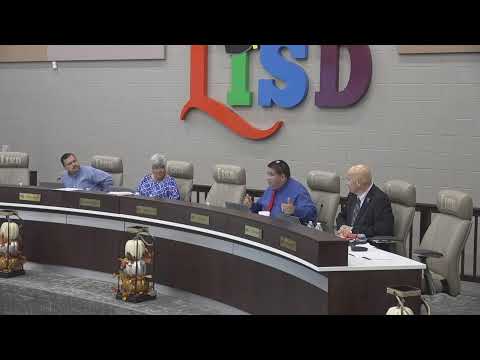
LAREDO, Texas — Laredo Independent School District special education director Raul Gomez told the Board of Trustees on Sept. 23 that the district's special education population has increased in recent weeks and that staffing, classroom space and federal funding timing are creating short-term strains.
"Special education is available because of a federal law called the Individuals with Disabilities Education Act, IDEA," Gomez said in the Amber Urie Boardroom, explaining the basis for special education programs and the district's responsibility to serve eligible students and their families.
Gomez told trustees the district counted 2,650 special education students as of Sept. 16 and 2,673 as of Sept. 23, a net increase of 23 in one week. He said the district has 152 pending initial referrals and projected membership could reach roughly 2,745 by snapshot, though he cautioned the figure could change.
Why it matters
The board was briefed on how that growth is affecting classroom assignments, self-contained units and restrooms used for medical or hygiene needs, and on how IDEA Part B (commonly called 224) funding flows into the district. Gomez said the 224 grant for the 2025-26 grant period totaled about $4.6 million and that roughly 88.8% of the award'about $4.125 million'is used for salaries. Because much of the grant is spent on payroll early in the school year, Gomez said the district frequently relies on carryover funds in the spring to re-encumber those salary costs.
Details from the presentation
Program structure and services: Gomez reviewed the department's organizational chart and named four supervisors who oversee feeder patterns and related services. He described available instructional settings (resource, content mastery, in-class support, self-contained units, early childhood special education and specialized units such as autism and deaf education) and the requirement that students meet one of the 13 federally recognized disability categories and demonstrate educational need.
Testing and accountability: Gomez explained assessment options, including the regular STAAR assessment and STAAR Alternate 2 for students with the most significant cognitive disabilities. He noted federal guidance limits STAAR Alternate 2 usage to approximately 1% of the special education population and described the district's obligation to document the ARD (admission, review and dismissal) committee's decisions about assessments and placements.
Enrollment and program counts: Gomez provided a campus-level breakdown and said the district has 74 resource teachers, 72 elementary special education teachers, 36 at middle school and 34 at high school (these counts include teachers who now deliver dyslexia instruction). He said the district identified 551 students under a dyslexia umbrella; 434 were receiving dyslexia instruction and 117 were receiving accommodations.
Facilities and space concerns: Trustees questioned whether some classrooms and restrooms are adequate for students with significant medical or hygiene needs, especially in older or smaller rooms such as at Nixon High School and at expanding campuses such as Farias. Gomez said campuses are "resourceful" and principals work to make accommodations, but he and trustees agreed staff should review campus improvement plans and facility needs and report back to the board.
Staffing and substitutes: Gomez said the district has a shortage of special education teachers and teacher aides and that some budgeted aide positions remain unfilled. The board discussed recent pay increases for teacher aides (new base rates were approved earlier in the year) and asked staff to explore additional recruitment options, including Region 1 training pathways and possible supplemental pay (for example, weekend or after-hours work on ARDs) used by neighboring districts.
Budget timing and carryover: Gomez said the district receives the IDEA Part B (224) grant each July for the July 1'Sept. 30, 2026 grant cycle and that those funds are often encumbered quickly for salaries; he said that depletion typically occurs by December and the district counts on rollforward (carryover) funds, usually received in April, to refill accounts through the following September. He estimated prior-year carryover at about $3 million and projected a possible $2 million rollforward for the coming year if trends hold.
Process reminders: Gomez outlined the special education referral and evaluation process, including Child Find, pre-referral interventions, RTI (response to intervention) documentation, parental consent timelines (15 school days to secure consent for evaluation), a 45-school-day window to complete multi-disciplinary evaluations and a requirement to schedule the initial ARD within 30 calendar days of evaluation completion. He emphasized that eligibility hinges on documented educational need and that exclusionary factors (vision/hearing problems, lack of educational opportunity, high mobility, limited English proficiency) must be considered.
Board direction and next steps
Trustees asked staff to:
- Review campus improvement plans and engage principals about space and restroom accommodations for self-contained students. - Explore recruitment and retention strategies for aides and special education teachers, including training pipelines and pay scenarios (including the possibility of paid weekend work or alternative scheduling to complete ARD paperwork). - Report back with cost scenarios and recommended options.
Gomez and district administrators said they would bring more details and possible scenarios to the board. No formal vote or policy change was taken at the Sept. 23 meeting.
Ending
The board thanked Gomez and the special education supervisors for the presentation and acknowledged the department's workload in scheduling ARDs and meeting federal and state timelines. Trustees asked for follow-up information on staffing projections, budget carryover estimates and campus facility solutions at a future meeting.