Get Full Government Meeting Transcripts, Videos, & Alerts Forever!
Get email alerts on the State Budget Shutdown topic
No spam. Unsubscribe anytime.
County hears legislative update: possible Oct. 1 state budget deadline could affect courts, school meals and revenue sharing
Summary
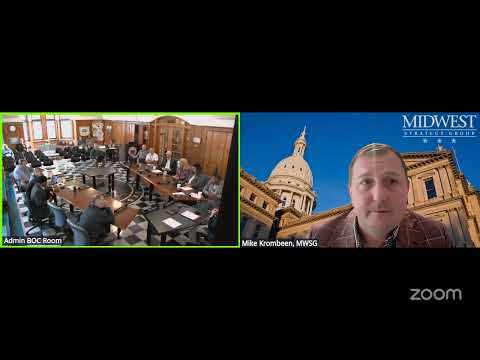
Mike Crombie of Midwest Strategy told Berrien County commissioners the state is close to a roads and budget deal but the Oct. 1 fiscal deadline could still produce a short shutdown; commissioners were advised to prepare for impacts on courts, licenses and school meal funding.
Mike Crombie of Midwest Strategy briefed the Berrien County Board of Commissioners on potential state budget outcomes and legislation that could affect county operations, including the possibility of a state government shutdown on Oct. 1 and changes to revenue sharing and road funding.
"We are just 6, 5 days away from a potential government shutdown," Crombie said, describing progress toward a framework deal on road funding but noting uncertainty over timetable and final details. He said discussions have focused on a road package that would include a mix of cuts and new revenue, and that lawmakers have considered revenue options ranging from cannabis taxes to fees on heavy trucks.
Crombie told commissioners that if there is no signed budget by Oct. 1 the governor will deem parts of state government essential or nonessential, and that would determine whether services such as permit processing, Secretary of State branch services or certain court functions continue. He warned that a longer shutdown could cause ‘‘essential’’ employees to be required to work without immediate pay and that could reduce staffing if employees call in sick.
The commissioner overseeing finance said the county has received 67% of its expected state payments for 2025 and remains owed about 33%, adding that some state‑funded payments (for roads, public defense and other programs) may be front‑loaded so the county could receive October and November payments in quick succession if the state delays disbursements.
Crombie also highlighted the revenue sharing debate: the state House proposal included increased spending on roads (about $3.4 billion) with offsets that would cut other areas, producing what Crombie described as roughly a $5 billion reduction relative to other projections. He said some proposals would cut revenue sharing while increasing money in a new Public Safety Trust Fund; that tradeoff would increase funding constrained to public safety uses while reducing flexible revenue for local governments.
Commissioners asked about specific consequences for courts and school meals. Crombie said courts could see interrupted or limited services depending on which staff the governor designates as essential, and that the school breakfast and lunch program has been funded as a line item in the state budget in recent cycles but schools are uncertain how funding will be treated if a budget is not finalized before Sept. 30. He described the school funding cadence as roughly 11 payments across the year and noted districts are communicating uncertainty to parents.
On legislation, Crombie said a bipartisan bill expected to move this week would address vacancy procedures after a primary winner dies before the general election; the measure would permit the local party to select a replacement for the general ballot in that circumstance, stemming from an Allegan County case. He also said legislators are continuing talks on short‑term rental regulation and that a bipartisan package could prohibit local outright bans while giving local governments regulatory authority and taxing parity provisions; he said introduction might come after the budget is settled.
Crombie encouraged commissioners to review draft resolutions from the Michigan Association of Counties (MAC) on protecting revenue sharing and to route questions through county staff. No formal county action was taken on the budget topics at the meeting.
Votes at a glance: the board approved minutes from the previous week's meeting by voice vote during the consent portion of the meeting.