Get Full Government Meeting Transcripts, Videos, & Alerts Forever!
Get email alerts on the School District Finance topic
No spam. Unsubscribe anytime.
Adams 12 FACT: Quarterly financial monitoring shows reserves met; bond proceeds spending underway
Summary
Finance staff reported the district met statutory and policy reserve requirements, outlined assigned fund balances and planned bond spending, and flagged pre-audit figures and receivables during a FACT meeting.
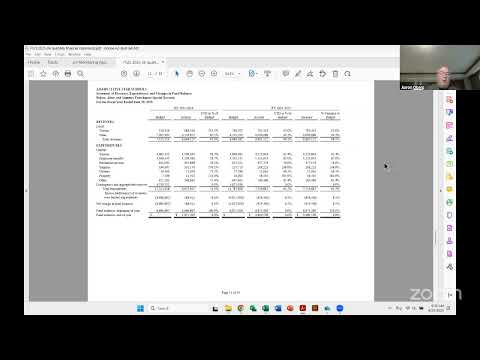
Aaron Oberg, Director of Finance for Adams 12 Five Star Schools, told the Finance and Audit Committee (FACT) that the district met its statutory and policy reserves in the quarterly monitoring report and presented pre-audited fund balances and planned uses for recent bond proceeds.
The monitoring report matters because Colorado statute and the district’s policies require regular review of reserves, liquidity and internal controls; the report shows how the district is meeting those obligations while beginning to spend bond proceeds approved by voters.
Oberg said statute requires the board to review the district’s financial condition at least quarterly and that the district’s monitoring policy requires presentation of reserves, cash positions (liquidity), payables/receivables, borrowing/spending on mill levy override (MLO) and bond proceeds, and audit/internal-control items. He told the committee that the reserve requirements for TABOR (a constitutional reserve) and contract-restricted bond redemption proceeds have been met, and that the food service fund remains restricted by federal regulation to non-profit nutrition operations.
Oberg described assigned fund balances the district holds for special revenue, capital projects, grant carryovers, Medicaid reimbursement tracking, before- and after-school enrichment programs, pupil activities and athletics, an instructional materials reserve, IT/device refresh reserves, and a risk reserve to cover expenditures beyond insurance coverage. He explained the district’s unassigned fund balance policy: the board requires an unassigned fund balance of no less than 4% and no more than 8% of general fund revenues. Oberg said the district is forecasting an unassigned fund balance of 4.9% at year end and that the 4–8% policy is intended to avoid accumulating excess unassigned reserves and to ensure current-year revenues are spent on current-year needs.
On liquidity, Oberg noted the district maintains roughly 30 days of cash on hand for operating needs and monitors timely tax and receivable collections, including student fees, rents and lease receivables. He said the district reports approximately $1.5 million in receivables, much of which relates to multi-year inactive student account balances.
Oberg reviewed the bond issuance and initial spending. He said the district issued bonds that, including premium, amounted to about $185 million (approximately $171 million par) and that bond proceeds are being tracked by LRPAC and other bond leadership groups. The district has distributed the first per-pupil charter share of bond proceeds to charter schools and is tracking budgeted project spending and encumbrances; Oberg said the district budgeted roughly $23 million of Thornton High School spending in the first year and is already more than halfway through that amount.
Oberg emphasized these figures are pre-audit (presented as of early July) and that significant accounting activity happens after that date. He also noted that the district will issue an RFP for external auditors after the current audit cycle and asked for committee volunteers to help review proposals, because the auditors report to the board.
The presentation closed with an invitation for committee questions; no formal motions or votes were recorded during the public portion of the FACT meeting.
Less critical details: Oberg said the monitoring report is 17 pages and includes the superintendent’s interpretation of board policies and supporting evidence; the district’s charters also maintain TABOR-like reserves per their contracts, which the district monitors because charter shortfalls could affect the district’s obligations.