Get Full Government Meeting Transcripts, Videos, & Alerts Forever!
Get email alerts on the Immigration Enforcement Sanctuary Codification topic
No spam. Unsubscribe anytime.
Portland councilors present sanctuary codification, mask and detention proposals as public hearing draws large turnout
Summary
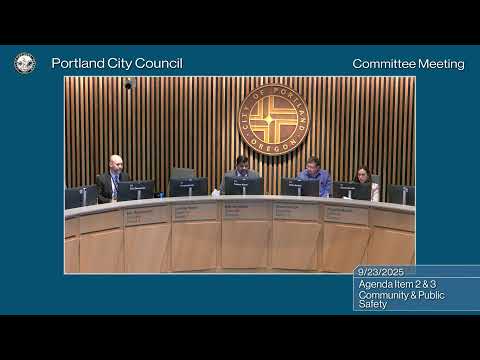
Portland councilors used a Sept. 23 Community and Public Safety Committee meeting to air multiple draft proposals aiming to strengthen protections against federal immigration enforcement activity in the city and to solicit public feedback.
Portland councilors used a Sept. 23 Community and Public Safety Committee meeting to air multiple draft proposals aiming to strengthen protections against federal immigration enforcement activity in the city and to solicit public feedback.
Councilor Kunal (sponsor) presented a draft ordinance to codify Portland's 2017 sanctuary-city resolution into binding city code; require signage and clarifications of public and nonpublic spaces; require bureau-level training and designated liaisons; and direct the city to submit Freedom of Information Act requests about federal activity in Portland. "We have the opportunity to use every single tool in the toolbox to make and keep our communities safe," Anna Maria Perez of Latinx PDX told the committee in support.
Two additional draft proposals discussed were Councilor Murillo's pair of measures: a detention facility impact fee to require property owners who lease to detention facilities to pay an ongoing fee to offset city costs (police overtime, traffic control, environmental remediation and relocation assistance), and an "unauthorized detention" code to clarify limits on private-security detentions and require transfer or release of anyone lawfully detained. Murillo also described a forthcoming data-privacy and governance resolution to limit city data exposure to federal agencies.
Councilor Avalos presented a resolution-style initiative called "Protect Portland," modeled on Chicago's effort, that would establish a cross-bureau initiative to safeguard Portlanders through legal research, FOIA requests, a multilingual education campaign, contractor protections and a commitment to future legislative work. "This is also about solidarity," Avalos said.
Public testimony and employee input: Members of Latinx PDX and dozens of community members gave oral comments during a public hearing that followed the presentations. Latinx PDX co-chairs and city employees said the city's 2017 resolution is insufficient and urged binding code, mandatory training for all bureaus, clear signage in buildings and automatic FOIA reporting on federal enforcement activity. "Our safety and clarity as employees and the safety of our community should not depend on who holds power tomorrow," said Maria Hernandez Segoviano, a Latinx PDX co-chair.
Supporters asked for enforcement mechanisms and clarity on exceptions. Some testifiers and council members urged that if ICE or other federal agents operate masked or refuse to identify themselves, the city should require verification of federal credentials before allowing access to nonpublic spaces. Petition organizers and advocates also urged clearer reporting to the public, monthly rather than annual reports, and stronger oversight and accountability for violations.
Detention fee and contractor concerns: Councilor Murillo said the proposed detention facility fee would not prohibit leasing to federal contractors but would require a fee intended to offset city costs associated with those facilities. Councilors discussed legal limits and potential unintended consequences; Murillo and other supporters argued the fee is aimed at companies and landlords that profit from detention while the city and neighbors bear large public costs.
Scope, enforcement and next steps: Councilors and city staff repeatedly said the drafts remain under legal review and are being shaped by input from the city attorney and the Public Safety Service Area. No formal votes were taken. Councilors asked for further cost estimates, clearer enforcement language, and possible co-sponsorship. Several councilors said the proposals could be filed as separate ordinances and later combined if appropriate.
Ending: The meeting concluded after several hours of testimony. Committee members signaled continued interest and requested legal edits, cost estimates and additional community consultation before moving any measure to formal council consideration.