Get Full Government Meeting Transcripts, Videos, & Alerts Forever!
Get email alerts on the Public Safety Erpo topic
No spam. Unsubscribe anytime.
Portland police describe process and limits of Oregon's extreme risk protection orders
Summary
Portland Police and Multnomah County officials described how Oregon's extreme risk protection orders (ERPOs) are filed, served and enforced, and urged wider use by family members and community responders while stressing evidence requirements and judicial review.
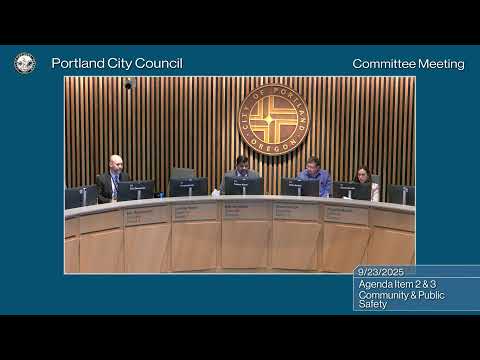
Sergeant Josh Silverman of the Portland Police Bureau told the Community and Public Safety Committee on Sept. 23 that Oregon's extreme risk protection orders, commonly called ERPOs or red flag orders, are civil court orders that can bar a person from possessing firearms for one year when there is clear and convincing evidence they pose a significant risk of harming themselves or others.
The panel's presenters — Sergeant Silverman of the Portland Police Bureau's Behavioral Health Unit, Sergeant John Pemberton of the Multnomah County Sheriff's Office gun disposition unit, Jake Chandler of Deschutes County (formerly of Bend Police), and Chelsea Parsons of Everytown for Gun Safety — described how ERPOs are applied for, served and enforced and urged more outreach so family members and crisis workers know to ask law enforcement to file petitions.
The committee heard that ERPOs require evidence of observable behavior, not merely diagnosis or speech. "It is not contingent on any kind of diagnosis," Parsons said, and courts look for "specific evidence of behavior." Silverman said officers and community responders typically document posts, threats, plans or other concrete acts that show risk. "Speech alone is typically not enough," Silverman said.
Why it matters: ERPOs are a preventive tool that remove access to firearms for a defined period without requiring the higher standard for involuntary civil commitment. Presenters said courts apply the standard of "clear and convincing" evidence for issuance and that violating an ERPO is a crime: possession of firearms while subject to an ERPO is a class A misdemeanor.
How Portland handles filings and service: Silverman said the Behavioral Health Unit now helps patrol officers by reviewing patrol reports, preparing petitions and filing them with the courthouse. After a judge grants an ERPO, the Multnomah County Sheriff's Office gun disposition unit serves the order and works with respondents on options for surrendering or storing firearms. "We take the time to talk with the folks," Sergeant Pemberton said, describing the unit's emphasis on patience and rapport-building to gain voluntary compliance.
Current use and outreach: Presenters said ERPO filings in Multnomah County have been low historically — roughly 15'to'1 per year — but that the county saw about 20 filings from January through June 2025 and is on pace to double that number. Silverman and Chandler both described training and in-county subject-matter experts as key to increasing appropriate use. "It often takes one officer to recognize the need and educate others," Chandler said of Deschutes County's experience.
Limits, evidence and renewals: Committee members asked what evidence courts require and whether renewals are available. Parsons and Silverman stressed that courts look for contemporaneous, articulable behaviors (for example, plans involving firearms or social media posts indicating intent). Silverman said an initial ERPO lasts one year; renewals require the same legal standard and must be reapplied for. Parsons noted some states have adopted longer initial durations but that Oregon currently sets one year as the standard and renewals are handled as new petitions in court.
Community and implementation considerations: Presenters urged outreach to family members, behavioral health providers, crisis response teams and community organizations so those who witness risky behavior can ask police to file petitions. Silverman provided an email address for inquiries and referrals (request@police.portland.oregon.gov) and said the Behavioral Health Unit has shifted much of the administrative work away from patrol to reduce operational disruption.
What the committee asked for next: Council members pressed on equal application of the law across race and political views and on whether speech or non-firearm-specific suicidal statements would justify a petition. Presenters repeated that courts require behavior-related evidence and that ERPOs are not a speech-policing tool. Members also discussed whether the one-year duration should be reconsidered; speakers said some states now offer longer initial terms and that renewals are available under the same standards.
Ending: No formal action or ordinance was taken by the committee on the ERPO presentation. The committee received the informational briefing and signaled interest in further outreach and training to increase appropriate and equitable use of ERPOs in Portland.