Get Full Government Meeting Transcripts, Videos, & Alerts Forever!
Get email alerts on the Energy Gas Moratorium topic
No spam. Unsubscribe anytime.
Portsmouth council approves letter opposing moratorium on new gas hookups; vote 4-3
Summary
At its Sept. 22 meeting the Portsmouth Town Council approved a revised letter to the Energy Facilities Siting Board opposing a proposed moratorium on new natural‑gas hookups on Aquidneck Island, amid divided public comment and council debate about Old Mill Lane and the island's long‑term energy needs.
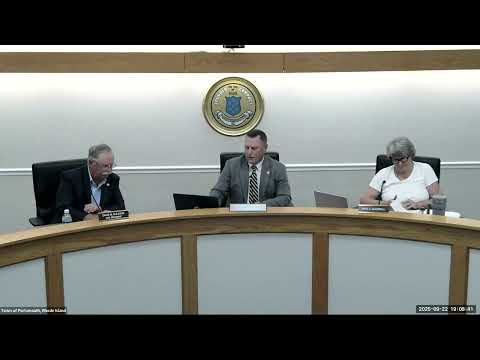
Portsmouth — The Portsmouth Town Council voted 4‑3 on Sept. 22 to approve a letter to the Rhode Island Energy Facilities Siting Board (EFSB) opposing a moratorium on new natural‑gas hookups on Aquidneck Island.
The council approved wording changes at the meeting that (1) clarify references to National Grid and Rhode Island Energy, (2) state that the town “opposes a moratorium on new gas hookups on Aquidneck Island as it is not in the public interest,” (3) request that the utility incentivize alternatives to conserve natural gas and accelerate programs to reduce demand, (4) ask that the feasibility of an additional mainland pipeline be investigated and that the results be provided to the public, and (5) correct an internal title from “town manager” to “town administrator.”
Why it matters: Council action ties directly to an ongoing, multi‑year EFSB docket and to temporary operations at the Old Mill Lane site — a portable LNG setup that residents and advocates say has created noise and safety concerns. Council members and members of the public disagreed about whether a moratorium on new hookups would reduce reliance on portable winter LNG operations or would remove incentives for Rhode Island Energy to pursue alternatives.
Public comment and council debate
Resident Steven McDonald, who identified his address as 124 Old Mill Lane, pressed the council to consider the long record of filings and reviews in the EFSB docket and said the portable operation has not been temporary in practice. “If you go ahead and say we don't want a gas moratorium, [that message] is going to be critical to our future,” McDonald told the council.
Senator Ojufusa, who identified himself as a state senator, argued against allowing more hookups: “Who wins if we continue to have hookups? The utilities and private developers in Middletown and Newport. Who loses? The people like Mr. McDonald, who live around Old Mill Lane, and every working family who's already struggling to pay for their energy bills,” he said.
Tina Munter, Rhode Island policy advocate for the nonprofit Green Energy Consumers Alliance, told the council a moratorium would “directly support efforts to reduce and or eliminate the need for the LNG facility on Old Mill Lane.” She cited studies and state climate policy that, in her view, make pipeline expansion and additional hookups inconsistent with the state's climate goals.
Council changes and split vote
Councilors debated specific language. Some members sought removal of other towns' names from the letter and clarified how to refer to National Grid / Rhode Island Energy. The council also added a request that any feasibility work on an additional pipeline include public release of results.
After discussion the council voted to send the revised letter to the EFSB. The motion passed 4‑3. Meeting minutes record the vote tally but do not list every “yes” name; council members recorded in the transcript as voting no include Councilor McDowell, Councilor Payer (spelled in the transcript several ways), and Councilor Blank.
What the letter will ask and next steps
The approved letter: opposes a moratorium as “not in the public interest”; asks the utility to accelerate demand‑reduction incentives and programs; requests an investigation of an additional mainland pipeline as a potential long‑term solution with results made public; and clarifies references to the utility’s current and former names. The council instructed staff to send the revised letter to the EFSB and to correct the internal title language.
No regulatory decision by the EFSB took place at the meeting; the council's action is an advisory position and part of the larger EFSB docket. The EFSB will receive the town's letter as part of its public record and may consider it alongside filings from other municipalities, the utility, and intervenors.
Ending note
Speakers at the meeting emphasized competing aims: immediate local safety and noise concerns around Old Mill Lane versus broader energy reliability and legal constraints. The EFSB docket and state climate policy remain key external factors that will shape how the island’s gas capacity issues proceed.