Get email alerts on the Solid Waste Transfer Station topic
No spam. Unsubscribe anytime.
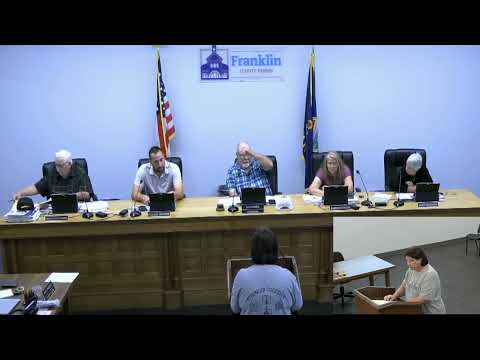
Franklin County approves transfer station rate changes, raises Freon fee
Summary
The Franklin County Commission approved changes to transfer station hours and fees, including raising the Freon recovery charge from $20 to $25 and a new Saturday cutoff to ease volumes. Commissioners debated out‑of‑county charges, roll‑off minimums and scale-system limits before a unanimous vote.
The Franklin County Commission approved changes to transfer station rates and operating hours on Sept. 24, including a $5 increase to the Freon recovery fee and an earlier Saturday cutoff to reduce weekend congestion.
Commissioners said the adjustments aim to cover rising contractor costs and shorten long Saturday lines. The commission voted unanimously to approve the proposed rate and operating-schedule changes after staff described the recommended adjustments and answered commissioner questions.
Peg, a transfer‑station staff member, told commissioners the Freon charge is being raised because “there are some changes coming down the pike, and whoever does our recovery is going to have to add equipment to do those, that recovery. Their rates will go up, won't be extreme. The guy who's currently doing it, says probably around $5 which if we raise ours by 5, we still are making just a wee bit of income on that.” Peg also described recommended changes to gate cutoff times: shortening the weekday cutoff window and moving Saturday’s cutoff to noon while keeping the facility open until 1 p.m. to clear traffic and reduce overtime costs.
Commissioners discussed several operational details during the debate. Several members raised the problem of long Saturday lines and how out‑of‑county customers affect resident wait times; staff said enforcing an out‑of‑county surcharge would slow processing because employees would need to check vehicle registrations and IDs. After discussion, staff recommended leaving a single rate (no separate out‑of‑county charge) and instead adjusting hours to improve throughput.
The proposed changes also include a three‑ton minimum for some roll‑off loads and a minimum charge for construction and demolition (C&D) loads up to 500 pounds, with per‑ton charges applied after that. Staff explained the 500‑pound minimum and the $10 minimum fee for small C&D loads reflect constraints in the county’s scale software and policies; after 500 pounds, the rate would convert to the standard per‑ton charge (as stated by staff during the meeting). Commissioners asked staff to revisit small roll‑off and low‑yardage exceptions if operators can show legitimate reasons for smaller loads.
The motion to approve the proposed rate and operating-schedule changes carried unanimously.
The commission did not adopt an out‑of‑county pricing change at this meeting; staff said they may return with tweaks to the policy if implementation issues arise.
For reference, staff said the three‑ton minimum and other specific line‑item prices were presented in the materials accompanying the proposal; details not read into the record in full were left for county files and future staff reports.
The commission closed the item after voting and thanked staff for the work on the proposal.
AI generated
The text on this page is AI generated. Summaries, highlights, analysis, and video transcripts are all produced from the original source material.
AI can make mistakes, so if you spot one, and we will fix it for everyone.
Note: the source content is unaltered by us. Any content source we link to, be it a video, an audio recording, or a document, is presented exactly as its publisher released it. That publisher is usually a government body, sometimes an individual official or another organisation.