Get Full Government Meeting Transcripts, Videos, & Alerts Forever!
Get email alerts on the Health Insurance topic
No spam. Unsubscribe anytime.
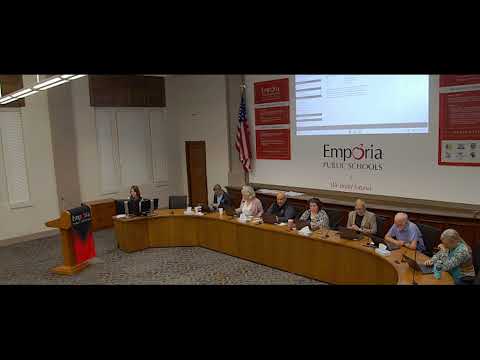
Board hears detailed briefing on 2026 health insurance options; self‑funding presented as an alternative to steep renewal
Summary
The Emporia Board of Education on Sept. 24 heard a detailed presentation from benefits consultants about options for the district's 2026 employee health insurance, including remaining fully insured with Blue Cross Blue Shield, switching carriers to Aetna with reduced benefits, or moving to a partially self‑funded plan with stop‑loss protection.
The Emporia Board of Education on Sept. 24 heard a detailed presentation from benefits consultants about options for the district's 2026 employee health insurance, including remaining fully insured with Blue Cross Blue Shield, switching carriers to Aetna with reduced benefits, or moving to a partially self‑funded plan with stop‑loss protection.
Consultants from IMA said the district's renewal under the current fully insured arrangement could be about 26.5 percent, a level that prompted the analysis of alternatives. Cody Purdy, IMA's national practice lead for public and labor, summarized the tradeoffs: "Self funding is a viable strategy for many, and we review it from a very objective and best‑practice perspective," he said.
Why this matters: the board must weigh a one‑year premium shock against multi‑year financial and operational consequences. A fully insured renewal locks the district into a higher fixed premium that the carrier will incorporate into future renewals. The self‑funded option shifts claim payment responsibility to the district up to negotiated attachment points but creates an opportunity to build reserves and capture any year‑to‑year savings.
IMA's illustrations compared three scenarios. The consultant presented the fully insured renewal as roughly $7.34 million. A partially self‑funded structure showed a worst‑case funding target near $6.8 million (the "maximum") and an actuary's expected claim outcome around $5.8 million; if the district ran at the expected level, IMA projected a reserve of about $1.5 million after one year. IMA also offered a competing Aetna fully insured proposal that the consultants said would price lower than Blue Cross Blue Shield but would require some reductions in benefits and a different provider network.
Board members pressed for details and operational implications. "In a 5 year window, what we typically see is three good years to two bad years," Purdy said when asked about variability in claims. Board member Grant asked whether catastrophic combinations of claims could overwhelm stop‑loss coverage; Purdy described contractual protections, competitive market shopping for stop‑loss, and reserve strategies that can be used to manage exposure.
Members also raised confidentiality and workload concerns. A board member asked whether HR or business office staff would face new privacy intrusions or more administrative work if the district self‑funded. IMA representatives said HIPAA and business associate agreements govern access to protected health information and that most reporting is de‑identified; they also said the vendor would provide support to keep the administrative lift low but that more frequent claims draws and additional monthly billings would be part of operations.
Board members asked for benchmarking and scenario analysis. Purdy said IMA performed a five‑year retrospective model and that, in a conservative scenario, the district would be roughly break even to slightly better if it had been self‑funded over the prior five years, and that a managed self‑funding strategy that included wellness programming and active utilization management could bend trend over time.
No board vote was taken. Several trustees said they wanted more time and additional detail from the district's insurance committee before making a decision; the insurance committee is scheduled to meet soon to review options and provide a recommendation to the board.
What's next: the board will receive committee input and compete any further underwriting and stop‑loss bids before a final decision. IMA recommended viewing the choice as a multi‑year commitment rather than a single‑year change.
Ending: Board members repeatedly asked the consultants to produce supplemental materials for the insurance committee's review: (1) an actuarial scenario showing five years of actual district claims modeled under a self‑funded structure; (2) a list of expected additional monthly tasks and estimated staff hours for the business office; and (3) stop‑loss market options and anticipated premium loads. The board did not commit to a direction on Sept. 24.