Get Full Government Meeting Transcripts, Videos, & Alerts Forever!
Get email alerts on the Federal Policy Hr1 topic
No spam. Unsubscribe anytime.
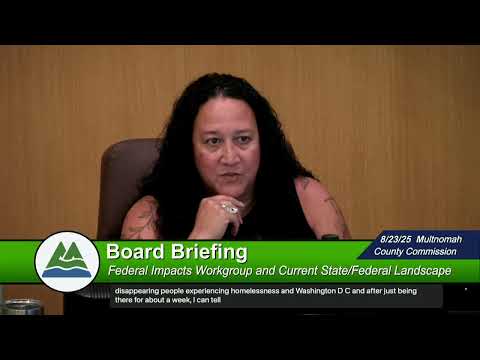
Multnomah County forms federal impacts work group and joins litigation as HR 1 threatens Medicaid, SNAP funding
Summary
County officials told commissioners they are tracking HR 1 and other federal actions that could shift billions in costs to states and counties, and said the county has joined lawsuits and created a cross‑department work group to assess risks to grants and programs.
The Multnomah County Board of Commissioners was briefed on a new countywide Federal Impacts Work Group and the potential local effects of H.R. 1, a recently passed federal spending and policy package that county staff said will shift significant costs and administrative responsibilities to states and local governments.
The briefing opened with Justin Black, deputy chief operating officer, who introduced the work group and explained it will coordinate department-level monitoring, with legal review from the County Attorney’s Office and financial analysis from the CFO’s office. "We established the federal impacts work group and project team to lead across departmental efforts in tracking, assessing, and communicating risks from federal actions," Savannah Grama, senior strategic initiatives manager in the COO’s office, told the board.
County staff emphasized H.R. 1’s two central effects: stricter work and documentation requirements for Medicaid and SNAP recipients, and cuts or shifts in federal administrative funding. Stacy Cowan, interim director of government relations, told the board the law will “restructure Medicaid and SNAP with strict work requirements, tighter eligibility,” and that, in the county’s view, the bill “saves federal money by shifting responsibilities” to states and counties. Multnomah County staff noted Oregon could lose billions in federal Medicaid funding over time and face large new state administrative costs for SNAP verification.
The County Attorney’s Office described legal steps the county has taken. Andy Jones, deputy county attorney, said Multnomah County has joined two multi‑plaintiff lawsuits challenging federal grant language and administrative directives (King County v. Turner in the Western District of Washington and City & County of San Francisco v. Turner in the Northern District of California). Jones said the litigation seeks injunctions against federal conditions that would condition grant receipt on compliance with certain executive orders or agency directives.
County staff described a five‑part internal process for tracking and responding to federal notices: department flagging, legal and CFO review, risk scoring, a termination plan if funding is reduced, and weekly monitoring of exposed funding streams. Justin Black said the county is trying to avoid reactionary steps and instead make decisions based on legal and programmatic analysis.
The presentation included timeline details staff said commissioners should watch: changes already in effect for some SNAP rules, an October 2026 reduction in federal SNAP administrative match (raising Oregon’s share of administrative costs), and major Medicaid changes — including work requirements and more frequent eligibility checks — slated for 2027. Staff warned these changes would increase administrative burdens, raise the number of appeals and enrollment verifications, and likely force choices about service reductions or new state/local revenues.
Commissioners asked for follow-up on definitions and implementation. Diana Pocherl, the county’s federal and state legislative liaison, said the federal government defines disability for the purposes of exemptions; states will determine verification processes and frequency. Commissioners raised concerns about the likely human impact, especially on older adults, people with disabilities, immigrants and families, and urged county leaders to develop clear policy direction for how the county will respond.
County leaders said they will continue cross‑jurisdictional coordination with the governor’s office and other local governments, maintain the tableau dashboard of at‑risk funding, and return to the board with updates as federal agencies, courts, and the state clarify implementation rules.
The briefing concluded with direction to maintain monitoring, legal review and interagency communications and to return to commissioners with further briefings and risk assessments as new agency guidance or litigation outcomes emerge.