Get Full Government Meeting Transcripts, Videos, & Alerts Forever!
Get email alerts on the Woody Biomass Processing topic
No spam. Unsubscribe anytime.
Valley County hears proposal to process woody biomass locally to cut disposal costs and wildfire risk
Summary
At a Sept. 24 working session, Forrester presented a plan to place modular pyrolysis systems on or near county sites to process untreatled woody debris, sell biochar and carbon credits, and reduce county disposal costs. Commissioners gave no decision; staff will seek site studies and a final plan.
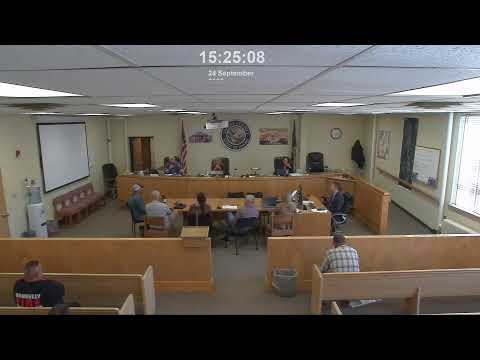
Valley County commissioners held a working session Sept. 24 to hear a company presentation about building local woody-biomass processing facilities that the firm says could cut county disposal costs, reduce wildfire risk and produce heat, electricity and biochar.
Ken Holton, identified in the meeting as the presenter for Forrester, described an end-to-end program the company says would accept untreated woody biomass at one or more drop-off locations, process the material with high-temperature pyrolysis technology, sell biochar and other products, and retain rights to carbon credits to help fund operations. “It’s a program that we think that we that could be good for the county, its residents,” Holton said.
The county session was informational; no contract or approval was requested. Commissioners and staff asked technical and site-planning questions, raised safety and operational concerns, and agreed to pursue follow-up work including geotechnical review of one possible site.
Why it matters
County officials told meeting attendees that recent grant funding that helped pay for chipping and disposal has ended and that county costs for managing woody debris have risen. Clerk Miller said, “what we expended in 2024 was $276,626. For so far this year, we've expended $209,035.55. And it's my understanding that there's another invoice being submitted for payment for a rough estimate of around 400,000 for this fiscal year.” Forrester and federal partners said a local processing option could reduce recurring county expenses and create a scalable alternative to hauling material out of the county.
Proposal details and technology
Forrester proposed locating one or more stationary, modular pyrolysis systems on county-owned or privately leased parcels. The company said the typical facility footprint would be about 1–2 acres and that a single system could produce roughly 500 tons of biochar a year, about 3,000,000 kilowatt-hours (kWh) of thermal energy and, if converted, about 750,000 kWh of electricity. Holton said the systems run at very high temperatures and that harmful emissions are substantially reduced compared with open pile burning: “this is a technology... where woody biomass is processed by a technology called pyrolysis at extremely high temperatures. And, essentially, it's burning off effectively all the potential harmful emissions.”
Forrester said it would initially focus on untreated woody biomass; construction materials and treated wood would be handled separately. The company proposed maintaining the county’s current free drop-off policy for residential customers and keeping a similar fee structure for commercial loads, while providing “100% of the funding” to develop the processing program and seeking funding streams such as biochar sales and carbon-credit revenues.
Scale, feedstock and logistics
Forrester estimated the county currently takes in about 4,700 tons of woody biomass a year and warned that intake could increase over the next five to ten years. County staff and federal partners gave additional context: staff said the transfer site receives roughly 4,000 tons annually, and U.S. Forest Service representatives said federal projects and Good Neighbor-style work would add more available material if drop sites are convenient to contractors.
Commission staff and the company discussed multiple potential locations, including the county transfer site, Lake Fork disposal area, the road department parcel near Gold Dust and other county or privately held parcels. The presenters said some candidate locations may require site improvements, access work and possible changes to permitted uses.
Safety, operations and community concerns
Fire and emergency officials urged the county to require strict safety protocols and inspections. Juan Munia, Valley County emergency manager and Donnelly fire chief, said his “biggest thing is to make sure that we have the right protocols in place” because similar pyrolysis systems worldwide have had incidents when maintenance or procedures are skipped. Munia said the county’s fire and building officials would need to review proposed designs, inspection regimes and response protocols if a system were sited near populated areas.
Staffing and operations questions included where residents would take material that requires chipping, whether some sites would host chippers, and whether modular systems could scale. Forrester said the processing systems are highly automated, could be remotely monitored, and typically require a small on-site staff (the company said a system would need about one-eighth of a full-time person to operate). The presenter also said a single system would use roughly 2,000 tons of biomass a year but that systems are modular and can be scaled to meet greater feedstock supply.
Next steps and county response
Commissioners did not vote to accept the proposal. Forrester said it would prepare a detailed plan and site-specific work for county review. County staff asked the road and public-works department to evaluate one candidate — the Lake Fork site — and Jeff (Road Department) was asked to place a geotechnical survey of Lake Fork on an upcoming agenda for further vetting. County staff and federal partners also said they would explore available grant funds and hauling incentives to support pilot activity.
Votes at a glance
At the end of the working session, commissioners moved into an executive session. A commissioner said, “I will move that we go into executive session for item code 742061 f to communicate with our legal counsel.” The motion was moved and seconded; roll call recorded Commissioner Thompson, aye; Commissioner Oppen, aye; and a third commissioner who said, “I'll go aye.” The commissioners entered executive session at 3:30 p.m.
The meeting record shows the session was a working discussion; staff and Forrester will return with a site-specific plan and additional technical data for future public consideration.
Ending
County staff indicated they will schedule site reviews and geotechnical work and asked Forrester to return with a final proposal. No contracts were approved at the Sept. 24 session; commissioners emphasized public outreach, safety reviews and a transparent permitting path before any decision on siting or operations.