Get Full Government Meeting Transcripts, Videos, & Alerts Forever!
Get email alerts on the School Finance topic
No spam. Unsubscribe anytime.
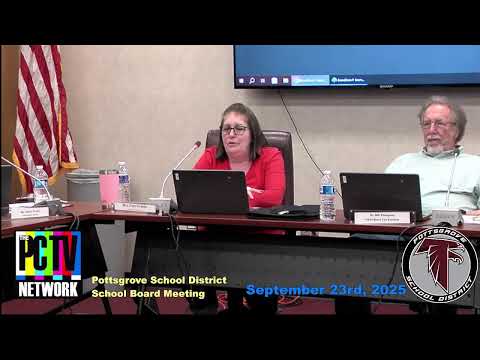
Pottsgrove board approves design contracts for proposed athletic complex; financing options outlined
Summary
The Pottsgrove School Board on Sept. 23 authorized contracts to begin design work on a proposed athletic complex and heard a financing briefing from PFM Financial Advisors about a potential $8.995 million borrowing and related IRS rules and timing options.
The Pottsgrove School Board on Sept. 23 voted to move forward with design contracts for a proposed athletic complex, while receiving a financing presentation from Jamie Doyle of PFM Financial Advisors about a possible $8,995,000 borrowing to fund construction.
Board members approved only the design-phase contracts at the meeting; no final financing or construction commitment was made. Doyle described market conditions, federal tax rules that affect tax-exempt borrowing, and a sample timeline that would let the district use calendar-year 2025 issuance limits if it chooses to do so.
Doyle told the board the district could borrow at attractive tax-exempt rates and explained the Internal Revenue Service requirements that govern tax-exempt municipal debt. "You have to have reasonable expectations," he said, summarizing IRS guidance on spending proceeds and entering binding obligations. He described three practical tests the IRS applies, and noted the district would qualify for the "small issuer exception" because the contemplated borrowing is under $15 million. Doyle added the borrowing could be structured as a 13-year financing tied to the district's existing debt drop-offs to keep overall debt service declining.
Doyle explained other technical features the board should consider, including bank-qualified status that can lower tax-exempt rates when a district uses less than $10 million of that calendar-year limit, the possibility of positive arbitrage if the district can invest borrowed proceeds at higher rates than the borrowing cost, and the value of a reimbursement resolution for retroactive project costs. He summarized how capitalized interest could phase new debt service into the district budget over two years.
He also presented a sample calendar: the board could adopt a parameters resolution at a later meeting (Doyle said Nov. 11 as an example), enter the market as soon as the parameters are set, and settle roughly 35 days after sale if that timing was chosen. "If the parameters resolution is adopted on November 11, we can be ready to enter the market as early as November 12," Doyle said.
Board members asked about urgency. Doyle said there was no requirement to borrow immediately "not unless you want to use the $10,000,000 limit for '25," and noted advantages to acting in 2025 if the board wants to capture that calendar-year bank-qualified threshold.
The board approved the architecture and construction-manager contracts that will allow the design phase to proceed; the contract documents remain subject to solicitor review, and the board retains the option to reduce the scope or stop the project after design work is complete.
What happens next: the presentation was an initial step. If the district pursues financing, board members will face separate decisions about a parameters resolution, final project scope and a bond sale. The board vote Sept. 23 covered only the design-phase contracts and did not authorize final borrowing or construction.