Get Full Government Meeting Transcripts, Videos, & Alerts Forever!
Get email alerts on the Homelessness topic
No spam. Unsubscribe anytime.
Columbus approves $17,374 for United Way-led homelessness strategy
Summary
City council voted to pay half the cost of a United Way–led effort to create a six‑month strategic plan on homelessness and housing, agreeing to cover $17,374 of a $34,748 facilitation and research budget.
Columbus city council on Tuesday voted to provide half the funding requested by a United Way–led Housing Solutions Group to develop a six‑month strategic plan addressing homelessness and affordable housing.
The United Way asked the council to contribute $17,374 — half of a $34,748 budget for facilitation, research and incidental costs — to hire a facilitator and complete supportive‑housing research, and the council approved the request by voice vote after a short discussion.
The vote matters because the proposal is explicitly intended to prepare the community to pursue federal and other funding and to coordinate local providers and stakeholders. Pat Frey, vice president of United Way, told councilors the effort would impanel advisory panels and integrate recent housing studies into a practical action plan. “Our ask of you tonight is half of that. We would like this to be a public‑private partnership,” Frey said.
Frey and Ben Moser, who co‑lead the Housing Solutions Group, described a roughly six‑month timetable and a modest budget: $4,000 for a supportive‑housing institute and research expenses, $28,848 for professional facilitation (the group proposed contracting with CSU’s Leadership Institute and Shana Young), and $2,500 for incidental costs, for a total of $34,748. Moser told councilors he expected United Way and private donors to raise the other half. “I will raise the other money, privately,” he said.
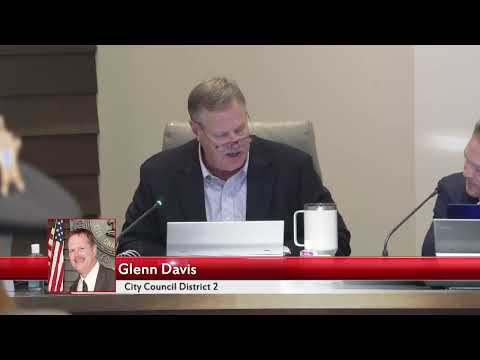
Councilor Walker Garrett made the motion to fund half the request; a second was recorded but not identified by name in the public record. Councilors had a brief exchange before the voice vote. Councilor Glenn Davis said federal grant opportunities make a small local investment worthwhile. “This is a small investment if we can capitalize and have a plan and show them that we’re prepared and ready,” Davis said.
Councilor Joanne Cogel asked for the prior strategic plan materials to be circulated to councilors; Frey said United Way would supply the previous plan. Deputy City Manager Hodge told councilors the city would develop an agreement to bring back for formal approval of the funding arrangement.
What the funding will and will not do - The city’s $17,374 is a one‑time contribution toward facilitation, research and incidental expenses for a communitywide planning process overseen by the Housing Solutions Group and United Way. It is not described as a direct service grant, rent subsidy or capital allocation. - United Way and volunteers will perform in‑kind work (the group estimated 400+ volunteer hours) and said they would recruit a facilitator to manage advisory panels from faith groups, homeless services providers, people with lived experience, landlords, workforce development and others. - The group expects to draw on a recent Georgia Tech housing study that United Way posted online and to coordinate with state and federal agencies when the final plan is available.
Next steps United Way and the Housing Solutions Group will proceed with the planning work now that the city has approved its share of the facilitation budget. City staff said they will draft a funding agreement and bring it back to council for formal authorization and implementation details. United Way said it would also pursue private fundraising to cover the balance of the $34,748 budget.
The council did not provide a roll‑call vote or a numerical tally in the meeting minutes for the motion; the clerk’s record shows the motion passed by voice vote.