Get Full Government Meeting Transcripts, Videos, & Alerts Forever!
Get email alerts on the Coastal Erosion And Threatened Oceanfront Structures topic
No spam. Unsubscribe anytime.
Dare County panel details erosion, insurance and FEMA grant options as Outer Banks homes collapse
Summary
State, federal and county officials told homeowners at a Coastal Studies Institute briefing that accelerating erosion and sea-level rise are causing house collapses on Hatteras Island; officials described short-term cleanup, longer-term grant timelines and voluntary application steps but said immediate solutions for many at-risk homes are limited.
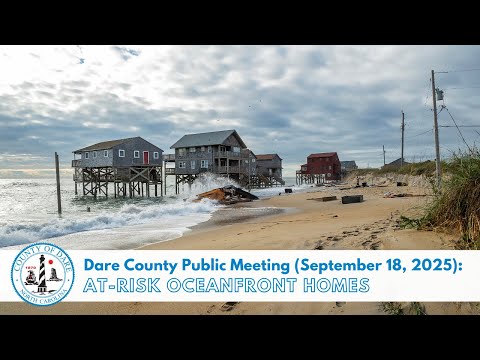
Dare County officials, state agencies and federal partners briefed more than 300 registered participants at a public meeting hosted at the Coastal Studies Institute on coastal erosion, collapsing oceanfront homes and available assistance for at‑risk homeowners. Presenters summarized recent house collapses on Hatteras Island, the science of sea‑level rise and storm-driven erosion, insurance rules for flood loss and the county’s plan to seek FEMA hazard‑mitigation funding while collecting voluntary interest forms from homeowners.
Why it matters: the Outer Banks are seeing rapid shoreline change and episodic, high‑energy events that have recently caused houses to collapse and created public‑safety and public‑health hazards when debris and septic system parts wash onto public beaches. Officials said beach renourishment, groin repairs and federally funded buyouts or elevations can buy time for some properties, but those measures are costly and in many cases will not stop ongoing erosion.
Scientists and park managers opened the briefing with a review of long‑term shoreline change and recent measurements. "We should expect a 1‑foot rise in sea level by 2050," Reid Corbett, executive director of the Coastal Studies Institute, told the meeting, and he summarized tide‑gauge records showing local rates that translate to roughly 1.6–1.8 feet per 100 years at some Outer Banks gauges. Corbett said that sea‑level rise, higher water tables and more frequent heavy rain events combine with storm surge and wave action to raise vulnerability across the coast.
Dave Hallock, superintendent of Cape Hatteras National Seashore, reviewed multiple recent collapses and ongoing debris problems. "We had four houses collapse" between 2022 and 2024 in several locations, Hallock said, describing large debris fields that in one case filled nine full‑size dumpsters after a recent swell event. He added that park staff collect pieces of houses and septic systems from beaches daily and that collapsed structures can create immediate hazards for wildlife, water quality and public safety.
Insurance, appeals and short‑term measures: Lisa Sherrard, a flood‑insurance specialist, explained National Flood Insurance Program (NFIP) rules homeowners should know. She said the NFIP definition of "flood" includes collapse caused by wave action and that a structure entirely over water may be eligible for coverage only if the policy has been continuous. On loss‑avoidance measures she said homeowners may be reimbursed up to $1,000 for moving contents and that those costs do not count as an NFIP claim. "If the structure becomes entirely over water... it is eligible for coverage provided you have continuous coverage," Sherrard said, and she advised homeowners to keep receipts and to use appeal processes and independent engineers if an insurer’s engineer denies coverage for a claimed item.
FEMA funding and timelines: Steve McGuggan, assistant director for hazard mitigation at North Carolina Emergency Management, said the state administers FEMA mitigation grants and will work with Dare County on applications. He explained hazard mitigation grants pay acquisition at pre‑storm or current market value (not tax‑card value) and that grants typically require a benefit‑cost ratio of 1.0 or greater. McGuggan cautioned homeowners that FEMA grant processes are not immediate: "It will pay at the time of acquisition the pre storm value or the current market value," and the state must submit applications to FEMA for approval before funds are available.
Dare County’s outreach and options: Barton Grover, Dare County grants and waterways administrator, said the county is soliciting a voluntary homeowner interest form and intends to submit applications for FEMA’s Hazard Mitigation Grant Program (HMGP) related to recent storms. He said the HMGP deadline at the time of the meeting was Oct. 31 (county staff requested homeowners submit applications by Oct. 15 to allow time for review) and stressed that the interest form is voluntary and not a commitment to sell or relocate. Grover noted prior local projects and recent nourishment history: a 2017 Buxton nourishment placed about 2.6 million cubic yards of sand; a 2022 re‑nourishment placed about 1.2 million cubic yards at an approximate cost of $18 million. He said a Rodanthe (Rodanthe) nourishment feasibility estimate exceeded $40 million and that the county has not secured funding at that scale.
Permits, cleanup and legal constraints: Stan Grimiller, director of the Division of Coastal Management (NCDEQ), explained permitting limitations on hard structures and temporary protections. He said state statute generally prohibits new oceanfront hard structures except in limited circumstances (for example, a terminal groin at an island terminus) and that temporary erosion control on the oceanfront is largely limited to sandbags under current law. Grimiller answered a homeowner’s question about a 10‑month permitting timeline for moving a house by explaining that permitting time often depends on which relocation site is chosen and whether the move would require filling or permitting of wetlands, which adds time.
Health risks from exposed septic systems: Josh Coltrane, Dare County environmental health supervisor, said many Outer Banks homes use onsite septic systems and rising water tables and erosion expose septic components. He told the meeting that county rules require homeowners to apply for repairs and that, if the repaired system meets setbacks and criteria, the department is "legally obligated to issue...a repair permit." Coltrane and Hallock described dozens of septic components recovered from beaches after recent storms; Hallock said between Aug. 12 and Oct. 1, 2024, more than 20 wastewater systems were reported damaged between Rodanthe and Buxton and that the park briefly worked with environmental health to post swimming advisories while testing occurred.
What officials said homeowners should do now: county staff emphasized immediate steps homeowners can take even if federal grants take years. Grover asked homeowners to complete the voluntary interest form so staff can contact them as grants open; officials said the county has submitted initial letters of interest for about 14 acquisition applications and roughly 45–47 elevation applications. Staff advised documenting property surveys, keeping insurance in force (continuous NFIP coverage is critical for some claims), keeping receipts for loss‑avoidance expenses and preparing for quick cleanup responses if a house collapses so debris can be removed before longshore currents disperse it.
Questions from the public and takeaways: homeowners pressed for faster permits and emergency options to move houses. A Buxton civic leader said bluntly that many houses on Tower Circle and adjacent blocks appear unlikely to remain in place long term and urged planning for containment and cleanup when collapses occur. Officials repeatedly stressed there are no simple fixes: beach nourishment and jetties can buy time in some locations but are temporary and expensive; state law constrains new hardened structures on the oceanfront; FEMA funding requires applications, benefit‑cost analysis and time for approval. As moderator Andrea Webster, resilience policy advisor at NCDEQ, closed the meeting she reiterated the county’s invitation to submit the voluntary interest form and the county’s offer to follow up with homeowners individually.
Ending: officials said the meeting was intended to provide science, explain legal and funding constraints and point residents to practical next steps. They urged homeowners to keep insurance current, to preserve documentation, to complete the county’s voluntary interest form and to contact county staff for site‑specific guidance. "We are trying to figure out how we can help folks no matter what that option might be," Webster said in closing.