Get Full Government Meeting Transcripts, Videos, & Alerts Forever!
Get email alerts on the Renewable Energy Ordinance topic
No spam. Unsubscribe anytime.
Wapello County holds public hearing on draft renewable energy ordinance amid mixed public input and conflict disclosure
Summary
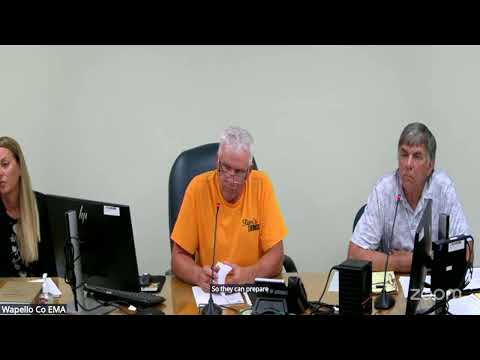
WAPELLO COUNTY, Iowa — The Wapello County Board of Supervisors held a public hearing Sept. 9 on a draft renewable energy ordinance that would regulate wind, solar and battery projects in the county, hearing both support for economic benefits and concerns about setbacks, decommissioning and local impacts.
WAPELLO COUNTY, Iowa — The Wapello County Board of Supervisors held a public hearing Sept. 9 on a draft renewable energy ordinance that would regulate wind, solar and battery projects in the county, hearing both support for economic benefits and concerns about setbacks, decommissioning and local impacts.
The hearing came after planners from consulting firms presented the draft ordinance and summarized its main features. "In 2024, Wapello County decided that they needed to have a renewable energy ordinance," Sarah, a senior planner with FSA Professional Services, told the board, saying the draft draws on state guidance and ordinances from other counties to balance landowner rights with protections for nearby residents and public lands.
The draft was developed by consultants with input from local planning bodies; Jenna Gillum, assistant planner at MSA, said about "90% have adopted wind, solar, or a combination thereof" in separate or integrated zoning ordinances and that the consultants were “open to feedback.”
Why it matters: speakers framed the ordinance as a choice between new revenue streams for a county that has faced budget shortfalls and protections against noise, debris and other local impacts. Supporters emphasized tax revenue, jobs and opportunities for landowners; opponents focused on setbacks, blade-fall/debris risks, lighting and whether the county’s rules would sufficiently protect nonparticipating neighbors.
Public input: County staff reported 14 written comments (one urging a countywide vote, three in favor and 10 opposed). Dozens of residents and stakeholders gave verbal remarks. Mark, of Greater Temple Partners in Progress, argued the county lacks local green energy capacity and urged adoption, saying Wapello County “has none to offer” for companies seeking green energy offsets and estimating the county could receive roughly $1.1 million annually under one projection. Justin Smith, a project developer for Diverxia Infrastructure, said two solar projects his firm is tracking across three counties are forecast to bring about $77.5 million to those counties over a combined 35-year lifetime.
Many residents raised concerns about setbacks and long-term impacts. Roger Russ said turbines near residences can be noisy and that flashing red lights are persistent at night. Ed Miller, a landowner and operator, said some provisions—particularly for setbacks, battery storage and decommissioning—are not specific or protective enough for adjoining landowners, small towns and churches. Several speakers asked that the county treat solar differently from wind because solar arrays do not present the same fall or noise risks.
Developers and proponents offered technical responses. Matt April, representing Apex and Dusty Fox Wind, said the draft requires an aircraft detection lighting system (ADLS) that he said can reduce blinking lights by up to 98% and confirmed that decommissioning and road‑use plans would be required and funded by developers. He also warned that some setback combinations could make projects unbuildable and noted the draft ordinance used standards more restrictive than the state’s model in some respects.
Board actions and conflicts: At the start of the hearing a board member disclosed a potential financial conflict, stating that she and her husband signed a lease with Dusty Fox in 2023 and that "effective today, I will not participate in the discussions regarding the renewable energy ordinance, and I will be abstaining from any official action regarding the renewable energy ordinance." That member abstained when the board voted to open the public hearing; the hearing proceeded and was later closed after public comment. The board later tabled scheduling the first reading/vote on the ordinance and set a working session to continue drafting and discussion.
Next steps: Supervisors scheduled an initial work session to continue ordinance revisions for 9 a.m. Oct. 30 (courtroom availability to be confirmed) and indicated additional open work sessions will be needed. County staff also reported the consultant contract for ordinance work (separate from the comprehensive plan) had exceeded $36,000 so far and may require amendment if further meetings are added.
What was not decided: The board did not adopt the ordinance at the Sept. 9 meeting. No formal vote on ordinance adoption occurred; supervisors asked for more public input, technical refinement (particularly for setbacks, battery storage language, insurance and decommissioning specificity) and additional work sessions before scheduling a first reading and vote.
Speakers and roles cited in this report appear as spoken at the hearing and were identified at the meeting or in public comment.