Get Full Government Meeting Transcripts, Videos, & Alerts Forever!
Get email alerts on the Early Intervention topic
No spam. Unsubscribe anytime.
Early intervention council presents ‘Where the Children Are’ report and proposes ordinance review
Summary
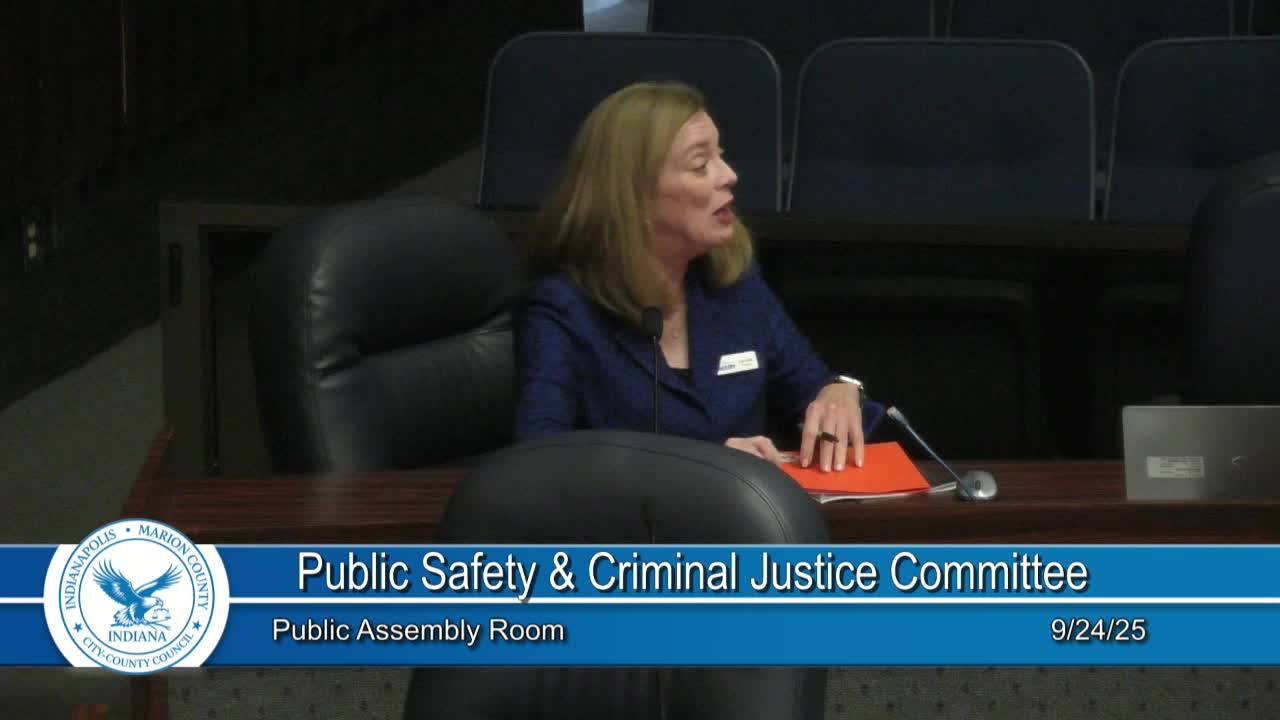
Elizabeth Coit, coordinator for the Marion County Commission on Youth (McCoy) and presenter for the Early Intervention Planning Council, told the Public Safety and Criminal Justice Committee Wednesday that the council published a compiled data report titled “Where the Children Are” to give local decision-makers a single source of information about children who are involved with child welfare and juvenile systems.
Elizabeth Coit, coordinator for the Marion County Commission on Youth (McCoy) and presenter for the Early Intervention Planning Council, told the Public Safety and Criminal Justice Committee Wednesday that the council published a compiled data report titled “Where the Children Are” to give local decision-makers a single source of information about children who are involved with child welfare and juvenile systems.
“The earlier we can intervene, [the] results in positive outcomes for children, families, communities across the county, decreases the cost [to] public safety and law enforcement, and leverages existing resources,” Coit said, summarizing the council’s prevention-focused mission and the rationale for the report.
The report pulls publicly available data into one place to show counts and trends the council said are essential for policy and budgeting decisions. Coit told the committee the council intends to propose revisions to the establishing ordinance and return with draft updates in 2026 to clarify the council’s membership, audience and responsibilities.
Why it matters: The council said a common data baseline is intended to help agencies coordinate prevention and intervention, align limited resources and reduce the number of children who are removed from families or who cycle between systems.
Key findings and details presented - The early intervention planning council’s annual operating budget is $71,500; McCoy said that sum covers personnel to organize and coordinate the council and is leveraged by more than $1 million in related grants and programs run or sponsored by McCoy. - The report uses mostly 2023 data where available. Indiana’s child population in those data was described as a little over 1.5 million; Marion County contains roughly 15 percent of that total (about 240,000 children). - Specific counts called out by Coit: approximately 4,500 children in the county who lack permanency, about 726 in juvenile detention, and a little over 2,000 designated as children in need of services. Coit said the county has one of the highest percentages of “dual status” children (those who are involved with both child welfare and juvenile-justice systems). - The council documented placement types and lengths of stay (in-home care, relative placements, nonrelative care) and noted demographic differences across those placements.
Council priorities and next steps - The council said it will continue community outreach to share the data and gather feedback and plans to review the original 2005 ordinance that established the council to clarify its charge, membership and reporting expectations. - Coit said council leaders want to consider broadening appointed membership to include additional early-intervention experts and to make the council a more visible voice when city and county leaders discuss services for children. - Coit introduced Sarah Comfort as the incoming coordinator for the Early Intervention Planning Council; Comfort also serves as Director of Advocacy and Public Policy at McCoy.
Responses from committee members - Several council members praised the report’s data and bipartisan history. One council member who serves as the Republican caucus appointee to the council thanked the co-chairs and noted the council’s long history and recent modest budget increase in 2023. - Committee members asked whether the council coordinates with juvenile-justice specialists and experts on truancy; Coit said McCoy and the council work on juvenile-justice topics and absenteeism data and that stronger youth-justice representation on the council would be appropriate.
What the council did not finalize - The presentation did not include a formal vote or a council-adopted ordinance change; Coit said the council will return with proposed revisions and timelines in 2026.
Ending note - The committee accepted the presentation and proceeded to the evening’s budget items.