Get Full Government Meeting Transcripts, Videos, & Alerts Forever!
Get email alerts on the Municipal Fees Bns Towing topic
No spam. Unsubscribe anytime.
Committee rejects amendment to tie private nonconsensual towing fees to IMPD contract, approves broader BNS fee reforms
Summary
The Indianapolis City-County Council Metropolitan and Economic Development Committee on Tuesday debated Proposal 239, a package of changes to the municipal code that updates fee and penalty policies administered by the Department of Business and Neighborhood Services (BNS).
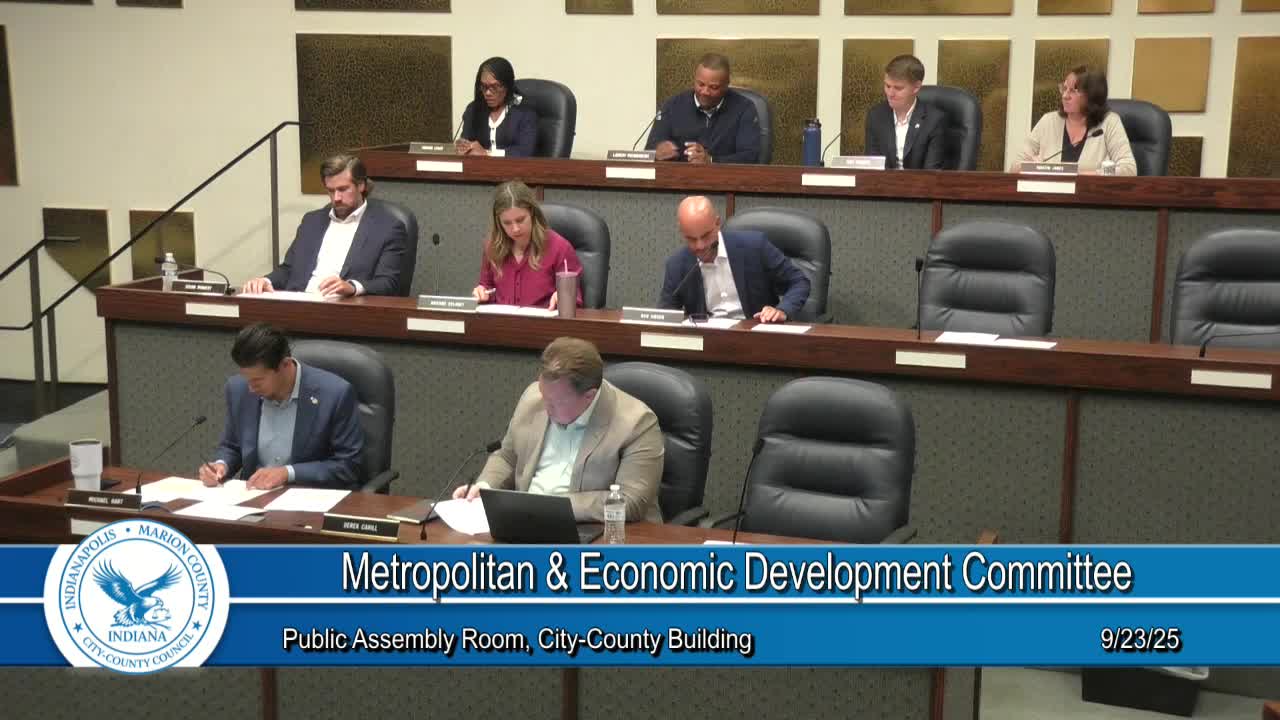
The Indianapolis City-County Council Metropolitan and Economic Development Committee on Tuesday debated Proposal 239, a package of changes to the municipal code that updates fee and penalty policies administered by the Department of Business and Neighborhood Services (BNS). The committee rejected an amendment to tie private nonconsensual towing rates to the Indianapolis Metropolitan Police Department (IMPD) towing contract but approved a separate set of director-led amendments addressing accelerated plan review, inspections and nonprofit affordable-housing permit fees; Proposal 239 then passed the committee as amended.
The committee considered an amendment from Councilor Michael Paul Hart, District 20, that would have set the maximum nonconsensual towing fee at the same dollar amount as the IMPD contract (stated in the meeting as $180 for a tow and $30 for storage) and provided that any future adjustments to the IMPD tow contract would automatically update the municipal maximum. Hart said, “What makes this time unique is that we are literally here talking about changing fees for zoning and permitting and we’re adjusting fees today.” The committee voted to reject that amendment.
Supporters of the Hart amendment included private towing operators who testified that costs have risen since the COVID-19 pandemic. J. R. Cook, owner of Cooks Towing Service, told the committee “since COVID, you know, everybody knows the cost of labor went through the roof,” and said higher fees were needed to cover wages, equipment and insurance. Cindy King, owner of Indie Towing Service Inc. (DBA Pro Towing), said her company has been operating for decades and that the change would affect employees: “This amendment would directly impact their lives.” Industry witnesses also described administrative costs tied to notifications and auctions that they said would be eased by higher regulated fees.
Opponents on the council voiced concern about the effect on vehicle owners, who are often in distress after being towed. Councilor Bridal Delaney, District 2, and Councilor Ron Gibson, District 8, both questioned whether now was the right time to raise fees that would fall on individuals retrieving their vehicles. Gibson argued that an increase “benefit[s] a particular company” and could unduly burden residents.
BNS Director Abby Brands explained the agency’s role and the classification of tows in Indianapolis: nonconsensual private-property tows are regulatory and set by council, while other towing activity (such as IMPD impounds or city tows) is handled differently. Brands said, “These fees are not fees that I assess. They are not fees that I collect. They are not penalties I assess or collect. These are specific, regulatory fees to ensure that these companies are charging the same across the board.” She also noted that the nonconsensual rates had not been adjusted in 14 years.
Separately, Director Brands led a set of technical and policy-oriented amendments that the committee approved. Brands said the board and staff would: 1) remove a narrow accelerated plan-review provision from the ordinance to allow staff to draft a comprehensive policy covering different project types and timelines; 2) clarify accelerated commercial inspection fees by adding an hourly rate for inspections that substantially disrupt normal schedules (while leaving residential accelerated inspections unchanged); 3) mirror existing carve-outs elsewhere in the code to extend building-permit fee relief for qualified nonprofit affordable-housing projects; and 4) set the effective date of the ordinance changes to Jan. 1. Brands told the committee the board will return with a comprehensive accelerated-review policy after third-party contract negotiations next spring.
During public testimony on the overall proposal (not limited to the towing amendment), John Kissel, representing the Builders Association of Greater Indianapolis (BAGI), told the committee that some proposed permit-fee increases would raise housing costs and could reduce the number of households able to purchase new homes. Kissel said members oppose proposals that increase fees for single-family and rental properties. Brands responded during discussion that the board seeks to standardize and rationalize fees and is proposing targeted carve-outs for nonprofit housing developers.
The committee’s actions recorded in the meeting transcript were: the Hart amendment (to tie nonconsensual private towing fees to the IMPD contract) failed; the director’s package of BNS amendments was adopted; and Proposal 239 passed the Metropolitan and Economic Development Committee as amended.
Proposal 239 will now proceed following the committee’s approval; the committee did not specify additional implementation steps beyond the director’s statement that staff will draft the comprehensive accelerated-review policy and renegotiate vendor contracts next spring.