Get Full Government Meeting Transcripts, Videos, & Alerts Forever!
Get email alerts on the Wildfire Mitigation topic
No spam. Unsubscribe anytime.
Payson adopts wildfire structure hardening code after months of debate, council votes 5-2
Summary
After multiple meetings and outreach with local builders, the Payson Common Council adopted Ordinance 970, a wildfire structure hardening code requiring ignition-resistant materials and other building measures; the council approved the ordinance 5-2 following extensive public comment from contractors, homeowners and fire officials.
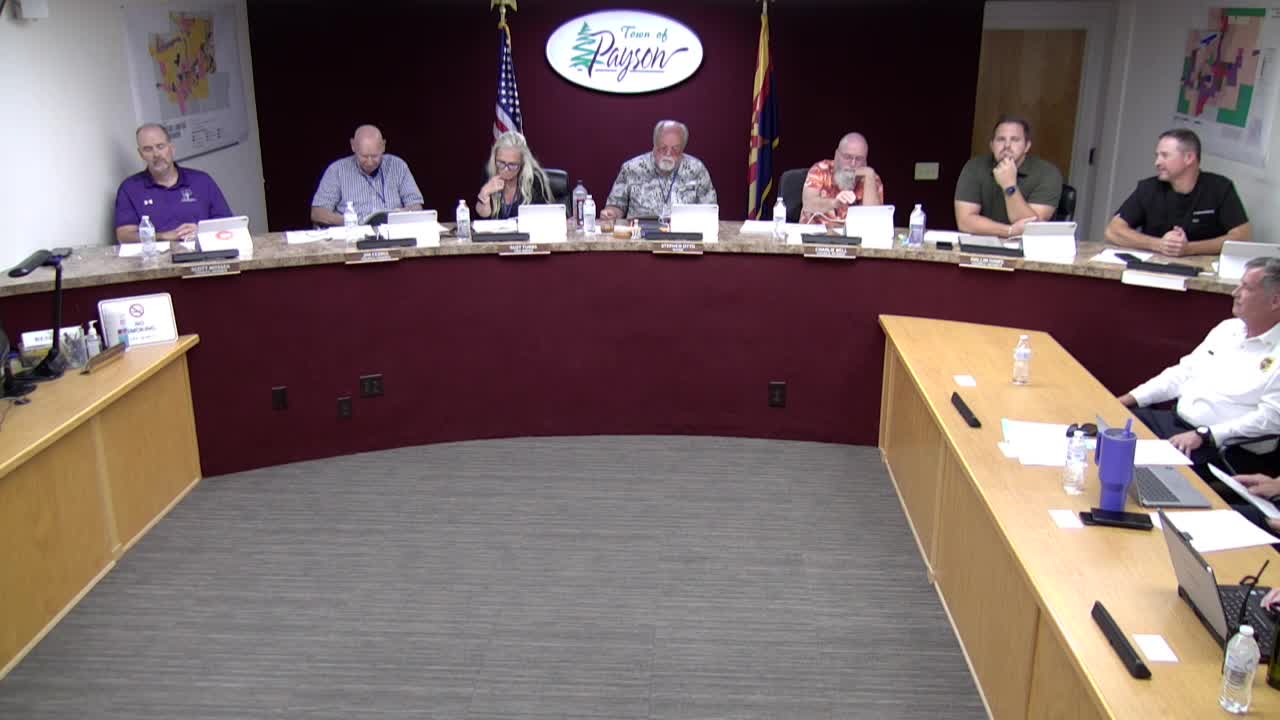
The Payson Common Council on Sept. 24 adopted a new wildfire structure hardening code aimed at reducing structure ignition during wildland-urban interface fires, approving Ordinance 970 on a 5-2 vote after extended public comment and council debate.
The ordinance, described by Assistant Fire Chief Kevin McCully and fire department staff as a performance-based package of building standards, applies to new construction and major remodels. It requires a combination of ignition-resistant materials and construction techniques—measures the staff described as a system that must be implemented together to be effective rather than piecemeal.
In a staff presentation, McCully summarized outreach to the building community and said town staff held a meeting with seven local contractors to discuss the draft code. He told council that eave protection and deck structure requirements were among the most contested items during those contractor meetings. McCully and staff cited research from the Insurance Institute for Business & Home Safety (IBHS) and local costing estimates to explain why the components were included: for a representative 2,600-square-foot house, staff estimated an added material cost of roughly $560 for fire-rated eave protection and about $700 for ignition-resistant deck structure; treated wood siding was described as about 37% more expensive than certain alternatives, and a manufactured-home “wooie package” figure of $1,800 was referenced for modular builders.
Local contractors and residents urged the council to delay or scale back the ordinance, arguing the measures would raise building and remodeling costs and that stricter enforcement of existing Firewise and defensible-space rules would provide broader community benefit. Several commenters, including contractors and a contractor’s letter read into the record, said many homeowners and builders had not been sufficiently informed about the proposal and worried the added cost could reduce housing affordability and slow remodeling work.
Council discussion focused on balancing wildfire risk reduction against building costs and community equity. Opponents on the council said they were not persuaded the ordinance would meaningfully reduce wildfire losses given the town’s existing fuels and defensible-space challenges, and asked for more precise local cost estimates and broader contractor buy-in. Supporters said structure hardening is one component of a risk-reduction strategy and that the town is land‑locked and will see infill and new development; adopting hardened standards for new builds and major remodels will gradually harden parts of the community over time.
After further debate, a motion to adopt Ordinance 970 passed 5 to 2. Dissenting council members said they were concerned about immediate cost impacts for homeowners and the adequacy of contractor outreach, while supporters said the ordinance reflected IBHS recommendations and local advisory-board input and would improve long-term community resilience.
The ordinance is set to take effect in accordance with the town’s ordinance-adoption schedule. Implementation will require building-plan review and ongoing inspections by town staff; staff said the town will continue enforcing fuels-management and defensible-space rules independently of the building code changes.