Get Full Government Meeting Transcripts, Videos, & Alerts Forever!
Get email alerts on the Erc Working Groups topic
No spam. Unsubscribe anytime.
Austin Ethics Review Commission debates scope and membership of working groups, focuses on complaint-process overhaul
Summary
Commissioners reviewed active and inactive working groups, discussed widening the complaint-process working group to a comprehensive review of complaint rules and procedures, and asked staff about membership rules and Open Meetings Act constraints.
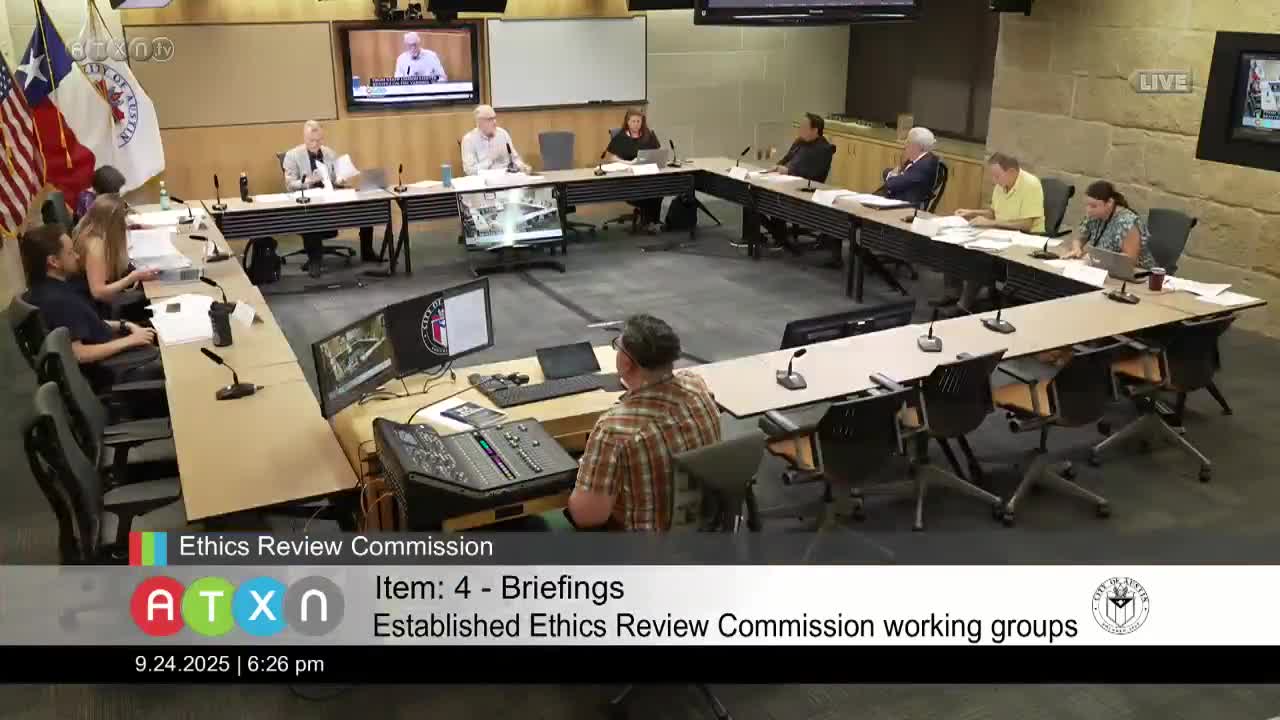
The Ethics Review Commission reviewed the status of its working groups on Sept. 24 and debated whether the working group that reviews the commission-initiated complaint process should be broadened to conduct a comprehensive review of ERC rules and the complaint procedures.
Lizette Menditez, staff liaison, presented a list of inactive and active working groups and described which groups had been disbanded because members left or terms ended. The commission reviewed three active groups: one to review the ERC complaint process (created August 2022), one to review and revise ERC bylaws (created August 2024), and one to review and revise ERC rules and regulations (created July 2025).
Commissioner Andrea Lowe, who said she has served since March 2023 and is the longest-serving commissioner, described the complaint-process working group’s original intent as a global review of the entire complaint process. Lowe said commission-initiated complaints must be considered in the context of how all complaints are processed so that respondents are treated equitably whether a complaint is commission-initiated, filed by a citizen, or comes from the auditor’s office. Lowe said the group’s work includes thinking about mechanisms needed to process complaints more efficiently and fairly, particularly when many complaints arrive around election times.
Commissioners asked how this mandate differs from the separate rules-and-regulations working group. Chair Ross Pumphrey and others said the apparent overlap may be a drafting issue in the agenda language and that the complaint-process working group is intended to focus on rules that affect complaints specifically, including prehearing procedures, filing requirements, and possible waivers or procedural additions not currently in the ERC rules.
Legal counsel reminded commissioners they must set formal membership for working groups and ensure membership stays below a quorum to avoid Open Meetings Act issues. Caroline Webster of the law department advised that working-group membership and outside consultants must be handled so that the commission does not inadvertently hold a meeting of a quorum outside public notice: “You do have to set the membership of the working group,” she said, and cautioned about the quorum rule because working groups are not subject to the Open Meetings Act.
Commissioners discussed whether to invite former commissioners to consult informally; staff advised that outside consultants or former members may speak to the working group or commission, but formal membership needs to be set at a public meeting and the membership size must be managed to avoid a quorum of the commission participating off the record.
Secretary Matern (absent from this meeting) had previously prepared materials and a flowchart that commissioners expect to see at the October meeting. Commissioners also reported that the bylaws working group has drafted proposals and will circulate them to the law department for review before another commission discussion.
Chair Pumphrey asked whether formal changes in membership or scope would be acted on under the agenda item; staff confirmed such changes can be taken under the item but are not required at this meeting. Menditez said inactive working groups will remain inactive unless commissioners request future agenda items to reconstitute or change them.
The commission did not record formal membership changes at this meeting; commissioners agreed to defer some updates and to continue the complaint-process discussion at the October meeting, when additional materials are expected.