Get Full Government Meeting Transcripts, Videos, & Alerts Forever!
Get email alerts on the Ethics Jurisdiction topic
No spam. Unsubscribe anytime.
Austin law department proposes code cleanup to clarify Ethics Review Commission jurisdiction
Summary
City law staff presented a draft ordinance to clarify which officials the Ethics Review Commission (ERC) may investigate, updating cross-references in city code after earlier amendments in 2019 and 2024; the commission discussed but did not record a formal vote.
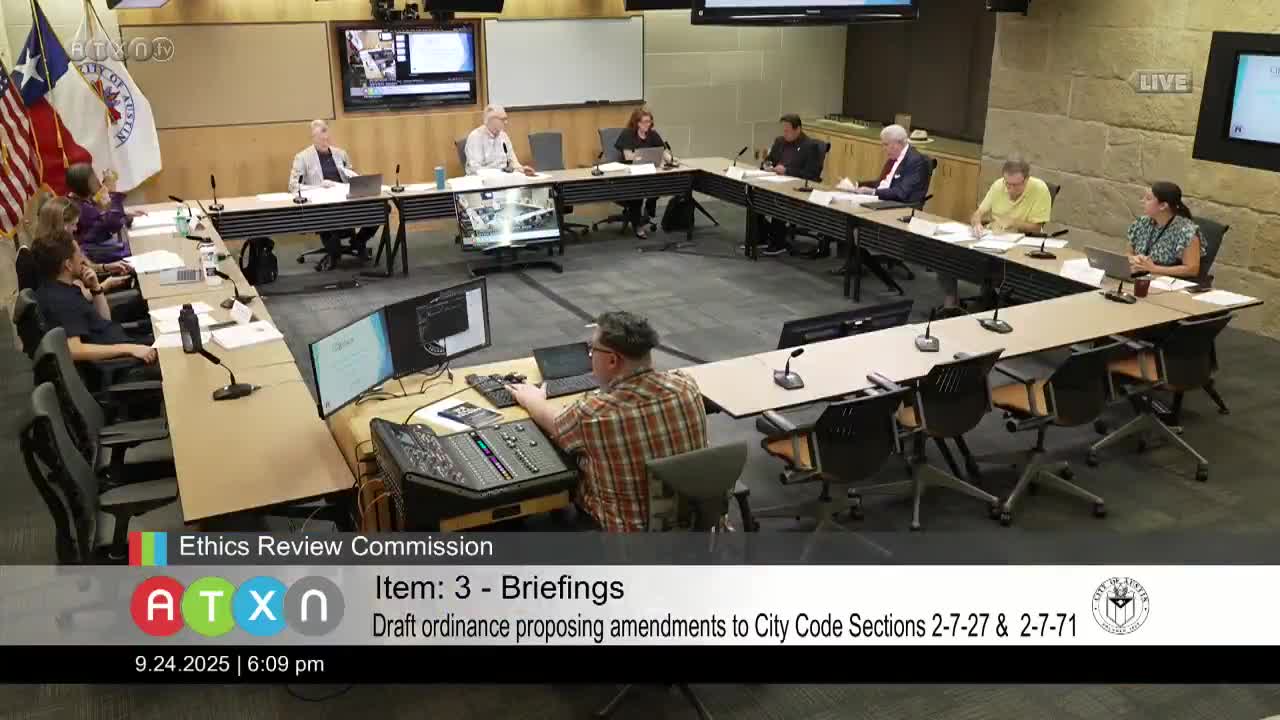
The City of Austin Law Department presented a draft ordinance on Sept. 24 to clarify references in city code about who the Ethics Review Commission may investigate, and commission members discussed the change and asked staff questions but did not record a formal vote.
The ordinance would revise City Code section 2-7-27 to state directly which officials the ERC may hear sworn complaints about instead of pointing readers to another section of code. The law department said the change is intended only to clarify jurisdiction after a 2019 amendment and a separate 2024 amendment to a related section left a cross-reference that is now outdated.
Caroline Webster, executive liaison for the City of Austin Law Department, said the proposed language would read, in part, that “the ethics review commission may only hear or initiate a sworn complaint alleging a violation of Article 4, the code of ethics, against a member of the city council or their direct staff, a person appointed by the city council pursuant to the city charter, or a person appointed by the city council to a city board, task force, or similar body.” Webster said the change restates existing limits on jurisdiction in a single place so readers need not flip to other sections of code.
Webster told commissioners the ambiguous cross-reference originated because section 2-3-5 was amended again in 2024 and a corresponding update was not made to 2-7-27. She described the proposed fix as a clarification, not an expansion of the ERC’s authority.
Jason Adavi, deputy city auditor, and Brian Lloyd, chief of investigations in the Office of the City Auditor, were present to answer questions. Lloyd said the auditor’s office does not anticipate changing how it investigates or which matters it refers; he told commissioners, “I don't anticipate any changes in how we operate, who we would investigate, and then whether we would follow our normal process.”
Commissioners asked how the change affects who must file statements of financial interest; Webster said the draft also changes section 2-7-71 to allow the city manager to identify affected positions through an administrative bulletin (rather than listing every title in code) and to add some designated positions such as members of the Community Police Review Commission and purchasing agents. Webster said that approach is intended to make the filing rules easier to read and maintain as job titles change across departments.
Commissioner Andrea Lowe asked whether the auditor’s office would conduct different kinds of investigations under the revision; Lloyd answered no and said the change merely clarifies who is covered in code. Commissioner McGovern said the clarification “is a huge improvement” for people administering the law and the public.
No formal motion or recorded vote on the draft ordinance appears in the transcript. Webster said the law department will move forward with the change in some form regardless of whether the commission adopts a formal recommendation; commissioners were invited to ask follow-up questions and provide feedback.
If adopted by City Council through the city’s formal ordinance process, the change would primarily affect where Austin residents and officials look in city code to determine whether an individual falls under ERC jurisdiction. The proposal does not, according to staff, alter the practical allocation of investigative responsibility between the auditor’s office and other city officials.
Details the commission discussed include that the small set of officials specifically listed in the proposed text would include the auditor, city clerk, municipal court judge (or their designee), municipal court clerk, members of the municipal civil service commission, planning commission members, and the city manager. Webster emphasized that department heads are not covered by ERC jurisdiction for Article 4 complaints as a result of prior code changes; those matters are handled by the auditor’s office and then routed according to 2-3-5 procedures.
The law department and auditor were available for follow-up questions; the item was not formally voted on at the meeting.