Get Full Government Meeting Transcripts, Videos, & Alerts Forever!
Get email alerts on the Land Use Rezoning topic
No spam. Unsubscribe anytime.
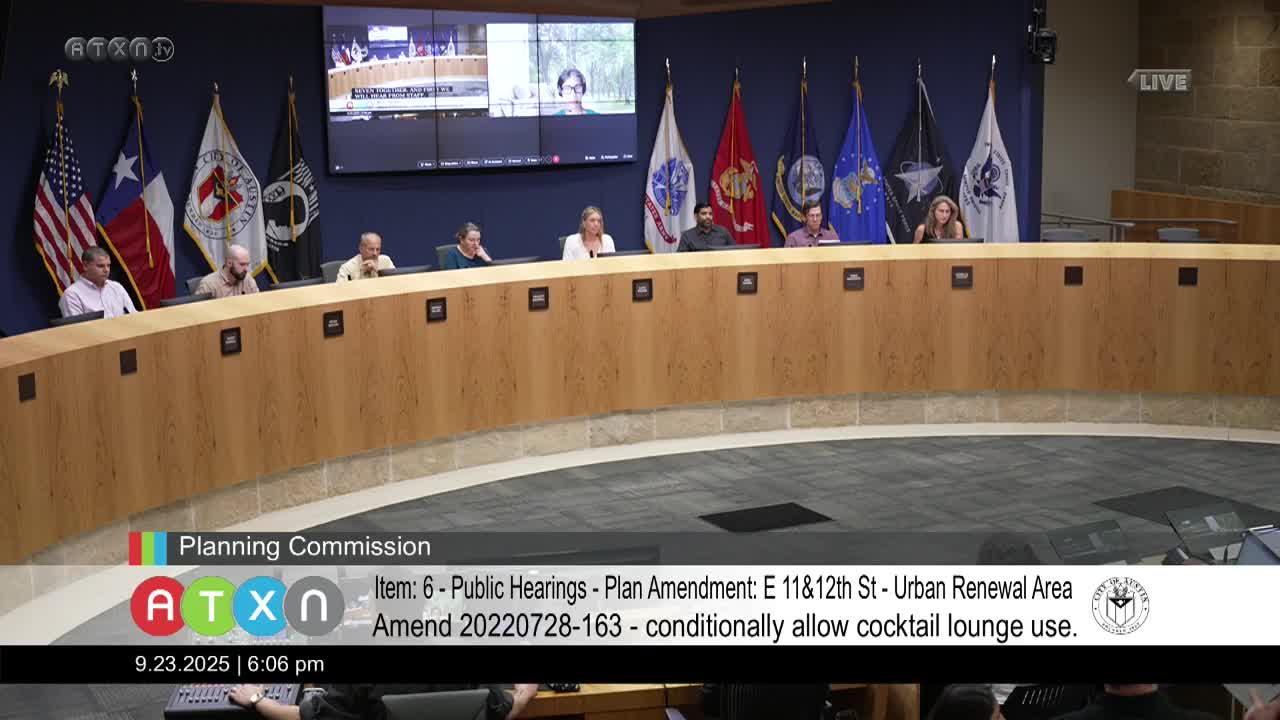
Planning commission sends cocktail-lounge rezoning request for 1201 East 11th Street to council without recommendation
Summary
A planning-commission-initiated request to restore a conditional cocktail-lounge entitlement for 1201 East 11th Street drew strong neighborhood opposition. After debate, commissioners failed to pass a motion to deny and allowed the case to move to City Council with no recommendation.
The Austin Planning Commission voted to send a planning-commission-initiated rezoning and plan-amendment request for 1201 East 11th Street to City Council without a recommendation after public testimony and debate.
The proposal, which would restore a conditional-use entitlement for a cocktail lounge at the site, was opposed by neighborhood residents, church leaders and social-justice groups who said the corridor already has many alcohol-serving venues and that another lounge would harm safety and neighborhood character. Planning staff recommended against the amendment, saying it would reverse a council decision from July 2022 that limited cocktail-lounge entitlements along East Eleventh Street.
Hunter Maples, housing department staff and liaison to the Urban Renewal Board, introduced the plan-amendment item and said the request would amend ordinance 20220728-163 and the East Eleventh and Twelfth Street urban renewal plan. Jonathan Tomko of the Planning Department summarized the rezoning case and noted the subject tract is about 8,832 square feet and currently contains a car wash. Tomko told commissioners staff did not recommend the requested change because it would effectively reverse council’s 2022 action that confined conditional cocktail-lounge entitlement to Blocks 16 and 18.
The property owner, Paul Stables, told the commission he sought “restoring my property entitlements for conditional use for a cocktail lounge” and emphasized that restoring the entitlement would not automatically create a lounge, but only allow him to apply for a later conditional-use permit. Stables described a multi-year process of changing positions among the Urban Renewal Board and staff about whether the 2022 ordinance intended to restrict cocktail lounges to Blocks 16 and 18.
Residents and representatives of nearby institutions urged denial. Francois Levy, a 20-year homeowner, said: “We do not want nor need another bar in our midst. Please deny the applicant's request to change what has already been established.” Elsa Rivera, chair of the pastoral council at Our Lady of Guadalupe Catholic Church, said the church sits a few blocks away and described earlier incidents she said raised safety concerns near the corridor. Fanny Akimbala of Ebenezer Baptist Church and Central Texas Interfaith said the site is near senior housing and a child-development center and added that approving the change would increase demand for police and parking enforcement.
During round-robin debate, Commissioner Ahmed moved to deny the applicant’s request; that motion received a second but failed on an initial 4–4–1 tally and then by the absence of a subsequent prevailing motion the commission allowed the case to advance to City Council without a formal recommendation. Commissioners who spoke against denial cited the procedural complexity of reconciling multiple versions of ordinances and the fact that a conditional-use permit — if granted later — would impose additional process and conditions before any lounge could open. Commissioners speaking for denial emphasized neighborhood testimony about safety, existing alcohol outlets, and staff’s legal interpretation of the 2022 council action.
No formal amendment or direction to staff was adopted. The case will appear before City Council for final action on the plan amendment and rezoning; the planning commission record will show no recommendation.
Planning staff documents cited ordinance 20220728-163 and the city’s Neighborhood Conservation Combining District (NCCD) language; the Urban Renewal Board and its 1999 plan and subsequent amendments figure in the background of the discussion.