Get Full Government Meeting Transcripts, Videos, & Alerts Forever!
Get email alerts on the Equestrian Overlay And Animal Keeping topic
No spam. Unsubscribe anytime.
Jurupa Valley holds workshop on expanding equestrian overlay and loosening animal-keeping rules
Summary
City planning staff and councilmembers led a public workshop on proposed changes to the Equestrian Lifestyle Protection Overlay and animal-keeping rules; staff will bring initiation of a general plan amendment and a zoning code amendment to City Council on Oct. 2 for potential next steps.
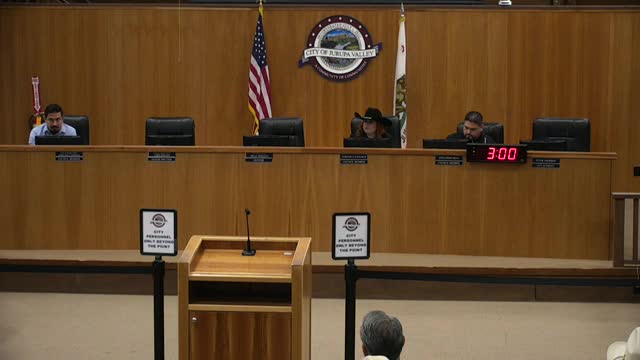
Jurupa Valley City Council staff held a public workshop to gather community input on proposed updates to the city's animal-keeping rules and expansion of the Equestrian Lifestyle Protection Overlay, with staff saying they will ask the City Council on Oct. 2 to initiate a general plan amendment and a zoning code amendment.
The planning presentation outlined a range of policy options, from an "open" approach that would allow more animals with best-management practices to a "protective" approach that would limit animals, increase setbacks and require conditional permits. Jim Petches, the city's principal planner, told attendees, "We're here to protect and strengthen Jurupa Valley's equestrian lifestyle."
Councilmembers and staff said the proposals are a multi-step effort that could include: expanding the overlay boundary (staff noted areas such as the Santa Ana River corridor and parts of the foothills), updating animal density and setback rules, adding consolidated development-standard tables for easier public reference, preparing a trail and connectivity improvement program, and identifying funding through the city's capital improvement program and annual budget.
Most important details
- Existing and example standards: staff said the city currently allows two animals per 20,000 square feet in some zones; horses must be 100 feet from a street and 20 feet from a property line under current rules. For poultry, staff gave examples of widely varying zone rules: some zones allow 4 hens (no roosters), others 12 hens (no roosters), and one inclusive zone (referred to in the presentation as "AD") was described as allowing up to 100 hens and 20 roosters.
- Policy options discussed: density options ranged from no numeric cap with best-management practices (an "open" model) to structured approaches (examples given: roughly 2 animals per acre) to protective models (example cited: one animal per 13,500 square feet). Setback options presented included an open 25-foot setback, a structured 35-foot setback, and a protective 50-foot-or-more setback. Permit approaches ranged from ministerial/minor-animal permits to tiered review processes and full conditional-use permitting.
- Process and next steps: staff described prior workshops on July 29 and Aug. 19 and said, if the City Council directs initiation on Oct. 2, staff will prepare draft ordinance language and environmental documents, hold an additional public workshop on drafts, then return to the Planning Commission and City Council for hearings and adoption.
Public comment and community input
Several residents praised the effort and urged protections for animals and traditional equestrian uses. Roberto Ramirez told the council in Spanish, "Muchas gracias... This was a great important day," and asked council and staff to reconsider some setback questions raised by Spanish-language respondents. Samuel Rodriguez said he had lived in the area for more than three decades and described the meeting as a positive reversal of prior enforcement pressure on livestock and birds. Reynaldo Gutierrez, who said he has lived in Mira Loma for 17 years, asked specifically for room in policy to allow roosters. Henry Escalera thanked councilmembers and staff for holding the event and encouraged continued public engagement.
Staff-run exercises at stations
Staff deployed four "policy menu" boards and an overlay expansion map and asked attendees to place dots to indicate preferences. Planners summarizing the exercises told the room that the most frequent responses favored the Santa Ana River corridor and the Indian Hills area for overlay expansion; the density and setbacks boards were dominated by "open" options (fewer numeric caps and closer setbacks), and many participants supported a minimum stall size (staff reported a commonly cited preference of 12-by-12 feet, with several participants favoring 16-by-16).
Other items mentioned
- Staff announced that the city recently approved permanent ready accessory building plans that include stables and barns; staff said homeowners may obtain those plans from the planning counter.
- Planners discussed potential equestrian infrastructure standards (trailheads, intersection improvements, shade/watering requirements, manure and runoff best-management practices), possible allowances for limited on-site farm sales, and beekeeping standards.
What was not decided
No ordinance or amendment was adopted at the workshop. The primary outcome of the meeting was public input collection; staff said they will present an initiation item to the City Council on Oct. 2 and will proceed with drafting only if the council directs them to do so.
Why it matters
Councilmembers who spoke emphasized that preserving equestrian uses is central to local identity and could be affected by developer interest and state laws. Councilmember Veronica Sanchez said she supports continuing the process and highlighted community traditions tied to equestrian uses. Staff and residents repeatedly urged continued, bilingual outreach and clearer Spanish translations of feedback materials.
Next steps
Staff will present the initiation of a general plan amendment and a zoning code amendment at the Oct. 2 City Council meeting. If the council directs, staff will prepare draft code language and environmental review, then return for further public workshops and hearings.