Get Full Government Meeting Transcripts, Videos, & Alerts Forever!
Get email alerts on the Buc Ees Development topic
No spam. Unsubscribe anytime.
Residents demand clarity and safeguards for Buc‑ee’s project in Boerne, cite traffic, environmental and contract concerns
Summary
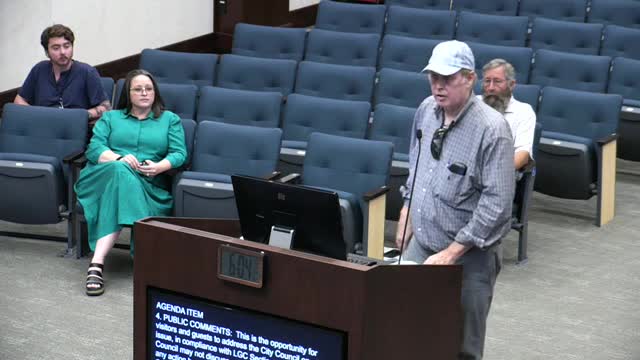
Dozens of residents used the public‑comment portion of the Boerne City Council’s Sept. 23 meeting to press elected officials for clearer, written terms and stronger safeguards for the long‑planned Buc‑ee’s travel center, raising questions about inconsistent project figures, potential environmental and public‑safety impacts, and whether the developer retains vesting rights under the city agreement.
Dozens of residents used the public‑comment portion of the Boerne City Council’s Sept. 23 meeting to press elected officials for clearer, written terms and stronger safeguards for the long‑planned Buc‑ee’s travel center, raising questions about inconsistent project figures, potential environmental and public‑safety impacts, and whether the developer retains vesting rights under the city agreement.
The speakers’ concerns focused on four central uncertainties: how many fuel pumps Buc‑ee’s will install, how much fuel will be stored on site, whether heavy trucks will be allowed to refuel, and whether additional retail pads will be developed — all items residents said appear inconsistently across the 2016 contract, city staff comments and a September traffic study.
"Nine years into this deal, citizens still do not know what Buc‑ee’s intends to build," said Lance Kyle, a Boerne resident, summarizing a list of discrepancies. Kyle cited differing counts given by the contract and staff: "The 2016 contract says at least 90" pumps; city staff told residents this summer a figure of 100; Kyle said he later heard 110 and that the September traffic study uses 140. He repeated the meeting refrain: "Citizens of Boerne deserve to know."
Why the questions matter: the number of pumps affects fuel‑storage volumes and traffic modeling. Speakers offered back‑of‑envelope calculations — noting that daily filling for 90 pumps could mean about 100,000 gallons on site while more frequent deliveries to support 140 pumps could raise that amount considerably — and said the disparity matters for spill risk, stormwater runoff and long‑term monitoring.
Several residents also disputed how the contract treats heavy‑duty fueling. "The city says fueling of 18‑wheelers are permitted or are prohibited except delivery trucks. The contract says only that fueling of 18‑wheelers will not be promoted. That's not prohibition," Kyle said, adding: "The difference is a big one. Citizens of Boerne deserve to know."
Legal and vested‑rights questions were raised in detail by Paula Reicher, who asked the council to review the economic development agreement and seek independent legal advice. Reicher read contract language she said appears to "waive any statutory claim under chapter 245 of the Texas Local Government Code," and argued the city has provided inconsistent messages about which ordinances would apply if a vesting date were set at 2016, 2019 or not at all.
"If the language in the Buc‑ee’s contract about waiver of vested rights was long established, why do city emails of just two years ago reflect that it was far from settled which ordinances applied?" Reicher asked the council, urging an outside attorney to opine on the contract’s legal effect.
Other speakers emphasized neighborhood and quality‑of‑life impacts. Sue Eklund cited traffic delays she’s observed at Buc‑ee’s locations elsewhere and raised concerns about oversized signage and light pollution, saying, "We are a dark sky area... I moved to Boerne 16 years ago, and when I walked out of my house at night, I could see the Milky Way. I can no longer see the Milky Way." Brenda Liao said a Buc‑ee’s at the town’s main entrance could "take away a lot of the character of Boerne." Alex Rudd warned of potential air‑quality and groundwater risks, referencing benzene and other volatile organic compounds and noting his view that the project resembles "an industrial center" rather than a typical gas station.
Neighboring homeowners asked the council to require physical separation and security measures. "I respectfully request that the city require a concrete or block wall comparable to the wall behind Bernie's HEB, which stands at 8 feet 3 inches," said Christie Ackerman, who also asked for security signage and clearer commitments on police presence. Ackerman said a planned donation of a 9‑acre preservation parcel would transfer maintenance and security responsibility to taxpayers unless the contract obligations are enforced by the developer.
What the council did (and did not do): the comments occurred under agenda item 4 (public comment). Council members did not debate or vote on new restrictions during the public‑comment period; the record shows council later went into an executive session to consult with the city attorney on compliance with existing economic development agreements (Tex. Gov. Code §551.071). No new motions or formal changes to the developer agreement were recorded in open session on Sept. 23.
Clarifying details raised during comments included: the 2016 contract minimum of 90 pumps; staff references to 100 and 110 pumps; a traffic study citing 140 pumps; a previously contested 75‑foot sign; and a referenced 20‑year agreement length. Residents said city emails as recently as 2023 showed staff disagreement over whether vesting rights had been waived or what vesting date applied.
The council did not take formal action on Buc‑ee’s at the Sept. 23 open meeting. Residents asked the council for a written, public accounting of project specifications, a binding list of developer commitments, independent legal review of the contract’s vesting language, and stronger physical and security protections for neighboring properties. The council moved the item to executive session for attorney consultation and left no on‑the‑record decision about next steps in open session.
Ending: Residents asked for prompt, written responses to their records requests and for the city to put "guardrails" in place; council members acknowledged the concerns and placed legal consultation in closed session. The matter remains active and is expected to return to the public agenda only after staff and the city attorney provide a legal and factual update.