Get Full Government Meeting Transcripts, Videos, & Alerts Forever!
Get email alerts on the Housing Single Room Occupancy topic
No spam. Unsubscribe anytime.
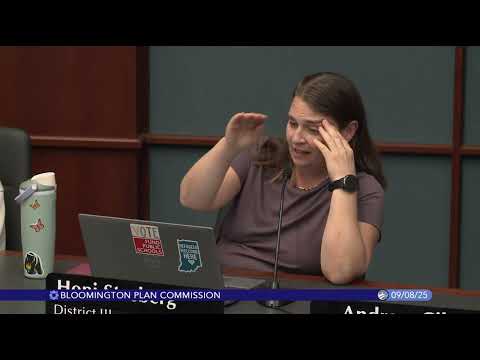
Plan Commission forwards single-room-occupancy UDO amendment to City Council after limiting changes
Summary
The Bloomington Plan Commission on Sept. 8 voted to forward to the Common Council a proposed amendment to the Unified Development Ordinance that would add a single-room-occupancy use, with several amendments to limit potential impacts on single-family neighborhoods.
The Bloomington Plan Commission on Sept. 8 voted to forward to the Common Council a proposed amendment to the Unified Development Ordinance that would add a single-room-occupancy use, with several amendments to limit potential impacts on single-family neighborhoods.
The commission voted 6–1 to forward ZO-03-25 to the council with a favorable recommendation. Commissioner Molly Holmes cast the lone no vote. The motion to forward followed adopted amendments that (1) revised the SRO definition to describe a “residential building where individuals rent individual bedrooms,” (2) replaced the word “room” with “bedroom” in six locations in the use-specific standards and related table entries, and (3) changed an earlier draft phrase from “facility” to “building.”
The department’s presentation said the version sent to council reflects council direction to the planning commission, and staff described the draft as “the best attempt” to accomplish the council’s goals while limiting unintended impacts. Eric Grulich, development services manager, said the amendment responds to a council resolution directing the planning commission to propose SRO standards, including whether to allow SROs in additional districts and whether owner occupancy should be required. Grulich noted the legal office advised against requiring nonprofit ownership and said staff removed that requirement from the draft.
“We are proposing a maximum of three rooms per SRO and keeping the proposed number of adults per room at two,” Grulich said, explaining that the change was intended to follow the council’s instruction while reducing potential for unintended conversions into high-occupancy, investor-owned rental properties.
Commissioners debated several points during the public hearing. Commissioner Stossberg asked that a previously adopted change — to list parking maximums “per bedroom” rather than “per guest room” — be retained in the record. Commissioner Seabor and others pressed staff on whether “room” should be clarified to mean a bedroom with required egress and other building-code attributes; Anna Killian Hansen, director of Housing and Neighborhood Development, told commissioners that building-safety inspections rely on a clear bedroom definition for egress, smoke-detector placement and other safety standards.
Members of the public offered mixed views. Wendy Briescht said she has seen owner-occupancy provisions be difficult to enforce and predicted investors would still convert houses into high-rent multi-bedroom rentals. “I don't see how you can possibly do that,” she said of enforcing owner-occupancy. Chris Derbaum recommended adopting the HUD standard of one adult per bedroom to better target affordability; he argued one-person-per-bedroom would make SROs more likely to serve lower-income residents rather than investors. Isabel Piedmont Smith (Bloomington City Council, District 1) argued the draft aligns with several Comprehensive Plan goals on housing diversity and proximity to services and said allowing two people per bedroom could increase affordability for some households, including couples and low-income students.
Staff and commissioners noted several limits and safeguards in the draft. The proposal retains an owner-occupancy requirement (the owner must live on the property), keeps SROs as a conditional use in the listed residential districts, and does not create an automatic waiver process for applicants with prior notices of code violation because staff could not identify legally defensible waiver criteria. Grulich said the council had extended the resolution’s timeline by 60 days and that the extension would expire before the next commission meeting, making action at this hearing time-sensitive.
Commissioner Bell offered a package of amendments that replaced the word room with bedroom in the definition and in the use-specific standards (a total of six locations), and the commission approved that amendment by roll call. An earlier amendment changing “facility” to “building” in the definition was also approved earlier in the hearing. After debate, the commission voted to forward the amended text to council with a positive recommendation (roll call: Burrell — yes; Seabor — yes; Korotke — yes; Holmes — no; Kinsey — yes; Stossberg — yes; Whistler — yes).
The commission’s recommendation does not enact the changes; the council must still consider the ordinance and any further amendments. Staff noted that some implementation and enforcement functions — such as inspecting whether a sleeping area meets the building-safety definition of a bedroom — fall under Title 16 enforcement cycles and occur through inspections or complaint-driven investigations, not continuous monitoring.
What the amendment would do
- Create a defined single-room-occupancy (SRO) use in the UDO described as a “residential building where individuals rent individual bedrooms” and requiring shared common facilities (kitchen, bathroom, common area). - Limit the number of bedrooms in the single-family districts to a maximum of three bedrooms per converted residence (as reflected in the use-specific standards), with no numeric cap listed for some multifamily districts in the current draft. - Allow up to two adults per bedroom under the proposed use-specific standards. - Keep SROs as a conditional use in the listed zoning districts; applicants must follow the conditional-use process.
What the commission did not adopt or could not require
- Staff removed a nonprofit-ownership requirement after legal review noted likely challenges. - The draft does not include a legally defined waiver process for applicants with prior notices of violation; staff said they lacked defensible, objective waiver criteria. - The draft does not mandate affordability covenants; public comments and staff noted Indiana law limits the city’s ability to require affordability for many private rental conversions.
Why it matters
Supporters said the change would broaden housing types and could create more lower-cost options by allowing renting by room rather than by whole-unit leases. Opponents warned the changes could accelerate investor conversions of older single-family houses into higher-rent, multi-bedroom rentals and said owner-occupancy will be difficult to enforce. City staff and commissioners stressed that conditional-use review and building-code inspection remain tools to address safety and neighborhood impacts.
Next steps
The Plan Commission forwarded ZO-03-25, as amended, to the Common Council with a favorable recommendation. The council will consider the ordinance and any further edits. Staff urged the commission to act because the council-provided extension of the directing resolution will expire before the next commission meeting.