Get Full Government Meeting Transcripts, Videos, & Alerts Forever!
Get email alerts on the Water Rates topic
No spam. Unsubscribe anytime.
City of Bloomington Utilities board approves 30.5% water rate increase and recommends $71 million bond authorization
Summary
The Utility Service Board voted to recommend a 30.5% adjustment to water rates and to authorize up to $71 million in bonds to fund capital projects including plant upgrades, mains replacement and a new service center; the Indiana Utility Regulatory Commission must still approve the plan.
The City of Bloomington Utility Service Board on Sept. 20 voted to approve Resolution 2025-16, recommending a 30.5% increase in water rates, and to approve Resolution 2025-17, authorizing up to $71 million in bonds to finance capital improvements. Both measures were approved by voice vote and will be submitted to the Indiana Utility Regulatory Commission for final approval.
City Utilities Director Catherine Zager introduced the proposal and said the board’s recommendation is based on a cost-of-service study conducted with consultant Stantec. "CBU staff feels confident that the cost of service study approach has resulted in one of the most accurate data-driven water rate assessments that this utility has had to date," Zager said.
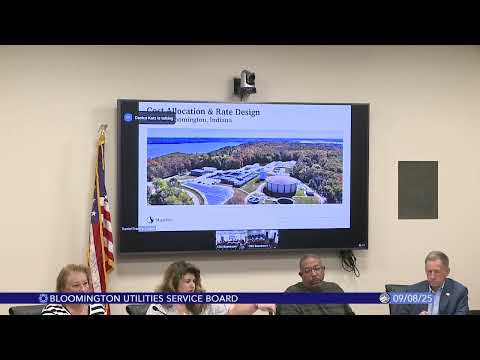
Stantec principal Danica Annika Katz described the study’s methodology, saying the consultant analyzed 2024 operational and AMI billing data to allocate the utility’s $29.1 million revenue requirement across customer classes and demand factors. Katz said the study produced a recommended reallocation that yields an overall 30.5% revenue increase; residential customers would see an 18.9% increase under the proposed design.
The rate design includes a cap on irrigation increases to limit "rate shock": irrigation charges were capped at four times the overall increase to move that customer class closer to cost of service while moderating immediate impacts. The study also consolidates the commercial and industrial customer classes into a single general service class because of small industrial counts and similar demand characteristics.
Zager and consultants laid out how the rate change will fund a multi-year capital program. Zager said planned water treatment plant projects total $30.7 million (electrical upgrades, sediment-basin rehabilitation, chemical building work, feed-line replacement and other reliability projects). Distribution-system projects total $34.4 million and include booster-station and storage-tank rehabilitations, emergency generators and water-main replacements. The utility also anticipates spending about $18.7 million on the water portion of the proposed Winston Thomas service center.
City Legal representative Chris Wheeler and bond counsel Brad Pittman (Barnes & Thornburg) briefed the board on financing. Pittman said the bond authorization is a companion to the rate proposal and that the board’s recommendation would let the council adopt an ordinance and then seek IURC approval. The resolution authorized a maximum of $71 million with two anticipated series (one in 2026 and one in 2028), each with separate 20-year maximum terms.
Board members asked about the IURC process and the possibility of removing municipal utilities from IURC jurisdiction in future. Wheeler said the city can pursue removal but that in this rate case staff considered staying under the IURC as prudent; he explained trade-offs such as the IURC/OUCC review role and customer protections. Board members also discussed risk of the IURC approving less than the requested increase and the effect on project timing; staff said if the full request is not approved the utility would prioritize maintenance and plant reliability projects based on an existing business-risk prioritization.
Votes and next steps: the board approved the rate-adjustment recommendation (Resolution 2025-16) and approved the finance-bond resolution (Resolution 2025-17) by voice vote. Both items will be forwarded to city council and to the Indiana Utility Regulatory Commission for consideration. Consultants and staff indicated they will include the Stantec cost-of-service materials and supporting documentation with the IURC filing.
The board’s action funds a capital program intended to address aging electrical and mechanical systems at the treatment plant, restore a sustainable fluoride delivery feed line, add emergency generator capacity, and accelerate water-main and valve replacement work. Staff and consultants said the proposed program represents catch-up investments identified in a Wessler business-risk assessment and a five-year capital-improvement plan; staff noted there is limited buffer for additional projects beyond the prioritized list.
The board’s approval was a recommendation; the IURC must approve both the rates and any bond issuances before they take effect.