Get Full Government Meeting Transcripts, Videos, & Alerts Forever!
Get email alerts on the Pensions Gers topic
No spam. Unsubscribe anytime.
Senate committee advances bill letting GERS retirees return to UVI payroll while keeping annuities
Summary
The Committee on Government Operations voted to forward legislation that would allow Government Employees Retirement System (GERS) retirees to take paid positions at the University of the Virgin Islands while continuing to draw their GERS annuity if they enroll in a different university retirement plan.
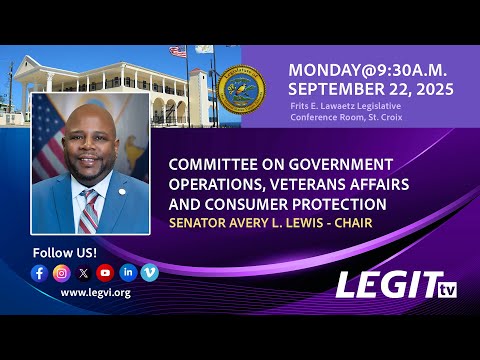
The Committee on Government Operations, Veterans Affairs and Consumer Protection voted to favorably report Bill No. 36‑0061 on Sept. 22, 2025, clearing the way for the measure to go to Rules and Judiciary. The bill would amend Title 3 of the Virgin Islands Code so retirees receiving a GERS annuity who later accept employment at the University of the Virgin Islands (UVI) could continue to collect their annuity while receiving a UVI salary if they enroll in an alternative university retirement plan.
Why it matters: Sponsors and witnesses said the bill opens opportunities for experienced faculty and technical staff to return to the territory’s only public university without losing retirement income, a recruiting tool the campus says it needs.
Administrator Angel E. Dawson of GERS testified the change “would merely extend” an existing carve‑out already available to UVI employees and that GERS “expresses no opposition at this time.” UVI President Sophia A. George told the committee the university currently has three employees directly affected by the restriction and “strongly support[s]” the amendment because it would allow those retirees to contribute while planning their finances.
Committee discussion focused on administrative and actuarial implications. Dawson said GERS would be able to track return‑to‑work service under existing procedures but noted the bill as introduced limits the UVI carve‑out to a four‑year return period; government‑wide law currently allows a six‑year return window. Dawson warned that differing time ceilings would increase administrative monitoring but called the challenge “not insurmountable.” On fiscal risk, Dawson and President George both said the measure should be actuarially neutral if it remains a university‑specific carve‑out.
The sponsor, Senator Carla J. Joseph, said the bill responds to real cases in which retirees were discouraged from rejoining the workforce by uncertainty over retirement treatment and urged passage to strengthen UVI’s recruiting for technical and medical education positions. After a roll call, the committee voted 7–0 to approve the bill and forward it to Rules and Judiciary.
What happens next: The measure will be considered by the Rules and Judiciary Committee and then, if approved, by the full Legislature. The motion reported to the committee text and a recorded favorable vote were entered into the hearing record.
Notes and context: Committee members asked for confirmation of vesting rules and any salary caps that might apply when a retiree returns to service; President George said vesting for TIAA is not required and that UVI’s vesting for GERS occurs after 10 years of credited service. Administrator Dawson provided an approximate figure that about 50 retirees currently return to government service across the territory.