Get Full Government Meeting Transcripts, Videos, & Alerts Forever!
Get email alerts on the Urban Forests topic
No spam. Unsubscribe anytime.
Residents urge $3 million urban-forest acquisition fund in 2026 budget
Summary
Dozens of residents, conservation groups and neighborhood leaders urged the Indianapolis City-County Council to dedicate $3,000,000 in the 2026 budget to acquire and protect at-risk urban forests across Marion County, arguing trees reduce stormwater costs, cool neighborhoods and preserve habitat.
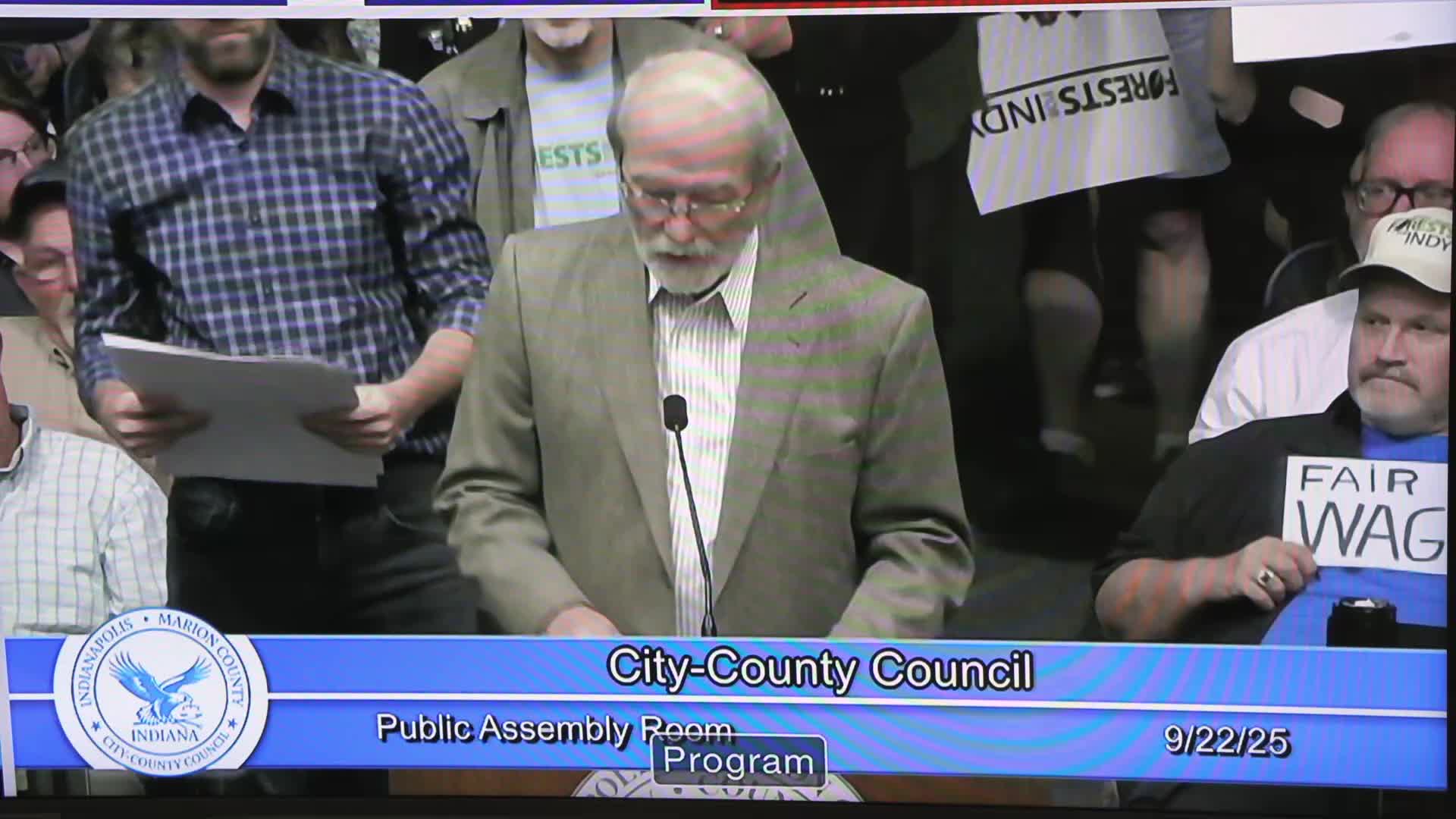
Dozens of residents and conservation advocates told the Indianapolis City-County Council during a public hearing on the 2026 budget that the city should dedicate $3,000,000 to buy and preserve remaining urban forests in Marion County.
Speakers from the Indiana Forest Alliance, Forest for Indy, Forest for All and neighborhood groups described steady canopy losses and urged the council to convert previously set-aside funds into a permanent, nonreverting urban-forest acquisition fund. "Without investment from the city, forests that belong to us all will remain near worthless to owners and we will continue to lose this vital green infrastructure to development," said Jonathan Munro, speaking on behalf of Forest for Indy.
Advocates said recent inventories show canopy cover falling from roughly 32% (2014 imaging) to about 27% countywide and singled out properties they said are at immediate risk, including the East Side Flatwoods, I‑70 Woods, Haverstift/Havers Creek site and Goose Creek Woods. "These lands, if lost, are gone. Forests don't grow overnight," said Elizabeth Mahoney, board president of the Indiana Forest Alliance and River Park Club Neighborhood Association.
Speakers emphasized the ecosystem services urban forests provide — stormwater absorption, temperature moderation, wildlife habitat and public-health benefits — and framed the $3,000,000 request as a modest fraction of the city's budget. "This fund would pay the city back in stormwater control, cleaner air and water, a cooler city, and improved public health in perpetuity," Mahoney said. Multiple speakers noted that $3,000,000 was set aside in the prior budget cycle but not secured and urged the council to make the appropriation permanent.
Supporters also described local examples of conserved forestland and new parks, including a 25‑acre Sargent Road Nature Park in one speaker's district, to illustrate public benefits and property-value gains. Several speakers appealed to the council to act quickly because owners are actively marketing parcels for sale and development. "Timing is critical. Once a forest is cleared, the canopy and the ecosystem it provides are effectively lost for generations," said Elliot Burger, an Irvington resident and consultant to Forest for All.
Speakers who described personal or neighborhood experience with the sites urged councilors to prioritize purchases on the most threatened parcels and to authorize coordination between the mayor's office, Department of Public Works and local conservation partners for acquisition and stewardship.
No formal council action was recorded on the proposal during the hearing; the public-comment period on the budget continued to other municipal corporation budgets after the remarks concluded.
The public hearing record will remain open as the council proceeds through budget deliberations; speakers asked that the council reallocate or secure funds so the city can act to preserve at‑risk forest parcels.