Get Full Government Meeting Transcripts, Videos, & Alerts Forever!
Get email alerts on the Mental Health Facility topic
No spam. Unsubscribe anytime.
County staff says merged department will oversee Miami behavioral‑health facility; board discusses forensic waits and housing needs
Summary
County staff announced that Community Action Human Services and Juvenile Services will merge under a licensed social worker to oversee the county mental‑health facility project; board members raised concerns about forensic wait lists, transitions from state hospitals and the need for supportive housing and community placements.
County staff updated the Miami‑Dade Behavioral Health Advisory Board on Sept. 22 about the status of the proposed county mental‑health facility and next steps for service start‑up and licensing.
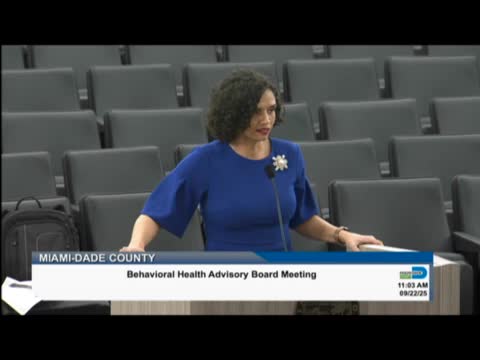
Kathy Burgess Burgos, who said she will oversee the merged department, told the board the Community Action Human Services and Juvenile Services departments will merge and that the merged entity will manage the mental‑health facility project. “This department will continue to oversee the mental health facility, the project as a whole, and we will also really focus on streamlining clinical services locally,” Burgess Burgos said.
Burgess Burgos told the board the building can begin programming for crisis, short‑term and long‑term services once the item passes and licensing is completed; she said the facility would require finishing work — notably a kitchen and build‑out of the seventh floor — but that meals can be delivered in the interim. She estimated that, if licensing and procurement proceed without delay after approvals, the county could set up programming within roughly six months.
Board members used the update to highlight higher‑level system gaps. The public defender said the county and state face a growing backlog of people found incompetent to proceed; those individuals are often held in jail while waiting for state forensic placement, he said, and urged the county to explore prioritizing placements and engaging the state to address the backlog. Several board members urged use of the facility and related community placements to support forensic diversion and step‑down capacity from state hospitals.
Board members and county staff also discussed the shortage of supportive housing and the need for community placements that would allow patients to step down from inpatient settings into residential programs. County staff said state dollars exist for a residential Level‑1 unit intended for forensic discharges but that local providers currently operate at Level‑2; staff said discussions are underway with managing entities about whether a Level‑1 unit can be operated at or near the Miami facility.
Why it matters: the facility and the merged department are intended to expand clinical capacity and create more local options for people leaving crisis settings; board members emphasized the need to align the facility with statewide forensic diversion and community housing needs.
Board members requested further briefings on data related to the county’s forensic wait list and on how the facility’s services would be prioritized for people in the criminal justice system or transitioning from state hospitals.