Get Full Government Meeting Transcripts, Videos, & Alerts Forever!
Get email alerts on the Factory Built Housing topic
No spam. Unsubscribe anytime.
Maui committee debates factory-built housing rules after wildfire; vote fails and item deferred
Summary
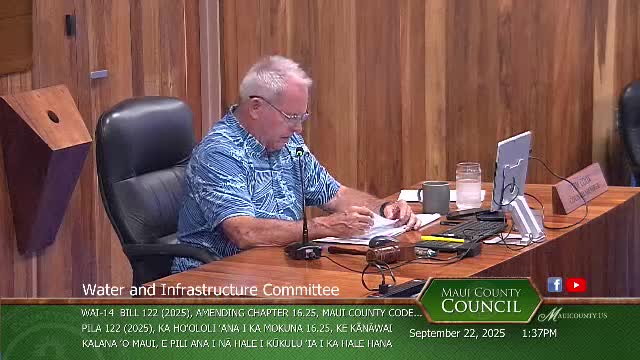
The Water and Infrastructure Committee on Sept. 22 considered Bill 122, an ordinance to allow and regulate factory-built one- and two-family homes in Maui County, including third‑party factory inspections and deputizing out‑of‑county inspectors.
The Water and Infrastructure Committee on Sept. 22 considered Bill 122, an ordinance amending Chapter 16.25 of the Maui County Code to create a framework for design, manufacture, installation, inspection and transportation of factory-built one- and two-family housing. The committee heard technical testimony and public comment, questioned Public Works Director Jordan Molina about inspection and certification procedures, and ultimately did not advance the bill; the chair asked that the item be deferred for additional review.
Committee Chair Tom Cook opened the discussion by summarizing the bill’s purpose: “Bill 122 creates a framework to allow factory built housing in Maui County in a safe, regulated, and consistent way. It sets standards for accountability, code compliance, and oversight while creating a pathway for more housing supply.”
The bill focuses on permanent, site-permitted one- and two-family dwellings built off-site in factories and shipped to Maui. Director Jordan Molina told the committee the department developed the proposal largely in response to the wildfire recovery effort and the arrival of many temporary units: “There’s a lot of interest in trying to make some of these temporary ones become permanent... how do we manage inspections that are not being conducted on-site by our building staff.” Molina said the ordinance would authorize certified third‑party inspection agencies to inspect factory production and would allow the county to deputize inspectors from other Hawai‘i counties to perform those factory inspections.
Molina described key features the bill would create: a process to approve a factory’s quality assurance manual, minimum accreditations for third‑party inspection agencies and individual inspectors, and a design‑registration pathway so commonly used plans can be reviewed once for repeat use. He said the county would still require on-site permits and on-site inspections for foundations, utility connections and final occupancy; off-site factory inspections would cover concealed work performed in the factory (electrical, plumbing and other work that would otherwise be inspected on-site before walls are closed). “The review that was undertaken was limited to water service, waste water service, and mainly electrical service,” Molina said of prior temporary deployments, “but a lot of those were not built as intended to be built as meeting Maui County building codes.”
Council members pressed the director on several operational points. Committee members confirmed the bill as drafted would apply to first users of factory-built one- and two-family dwellings, would rely on the county’s adoption of the ICC-based Maui building code (2018 IBC currently cited), and would not automatically make previously deployed temporary units permanent unless adequate factory inspection records were supplied. Molina said the department has been working with FEMA and vendors to collect manufacturing and inspection documentation for the Kilohana site and other FEMA-provided units and that “we feel comfortable that what they’re able to produce is sufficient for us to be able to issue building permits.” Later in the hearing committee members and staff estimated roughly 167 units at the Kilohana site; Molina said FEMA had produced vendor documentation that the county was reviewing.
A member of the public identifying themselves with the Royal House of Hawaii testified in opposition, calling the ordinance “not at all legal” and arguing it raised questions about Native land titles and long-term effects on local communities. The chair clarified the bill addresses building and permitting processes, not land ownership.
A disputed provision initially required verification that a factory be located in the United States. Council member Gabe Johnson moved to remove that clause; the amendment was seconded and passed on roll call (4 ayes, 3 noes, 2 excused). Molina told the committee the U.S.-only language had been intended to limit early implementation to products built under code regimes the county had more experience with, and he said the administration had “no objections” to removing that restriction to allow broader sourcing.
Several members expressed concerns before voting on whether to advance the bill out of committee. Issues raised included: how third‑party inspectors will be certified and monitored; how a factory’s quality assurance manual would be reviewed and recertified (Molina described a three‑year recertification threshold for factories, subject to factory inspection schedules); how shipping costs and tariffs could affect affordability; whether owner‑builder rules apply to factory-built units (Molina said the bill’s definitions and licensing requirements limit owner-builder construction of factory units); and how the county would ensure compliance with prevailing-wage or procurement rules for government purchases of factory-built structures.
A motion to pass Bill 122 out of committee was moved by Council member Paulton and seconded by Council member Keanu Rollins Fernandez. The roll call vote on the main motion was 4 ayes (Senensi, Rollins Fernandez, Paulton, Johnson), 3 noes (Ou Hodgins, Coma, Chair Cook), with Council Chair Alice Lee and Committee Vice Chair Yukili Sugimura excused; the motion did not reach the threshold to pass and thus failed. After the votes, Chair Cook said he did not want the proposal to die and asked members if there were objections to deferring the measure for additional review; there were no objections and the item was deferred for further committee consideration.
What the bill would change
- Scope: focuses on one- and two-family dwellings (design registration for repeat plans, plus site‑specific reviews required). - Inspections: establishes use of accredited third‑party inspectors for factory production work; authorizes the county to deputize inspectors from other Hawai‘i counties; requires a factory quality assurance manual and ongoing oversight. - Site review and permits: on-site permits and inspections remain required for foundations, utility connections and final occupancy; factory inspection reports would substitute for on-site inspections of concealed work. - Temporary units: units brought to Maui under emergency temporary permitting (such as FEMA‑deployed Kilohana units) are not automatically converted to permanent status without documentation that satisfies the county; Molina said the department is working with FEMA to gather those records.
Votes at a glance
- Amendment (remove U.S.-only factory verification): moved by Council member Gabe Johnson; seconded. Outcome: passed (4 ayes, 3 noes, 2 excused). - Motion to pass Bill 122 out of committee: moved by Council member Paulton; seconded by Council member Keanu Rollins Fernandez. Outcome: failed (4 ayes, 3 noes, 2 excused).
What happens next
Chair Cook asked that the item be deferred for additional review rather than be filed; staff confirmed deferral (not filing) would keep the bill active on the committee’s agenda. Committee members asked for additional information on certification standards for third‑party inspectors, potential cost and tariff impacts on affordability, and how the department would handle any factory recertification or spot‑checking process. The department said it will continue work with FEMA, DHHL and mainland vendors to assemble documentation and prepare implementation details for future committee hearings.
Reporting notes
Quotes in this article come from the meeting transcript and are attributed to speakers who spoke on the record. The assembly discussed real-world costs and examples (e.g., Kilohana unit counts, shipping cost estimates and illustrative per-square-foot figures) as approximations; where specific dollar amounts or counts were offered in testimony, the article reports them as stated by speakers. No facts have been added beyond what was raised in the committee record.