Get Full Government Meeting Transcripts, Videos, & Alerts Forever!
Get email alerts on the Police Use Of Force topic
No spam. Unsubscribe anytime.
Expert review and APD propose consolidated use‑of‑force policy, emphasize supervisor role and de‑escalation training
Summary
An external researcher and Austin Police Department staff briefed the Public Safety Committee on proposed consolidation of APD use‑of‑force policies, expanded ICAT de‑escalation training and renewed emphasis on first‑line supervisors; staff also reported work to clean and automate annual use‑of‑force reporting.
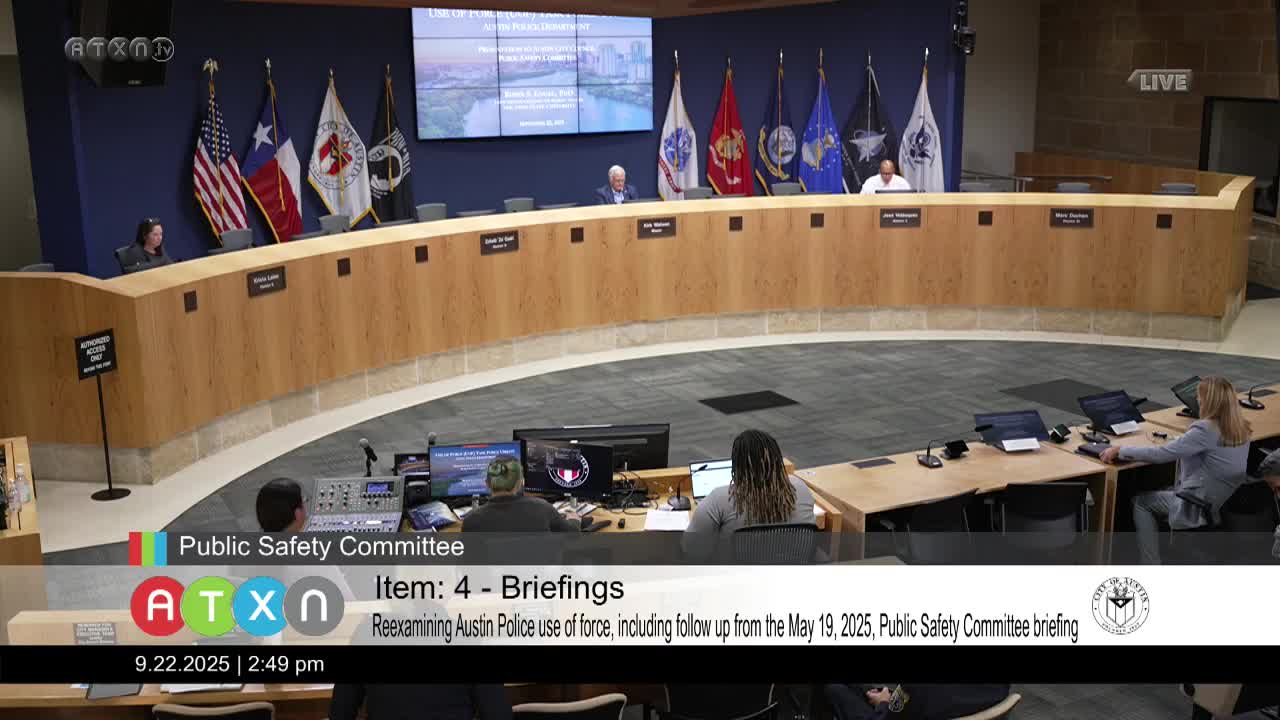
The Public Safety Committee received an update Sept. 22 on efforts to revise Austin Police Department use‑of‑force policy, expand de‑escalation training and strengthen first‑line supervisory oversight. Robin Engel, a researcher who reviewed APD policy and data, presented draft policy changes and evidence on training effectiveness.
Engel summarized a task force formed to examine APD use‑of‑force reporting, accountability, oversight and training after a data review showed inconsistencies. "There were significant issues with the data reporting, the reliability and validity of that data," Engel said, and the task force — co‑chaired by city and department leaders — has worked through spring and summer to develop policy and training recommendations.
Policy consolidation and emphasis on de‑escalation Engel said the department has consolidated several general orders related to response, restraint, firearms, control devices and reporting into a single use‑of‑force policy to recenter the suite of rules on non‑escalation and de‑escalation. The rewrite seeks to make de‑escalation expectations explicit and to realign accountability so first‑line supervisors have clearer oversight of lower‑severity reportable incidents rather than funneling the majority of cases straight to a centralized force review unit.
Training evidence and supervisory role Engel reviewed research on ICAT (Integrating Communications, Assessment and Tactics), a de‑escalation curriculum developed by the Police Executive Research Forum (PERF). She presented results from randomized trial research in other U.S. cities showing measurable reductions in use of force and injuries after ICAT‑style implementation, and stressed that officers' receptivity to training strongly tracks with perceived front‑line supervisor support.
"What predicts whether or not someone is receptive? ... if they believed their first line supervisor supported the training as well," Engel said, noting that supervisory reinforcement made officers more likely to report using de‑escalation tactics in the field. City and department leaders said they will require additional supervisor training: APD sergeants will return for a one‑week course meant to embed policy changes and reinforce expectations in the field.
Data, reporting and oversight Presenters said APD's research and planning analyst (named in the briefing as Dr. Cena Kang) has worked to fix prior errors and recreate prior use‑of‑force analyses for 2024; the briefing noted that an automated annual reporting mechanism will deliver richer public information in 2025. Engel said the task force has circulated draft policy changes to stakeholders and planned next steps for training and implementation.
Questions and technology discussion Council members asked about technology and its role in escalation. Engel and APD staff discussed TASER models and other technology, and noted national research and local experience indicating improved deployment of less‑lethal tools can reduce the need for close‑quarters force. Engel also described broader technology pilots under study — including agency drone programs intended to provide early situational awareness — that may affect officer safety and scene management.
Next steps Engel said draft policy changes remain under review and will be followed by updated training and a phased rollout. The task force planned to continue meeting, and staff said they will brief the committee again with finalized policies, supervisory training schedules and the automated reporting product.