Get Full Government Meeting Transcripts, Videos, & Alerts Forever!
Get email alerts on the Flood Safety Fee topic
No spam. Unsubscribe anytime.
Finance committee backs on-bill collection for Portland’s share of regional flood‑safety fee, sends ordinance to full council
Summary
The Finance Committee voted Sept. 22 to forward to full council a proposal to collect Portland’s share of a regional flood‑safety fee via a small line item on water and sewer utility bills, with staff recommending a $1.20 monthly residential charge and a 0.9% charge for nonresidential accounts.
Portland’s Finance Committee voted Sept. 22 to send to full council with a “due pass” recommendation an ordinance that would establish a mechanism to collect the city’s allocated payment to the Urban Flood Safety and Water Quality District via a small line item on utility bills.
Jonas Birri, the city’s chief financial officer, told the committee the district — created by the Oregon Legislature in 2019 and given fee authority by 2024 legislation (Senate Bill 1517) — charged incorporated cities within the district a flood safety benefit fee for 2025–26. “The district is a district created by the state legislature in 2019, charged with managing the Portland Metro levy system and the Columbia Corridor in North Portland,” Birri said. He noted the district’s 2025–26 allocation for the City of Portland is roughly $5.3 million and that the city’s adopted budget directs staff to develop an on‑bill collection mechanism by Oct. 15 for implementation July 1, 2026.
Staff recommended a two‑part collection method: a residential flat charge of roughly $1.20 per dwelling unit per month and a nonresidential charge set as 0.9% of the utility bill. Staff said gross collections under that structure would be about $7 million in the first year; applying low‑income discounts and estimated nonpayment plus collection costs administered by Portland Water Bureau, the projected net revenue for FY 2026–27 is about $5.7 million — slightly above the amount expected to be owed to the district.
Birri emphasized that the utility bill would be a collection mechanism only. “I want to be very clear, it's not a utility charge… Funds collected will be deposited directly into the general fund and will not be comingled with any water, sewer, or stormwater utility funds,” he said.
Councilors asked about equity, indexing and governance. Councilor Nick Green asked whether the city would hold overcollection as a separate subfund to cover future shortfalls; staff said it would be accounted for in a general fund subfund reserved for the fee and that council direction would be required to divert those dollars to other purposes. Councilors also asked whether the per‑door residential approach was regressive and requested staff consider the impacts on multifamily residents; staff said the methodology balanced administrative simplicity and equity given the size of the fee.
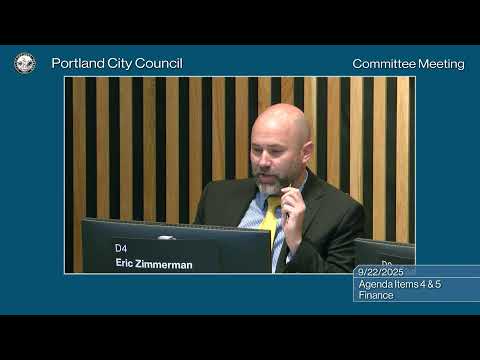
The committee approved a motion, moved by Councilor Nick Green and seconded by Vice Chair Protogany, to forward the implementing ordinance to full council with a due‑pass recommendation. Roll call recorded four ayes: Councilor Nick Green; Councilor Amanda Avalos; Vice Chair Protogany; Chair Zimmerman. No nay votes or abstentions were recorded in committee.
Next steps: The ordinance is scheduled for full‑Council consideration in early October. If the Council adopts the ordinance, Portland Water Bureau will begin technical billing work, customer communications and staff training to meet a July 1, 2026 collection start date; staff warned that timeline is accelerated and limits community engagement time.
Authorities cited: Oregon Revised Statute (ORS) section 550 (as modified) and Senate Bill 1517 (2024) were referenced by staff as the statutory basis for the district’s fee authority and the city’s responsibility to identify a local collection mechanism.