Get Full Government Meeting Transcripts, Videos, & Alerts Forever!
Get email alerts on the Emergency Medical Services topic
No spam. Unsubscribe anytime.
Johnson County court opens conversation on moving ambulance‑subsidy oversight to Emergency Services District
Summary
Commissioners discussed a potential partnership to shift oversight of the county ambulance subsidy contract to Johnson County Emergency Services District No. 1, citing technical expertise at the ESD and anticipated higher costs when the current provider’s contract is renewed.
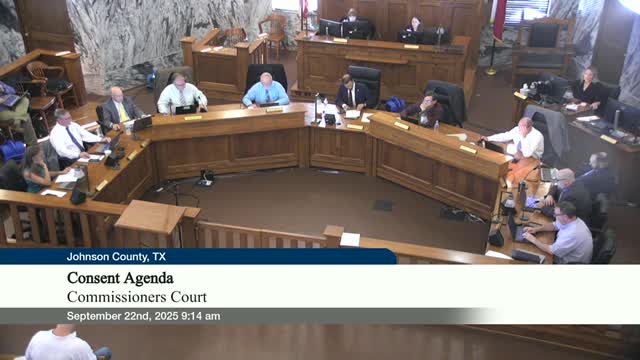
Johnson County Commissioners on Sept. 22 held a workshop discussion about possibly transferring contract oversight for the county’s ambulance subsidy to Johnson County Emergency Services District No. 1 (ESD 1), citing the ESD’s operational expertise and the increasing cost pressures on ambulance service.
The court’s presentation said the ESD service area matches the county’s ambulance subsidy area (excluding the cities of Cleburne and Burleson) and that ESD staff includes paramedics and first responders who regularly manage ambulance operations. Judge (presiding) said, “to me, it's always made sense that the ESD was the right place to oversee the compliance, the contract, and the service under our ambulance subsidy contract.” The judge emphasized that the discussion was exploratory and not an immediate change.
Tommy Foster, executive director of Johnson County Emergency Services District No. 1, attended the meeting and confirmed the ESD already participates in the compliance review committee and procurement process with purchasing and that the current provider, CareFlight, meets regularly with the ESD. Foster said the district has staff with paramedic experience and firefighting first‑responder credentials that align with contract oversight needs.
Commissioners raised operational and financial concerns. Commissioner Woolley asked whether shifting oversight would amount to “dumping” additional responsibilities on the ESD; the ESD’s representative replied the district could perform contract administration, but noted it would impose an extra workload and that financial arrangements would need to be resolved. The judge said it was not the intent to shift costs onto the ESD: “It's not my intent that we dump this on you financially either.”
Several commissioners urged early planning because staff reported call volumes much higher than the basis of the current contract bid. The court heard that the original bid assumed about 20 calls per day but actual call volumes were reported in the high 30s (38–40), and county staff said longer transports because of local hospital capacity are increasing costs. Commissioners also discussed long‑term funding options, including the possibility—but not an immediate recommendation—of establishing a separate ESD funded by a voter‑approved property‑tax levy if necessary. One commissioner noted that creating an additional ESD would require voter approval and could levy up to a statutory maximum tax rate but cautioned that the tax implication might far exceed current subsidy needs.
The court reached no final decision and treated the item as a workshop. The judge and multiple commissioners described the next step as continued conversation and closer budgeting ahead of the provider contract renewal. The ESD and county staff were thanked for their participation, and the judge asked staff to continue discussions so the court could better understand financial impacts before any formal transfer of responsibilities.
Ending: Commissioners asked purchasing, ESD and county staff to continue analysis of operational responsibilities and budget impacts, with the expectation a recommendation or proposal would come back to the court before the next ambulance contract renewal.