Get Full Government Meeting Transcripts, Videos, & Alerts Forever!
Get email alerts on the Land Use topic
No spam. Unsubscribe anytime.
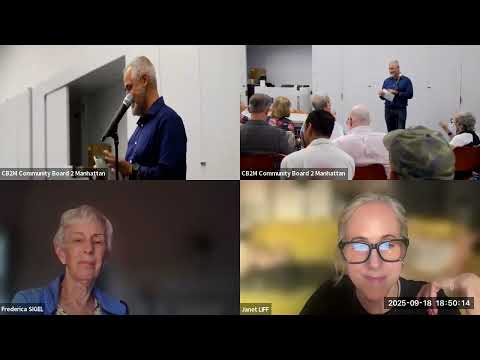
Manhattan CB2 recommends denial of variance for 51 Little West 12th Street after extended debate
Summary
Manhattan Community Board 2 recommended denial of a zoning variance for 51 Little West 12th Street at its September full-board meeting after concluding the applicant did not meet the five findings required for a variance under Zoning Resolution §72‑21.
Manhattan Community Board 2 recommended denial of a zoning variance for 51 Little West 12th Street at its September full-board meeting after more than an hour of discussion and several amendment attempts.
The board’s land use and housing committee had put forward a resolution that concluded the applicant had failed to meet all five findings required for a variance under Zoning Resolution §72-21. The proposed project would have created a 14‑story mixed-use commercial and residential building in an M1‑5 (manufacturing) district. The committee’s recommendation, delivered by committee chair Katie Bordenaro, said the application did not adequately address flight conditions, neighborhood character, rate of return, self-created hardship and minimum variance.
Why it matters: The block is in a manufacturing/zoning district that does not allow residential use as‑of‑right. Approving a variance would have permitted residential use and substantially increased the scale of development in an area many board members said is not yet planned or rezoned for broad residential uses.
Board members debated the substance and tone of the committee’s findings at length. Several members pushed to soften language in the committee’s recommendation; others argued the resolution fairly reflected the committee’s conclusions about the application. Resident and board member Rocio Sands objected to a passage that she called “unfair” to the applicant and urged removal of a finding that characterized the hardship as self‑created. She said: “This paragraph should be deleted … It is very unfair to have this paragraph in the resolution.” Board member Carter Booth responded that property owners must maintain and document their properties and noted the committee’s finding reflected both the building’s condition and the absence of preconstruction protections.
The full board voted to adopt the land use committee’s recommendation as amended. The board’s advisory recommendation will go to the New York City Board of Standards and Appeals; the board does not itself grant or deny zoning variances. The CB2 vote was procedural and advisory: it does not change the applicant’s right to pursue the BSA variance, but it formalizes the community board’s opposition.
The board’s discussion also included procedural questions about appropriate paths for adding housing to the district. Multiple members said that zoning changes should be pursued through a rezoning or city planning process rather than one-off variances. Others argued the area is already evolving and urged the board not to foreclose housing possibilities, but the majority concluded the applicant had not met the legal variance tests.
Next steps: The CB2 recommendation will be part of the record sent to the Board of Standards and Appeals and to the applicant. That body will consider CB2’s recommendation together with written public input and testimony at any hearing it schedules.
The board’s minutes show sustained public and member engagement during the land use debate and multiple motions to change the resolution language before final passage.