Get Full Government Meeting Transcripts, Videos, & Alerts Forever!
Get email alerts on the Group Net Metering topic
No spam. Unsubscribe anytime.
Freedom Energy Logistics pitches group net metering to Carroll County; commissioners ask for sample month-to-month contract
Summary
Presenters from Freedom Energy Logistics explained New Hampshire's group (virtual) net metering program and asked the county to consider joining under either a month-to-month or a five-year commitment; commissioners requested a sample month-to-month contract for review.
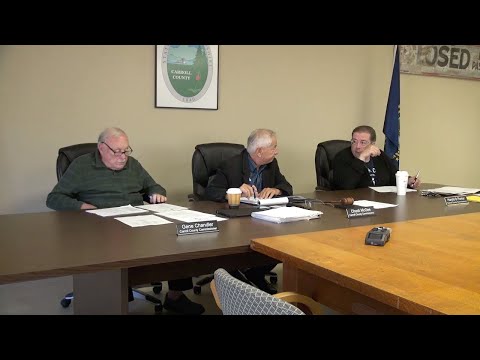
Freedom Energy Logistics representatives presented a detailed overview of New Hampshire’s group (virtual) net metering program to the Carroll County Commission on Sept. 22, arguing that political subdivisions can receive periodic rebates by becoming virtual off-takers of renewable generation (notably hydroelectric) without changing utility billing or supply contracts.
Presenters explained two enrollment options: a month-to-month arrangement that pays a lower rebate (described in the presentation as roughly two-tenths of a cent per kilowatt-hour) and a five-year commitment that pays a higher rebate (described as about one-half cent per kilowatt-hour). Presenters said the program is designed to help small hydro generators obtain retail-equivalent compensation by pairing them virtually with governmental accounts that have usage to match generation.
Commissioners and staff asked operational questions, including whether the rebate affects the county utility bill (presenters said it does not — rebates come from the generator and do not change what appears on the utility bill) and how the countys expected annual consumption would translate into rebate dollars. Commissioners also raised a scheduling concern: the county is evaluating potential behind-the-meter solar installations and several members said they would be reluctant to enter a five-year commitment that could preclude rooftop solar projects. The board asked Freedom Energy Logistics to provide a sample month-to-month contract; the presenters agreed to send the document.
Presenters listed other New Hampshire public-sector participants and said the statute limits larger (1–5 MW) group participation to political subdivisions; they emphasized that the program requires no physical connection between generation and the member accounts, and that administration and PUC reporting are handled by the firm. No formal commitment or vote was taken; commissioners indicated openness to beginning with a month-to-month enrollment pending review of the sample contract and additional internal analysis of the countys solar plans and energy needs.