Get Full Government Meeting Transcripts, Videos, & Alerts Forever!
Get email alerts on the Cellular Antennas topic
No spam. Unsubscribe anytime.
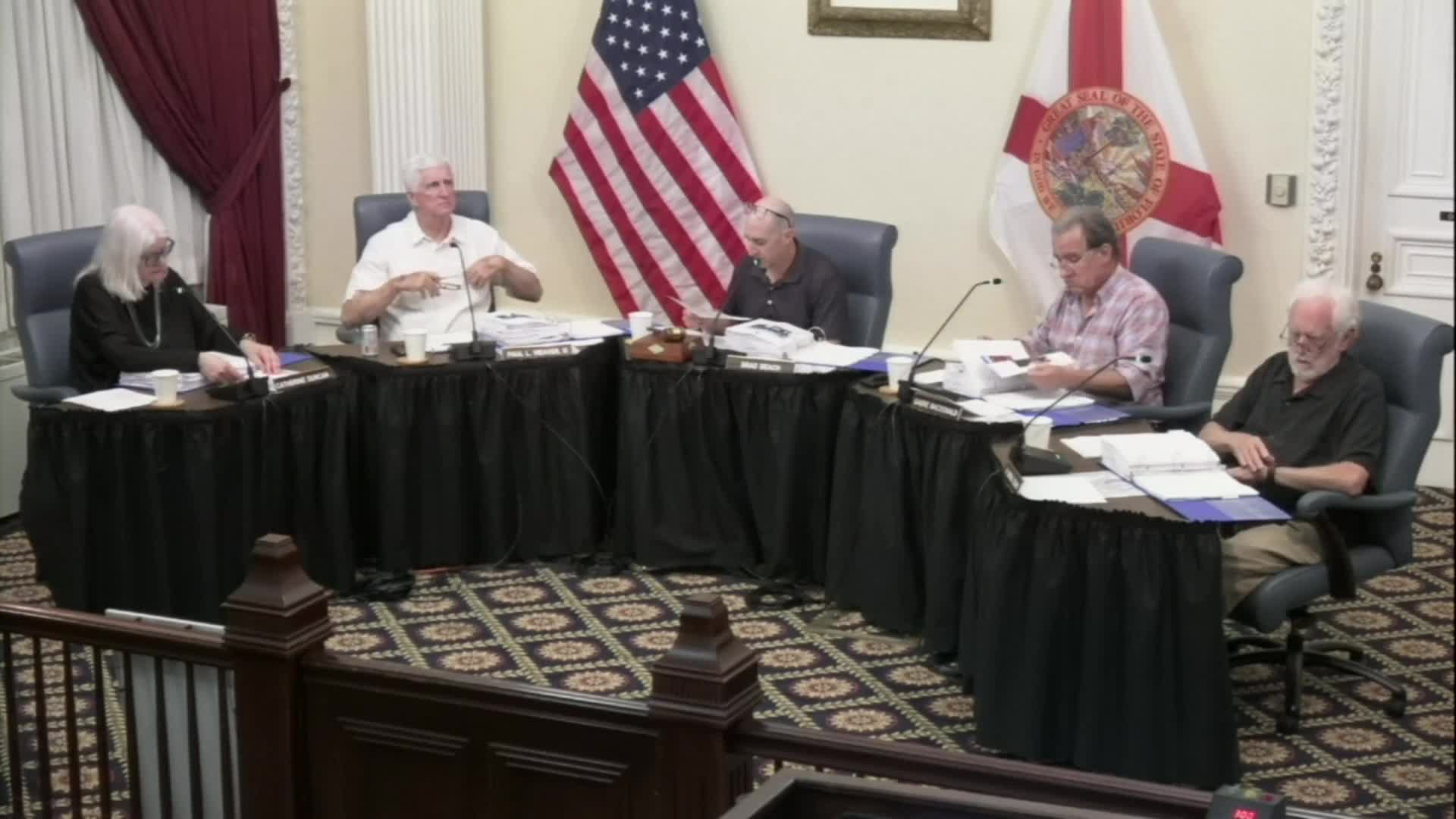
HARB approves T‑Mobile antenna installation in Flagler College bell towers after debate over visibility and public‑safety claims
Summary
The St. Augustine Historic Architecture Review Board on Sept. 18 approved T‑Mobile’s plan to place cellular antennas inside the arched openings of Flagler College’s bell towers, finding the installation reversible and that visual impacts could be reduced.
The St. Augustine Historic Architecture Review Board on Sept. 18 approved the installation of cellular antennas within the arched openings of Flagler College’s bell towers (application HP2025‑0060), concluding the work would be reversible and that visual impact could be minimized with matte black shrouds and placement behind the arches.
Staff and the applicant described field mock‑ups mounted in the tower openings, removal of existing unused speakers and miscellaneous equipment, and use of ballasted non‑penetrating stands to avoid structural damage to the 1887 Spanish Renaissance Revival building. The staff report advised the board that the proposal could meet the Secretary of the Interior’s Standards for Rehabilitation nos. 2, 5 and 9 if the board found the installations would not harm the building’s integrity; staff recommended a condition that visible mechanical equipment in the towers be painted a matte black finish to reduce visibility.
Chad Caudill, representing the applicant and the carrier, said T‑Mobile’s purpose was to improve 5G coverage and capacity in and around St. Augustine and said the company had removed two ladders, a microwave antenna, and eight speakers from the towers as part of the work. Caudill said a letter of support from the St. Johns County Sheriff’s Office’s IT department had been included; staff noted the city’s 911 center told staff that calls generally are routed among towers and that carriers sometimes provide temporary event boosters for large crowds.
Several local residents and preservation experts spoke against visible installations and urged extra care. Historian Leslie Keys and other speakers asked how long equipment would remain, what would happen to obsolete gear and whether the college’s carillon or other historic features would be damaged. BJ Kelly, speaking for preservation concerns, called for follow‑up inspections. The board pressed applicants on alternatives and on minimizing exterior penetrations; the applicant said the mounts were ballasted, required one small GPS antenna screw, and that conduit would be routed through existing chases and attic space.
After public comment and board discussion, the board voted to approve the certificate of appropriateness with a condition that the installed equipment match the mock‑ups presented, that unused or abandoned equipment be removed if the contract terminates or the equipment becomes obsolete, and that work be performed to avoid damage to historic fabric. The record shows all five board members voted yes.