Get Full Government Meeting Transcripts, Videos, & Alerts Forever!
Get email alerts on the Employee Health Insurance topic
No spam. Unsubscribe anytime.
Monroe County council approves $3 million cushion for self-insured health plan amid rising claims
Summary
The council approved a $3 million supplemental appropriation request for the countyself-insured health plan after a presentation from Employee Services and benefits advisor Apex; the vote was 6-1.
Monroe County Council approved a supplemental request on Tuesday to increase the county's internal reserves for employee health claims, agreeing to provide $3 million to the self-insured plan and related appropriations after a long discussion and presentations from employee-services staff and benefits advisers.
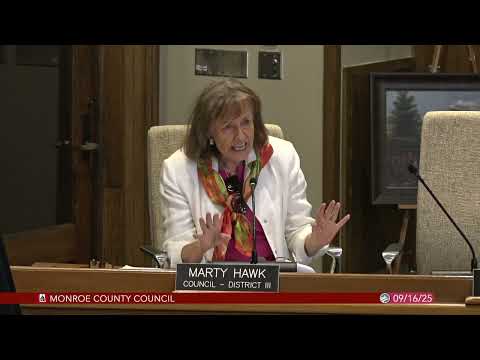
The council voted 6-1 to approve a $3,000,000 request in county general personnel to shore up the self-insurance fund. Councilor Hawk cast the lone dissent. Later in the meeting council also approved supplemental transfers for the self-insurance and associated service lines (recorded roll-call votes recorded as 6-1 and 6-1 for related motions).
Employee Services and outside benefits consultant Apex Benefits told the council revenue and claims trends over the last 12 months showed both higher enrollment and an increase in claim severity. Apex representatives said the county's self-insured arrangement has generally saved money relative to fully insured alternatives over time, but that 202425 saw an unusually large jump in cost. “The last 12 months, we are not doing the way we would like to be doing,” the Employee Services presenter told councilors, summarizing the need for a larger reserve.
Apex's Brandy Pardo and John Goss joined the meeting to answer technical questions about fully insured vs. self-funded arrangements. They told the council large employers in Indiana typically remain self-funded because fully insured rates can be materially higher and reduce plan control; however, they acknowledged the current year was an unusually costly one and presented strategies the county could pursue to contain costs without cutting benefits. Suggestions included pharmacy benefit changes, provider-direct contracting for certain high-cost services, expanded employee education to steer use of lower-cost providers, and incentivizing higher-deductible plan enrollment.
Councilors pressed for additional detail on near-term effects. Councilor Iverson said he appreciated the number of slides and background material Employee Services provided, including a multi-point explanation of the drivers of higher costs. Councilor Henry expressed concern about the scale of the ask and urged long-term planning; Councilor Hawk said he was reluctant to let the general fund absorb the entire amount and urged clearer mapping of which funds should carry civilian employee insurance costs where permissible.
The council later approved a companion motion to add $2.5 million in the self-insurance services category (roll-call 6-1) and also approved moving $1.25 million from the county's rainy-day fund to utilities/services contingency in a separate vote (approved 6-1). Councilors asked Employee Services and Apex to present specific cost-control proposals for 2026 and to return with more granular program-level options.
Why it matters: Monroe County is self-insured for employee health benefits; a large shortfall—driven by higher enrollment and unusually severe recent claims—would otherwise risk midyear budget pressure and possible benefit changes. The council's vote injects a one-time reserve but also triggers a follow-up cycle of analysis and potential benefit design or vendor changes.
What comes next: Employee Services and Apex will return with detailed proposals for how to limit near-term costs without cutting core benefits, including pharmaceutical management changes, provider steering, clinic utilization, and employee education. Council members asked that alternatives be prioritized before changes to employee coverage levels.
Ending: The council approved the supplemental funding but signaled the beginning of a more detailed review of plan design and county health-care strategy before the 2026 budget is finalized.