Get Full Government Meeting Transcripts, Videos, & Alerts Forever!
Get email alerts on the Public Health Fund Eligibility topic
No spam. Unsubscribe anytime.
Monroe County council pauses health salary changes as statelaw raises eligibility questions
Summary
Councilors moved a health-department personnel item to after budget talks amid debate over moving positions between health funds after an Indiana statute limiting some funds to lawfully present residents was cited by county counsel.
Monroe County Council on Tuesday moved action on a health department salary ordinance amendment after a lengthy discussion about where public-health positions should be funded and who may be served by certain local health funds.
The council voted to defer the item that would remove several positions from one health fund and reflect those changes in the county salary ordinance, placing the item later in the meeting so members could discuss it in the context of the broader 2026 budget. Councilors approved the procedural motion to move the item by voice vote.
The timing and funding question arose after the council learned that Indiana Code 16-46-10-3(f) says certain public-health funds may be used only for Indiana residents who are lawfully present in the United States. County Attorney Turner King said she had the statute open and read language saying funds may be limited to lawfully present residents, a point that drew immediate pushback from several council members who warned that the statute should not be read to bar noncitizens who are legally present and seeking public-health services.
Health Department staff told the council the positions under discussion oversee public-health emergency preparedness and that the requested change had been prompted by recent legislative and funding developments. "These positions have already been moved and approved into 11-59," the health presenter said, describing prior action to de-appropriate the positions in one fund. The current vote before the council was intended only to clean up the salary ordinance to match earlier appropriations, the presenter said.
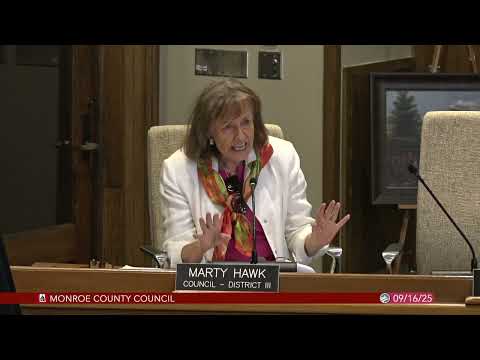
Council members pressed staff and counsel on practical consequences if positions were placed in the county levy fund (the "frozen levy" referenced during debate). Councilor Hawk said moving positions into the levy fund reduces flexibility and could leave less money for payroll and other services covered by the levy; Councilor Wilkes suggested tabling the item until after the budget discussion to see whether the budget picture required revisiting funding decisions.
Attorney Turner King told the council she was pulling up the Indiana code and later cited Indiana Code 16-46-10-3(f) by number and read its language to the council: funds may be used only for Indiana residents lawfully present in the United States. Health leadership and some councilors pressed for clarification, saying the statute's language had been amended to the phrase "lawfully present" and that the department's interpretation allowed service to people legally present on visas or other lawful statuses. "You can be here on a student visa; you can be here legally but not a citizen," one council member said, urging precision in public statements.
Because of the legal uncertainty and the council's desire to view the change among other 2026 budget decisions, Councilor Wilkes moved to place the health salary item after the budget discussion; that motion passed. Later in the meeting, multiple grant appropriations and housekeeping budget items from the health department went forward in separate votes. For example, the council approved smaller grant appropriations for public-health emergency-preparedness and sexually transmitted disease programming in roll-call votes that passed unanimously (6-0 or 7-0 depending on the item as recorded). Those grant approvals were described by health staff as routine and tied to established grant contracts.
Why it matters: The council must balance departmental staffing and long-term budget sustainability while complying with state restrictions on certain funds. Debate over moving public-health positions between county funds matters because where a salary is funded affects both who can be served under grant or statutory limits and how the county's constrained levy and general-fund balances will cover ongoing payroll.
Whatcomes next: Councilors directed staff and legal counsel to clarify how the Indiana statute is being interpreted and to return to the council with budget-level context. The health personnel removal remained on the agenda to be taken up after the council completed additional 2026 budget amendments later in the session.
Ending: Health department staff and county counsel said they would provide clarifying documentation about the statute and the department's funding sources; the council left the door open to move the positions back into the health grant fund pending that work and the outcome of budget deliberations.