
Committee signals support for S.190 to expand —Manos para el Campo— program; department urges clarifications and operational recommendations
Get AI-powered insights, summaries, and transcripts
Subscribe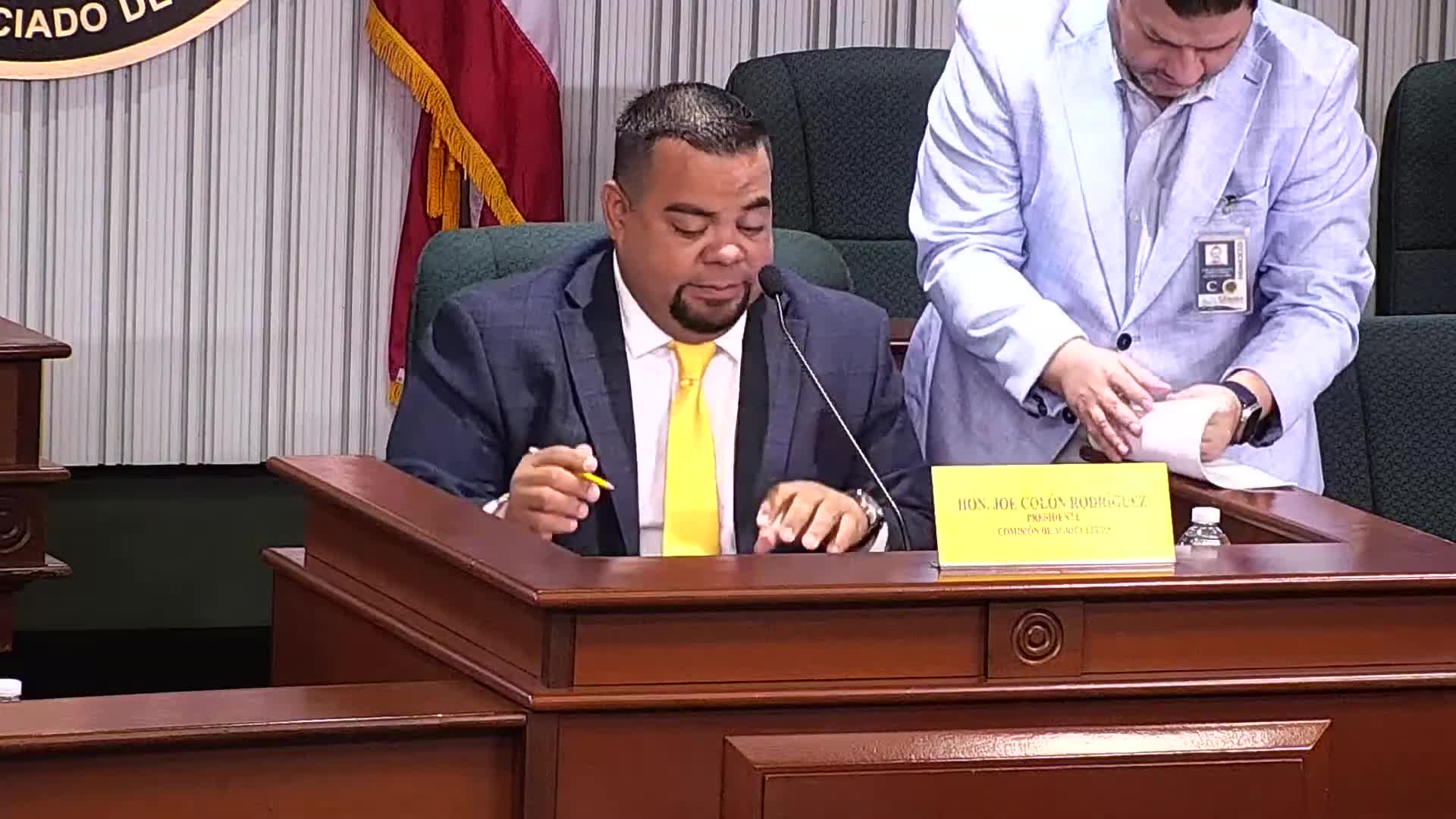
Summary
The House Agriculture Committee heard Sept. 19 from Department of Agriculture officials on Senate Project S.190 to expand the —Manos para el Campo— program beyond coffee harvests, and signaled a favorable committee report subject to clarifications and operational assurances.
At a Sept. 19 House Agriculture Committee hearing, agency officials reviewed Senate Project S.190, which would amend Law 38 of 2011 (the —Manos para el Campo— statute) to expand the law—s application beyond coffee harvests to other agricultural tasks and activities across Puerto Rico.
Irvin Rodríguez Torres, subsecretary of agriculture, and Sheila Báez Carrif3n, legal advisor, presented the Department of Agriculture—s written position and explained operational issues the agency recommends the commission address. The testimony supported the policy goal of expanding labor options for agriculture while urging changes to prevent unintended interference with existing incentive programs and to ensure administrative capacity.
The department highlighted three labor sources discussed in the hearing: (1) local workers; (2) confined individuals supplied by the Department of Correction and Rehabilitation (DCR); and (3) temporary foreign workers under H-2 visas. Officials noted that the program of H-2 workers (referred to in testimony as the H-2 or —h-segundo— modality) has increased in recent years, with the transcript listing annual entry numbers (20 in 2020; 83 in 2021; 284 in 2022; 438 in 2023; and 561 in 2024).
The department recommended the bill be revised to:
- Coordinate with the Department of Correction and Rehabilitation (DCR) before obligating DCR resources; ensure DCR can meet training, transport and security requirements for confined workers and that contracts are voluntary for employers.
- Clarify the interaction between the bill—s requirements and the existing salary‑subsidy incentives administered under Law 60 (the incentives code), to avoid unintentionally redirecting funds intended for correctional clientela or other programs.
- Provide procedures and evidence requirements for employers seeking H-2 visas, including documentation that the employer attempted to recruit locally (posting ads, contacting the Department of Labor) and the recordkeeping that accompanies visa requests. The department told the committee it can provide the recruitment and contact records used in visa applications and agreed to deliver that documentation within five days.
Sheila Báez said the department is preparing educational outreach materials (online and in workshops) to help farmers understand visa procedures, requirements, and costs. She noted the H-2 visas are seasonal by design and typically cover harvest periods; the agency explained that processing and re‑application takes time (testimony stated an average processing interval of about 75 days from application to approval), which complicates repeated short harvest windows.
The committee discussed costs to employers, differences in suitability between confined workers and H-2 visa workers, and the need to preserve employer choice. Representatives said both approaches can be complementary: confined labor can be less costly but requires DCR operational capacity; H-2 workers are more expensive but appropriate for larger commercial operators.
Representative (presiding) said the committee would give a positive report on S.190 with recommendations; the record shows the committee asked the Department of Agriculture to provide follow-up materials and to summon DCR officials to resolve outstanding operational questions.
Ending: Committee indicated support in principle for expanding labor options under S.190 but directed coordination with DCR and additional documentation from the Department of Agriculture before final committee action.