Get Full Government Meeting Transcripts, Videos, & Alerts Forever!
Get email alerts on the Short Term Rentals topic
No spam. Unsubscribe anytime.
Planning commission tables ULDO amendments on downtown residential rules and short‑term rentals, forms ad hoc committee
Summary
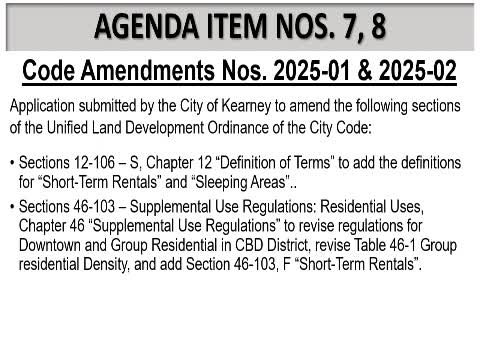
The Kearney City Planning Commission tabled proposed amendments to the Unified Land Development Ordinance that would have created short‑term rental licensing and changed downtown residential rules, and formed an ad hoc subcommittee to refine the proposals and return Nov. 21, 2025.
The Kearney City Planning Commission held a public hearing on proposed amendments to the Unified Land Development Ordinance (ULDO) chapters 12 and 46 — updates that would clarify downtown residential provisions and create licensing and minimum health-and-safety rules for short‑term rentals. After extended discussion and public comment, the commission voted to table the items and form an ad hoc subcommittee to study the proposals and return with recommendations at the Nov. 21, 2025 meeting.
City planner Melissa Durdio O'Hara presented the amendments and said staff recommended approval. The revisions the city proposed included definitions of “short‑term rental” and “sleeping area,” clarifications to downtown (CBD) and group residential rules to provide an avenue for street‑level residential in one‑story buildings (while requiring a commercial component), and a short‑term rental supplemental regulation that would require annual licensing, set minimum health-and-safety expectations (smoke/carbon monoxide alarms, egress for sleeping areas), and enable enforcement and collection of the hotel‑occupation tax from short‑term rentals.
Melissa described the short‑term rental proposals as a tool to track compliance with the hotel occupation tax and to address recurring code‑enforcement complaints tied to occupancy and nuisance concerns. She noted the state allows local regulation for health and safety and taxation but requires that short‑term rentals be permitted. She said the city had recorded roughly 13 short‑term rental properties reported for noncompliance over the prior 12 months.
Commissioners and several members present raised questions and concerns. Topics discussed included whether allowing more street‑level residential in the CBD would alter downtown character; how the Board of Adjustment would work with the change; the practical differences between short‑term and long‑term rental regulation; the potential economic impact on homeowners who rent short‑term for supplemental income; enforcement limits if hosts remain listed on private platforms; and whether the proposed regulations had “teeth” to remove noncompliant listings from Airbnb or Vrbo.
Commission members suggested more outreach to stakeholders, including the Downtown Improvement Board, hoteliers, short‑term rental hosts and platforms, and property‑owner representatives. Commissioners also requested clearer language on enforcement: how verified complaints would be counted, appeal procedures, timelines for compliance (staff proposed a 60‑day compliance period), and whether enforcement could compel platform delisting.
After discussion, Member Rickard moved — and the commission agreed — to table code amendment 2025‑01 (Chapter 12 edits) and 2025‑02 (Chapter 46 edits), refer the items to an ad hoc subcommittee to research stakeholder input and enforcement options, and return the topic for review at the Nov. 21, 2025 planning commission meeting. The commission named Members Rickard, McGuinness, Malone and Baker to the subcommittee and instructed staff to coordinate participation from building code, permitting and code‑enforcement staff. The motion passed by recorded voice vote.