Get Full Government Meeting Transcripts, Videos, & Alerts Forever!
Get email alerts on the Zoning Fence Variance topic
No spam. Unsubscribe anytime.
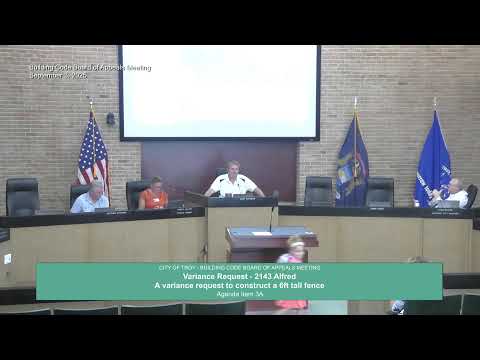
Troy City board denies variance for 6-foot front-yard fence at 2143 Alfred
Summary
The Troy City Building Code Board of Appeals voted 4-0 to deny a homeowner’s request for a variance that would allow a 6-foot fence inside the 25-foot front-yard setback at 2143 Alfred. The board cited precedent and alternatives that would meet code.
The Troy City Building Code Board of Appeals denied a variance request for a 6-foot fence inside the front-yard setback at 2143 Alfred on a 4-0 vote Wednesday.
The board found the property had not shown grounds for an exception to the city’s front-yard fence rules and pointed to alternatives that would comply with the zoning ordinance, including moving any 6-foot fencing to the required 25-foot setback. Board members voting in favor of the denial were Mister Abbothera, Miss Brooks, Mister Dezerman and Mister Wilson; the motion carried.
The petitioner asked the board to allow a six-foot wood-and-mesh “deer fence” placed about 1 foot inside the property line along Alfred. Building department staff (Dominic Abbot) told the board the property is in an R-1-D zoning district, which requires a 25-foot front-yard setback and limits fence height to 30 inches within that setback. Dominic Abbot said the homeowner’s constructed fence prompted a city enforcement case, EN2025-00558, for work without a permit.
The petitioner described the project as a family garden and a safe, enclosed space for her children, and said she had sought informal, verbal guidance from city staff before construction. "I called the city and, I believe Mister Dominic Abbot can, attest to the fact that I did speak to someone who gave me verbal approval," the petitioner told the board. She also said she had gathered neighborhood support: "I believe your copy of the petition has 30 some signatures, but since then I've been able to acquire 41."
Board members acknowledged the petitioner’s neighborhood support and the fence’s appearance but expressed concern about the permanence of a six-foot front-yard fence and the precedent an approval would set. Several members proposed alternatives that would allow the petitioner to keep a garden and some fencing while complying with the ordinance: move the six-foot portion to the 25-foot setback line, retain posts as an architectural element but reduce the top rail and mesh in the front to 30 inches, or plant screening (for example, arborvitae) in the front setback. Dominic Abbot told the board and petitioner that a 6-foot fence would be allowed at the 25-foot setback without a variance.
After discussion the board member who moved the denial cited two reasons in the motion: the property characteristics did not justify a variance, and alternatives exist that comply with the zoning ordinance. A second was recorded and the board voted 4-0 to deny the variance application. The chair and staff noted the board was operating with four of five members present and that a majority (three votes) is required to pass an application; the petitioner elected to proceed rather than wait for a full board.
The board advised the petitioner to work with the building department on permitted options and on obtaining required permits. Staff said a permit and final inspection would still be required for any fence work approved under existing code; the building department also said it could accept modifications such as lowering the fence in the front to 30 inches or relocating the 6-foot section to the setback. The petitioner said she was "perfectly happy to tear down the fence upon transfer of ownership," and indicated willingness to plant screening if requested.
The variance denial does not bar the homeowner from pursuing code-compliant options at the same property or reapplying with revised plans. Staff noted recording or notarized documentation (for example, as part of permit processing) could be used to memorialize conditions discussed, but legal recording practices were described as outside the board’s immediate responsibility.
The board also confirmed that an earlier agenda item (a variance for 5027 Shady Creek) was postponed at the petitioner’s request.